
The Metaphysics of Mike Nesmith
The artist’s view of non-linear reality
In 2017, I reviewed Michael Nesmith’s (1942–2021) memoir Infinite Tuesday for the Washington Post. I was pleased to recently discover that Nez wrote this on Facebook, April 15, 2018: “Here is a review from Mitch Horowitz of the Washington Post of Infinite Tuesday when it came out in hardcover last year at this time. I post it here because I was very happy with the review and Mitch’s apparent understanding of what I was swinging at.” I am reposting the piece.
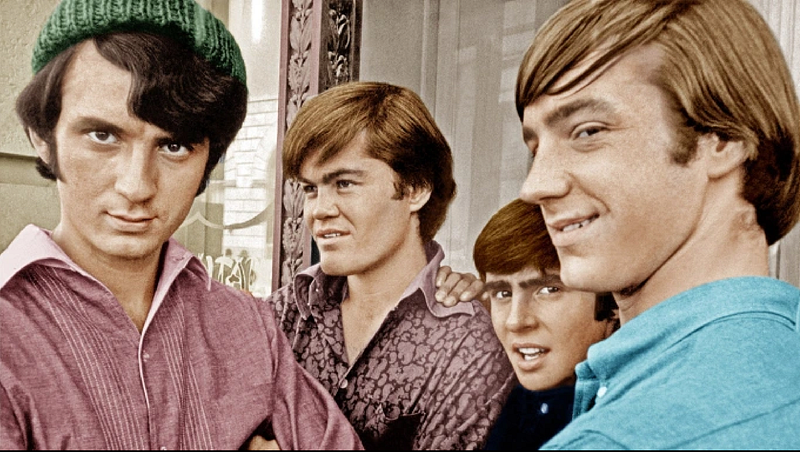
Okay, for anyone who didn’t grow up with the on-screen high jinks and infectious pop-rock of the Monkees, let me clarify: Davy was the “cute” one; Micky was the “funny” one; Peter was the “weird” one; and Mike — well, Mike was the “smart” one.
Although the Monkees’ stars dimmed as their musical output shifted from packaged pop and their show got canceled in 1968, critics slowly acknowledged that what began as a made-for-TV band grew into an ensemble of surprisingly capable musicians and songwriters. The Monkees became bigger artists than their mold.
Behind this gestation — and much else in the pop culture world — was guitarist, songwriter, producer and video artist Michael Nesmith, author of this penetrating memoir, “Infinite Tuesday.” And, yes, his mother did invent Liquid Paper, the fact most often recited about Nesmith after his career in the Monkees.
But his single mother’s backstory is more significant than her incredibly useful — and personally enriching — office product. “She attributed all the success of her business and her great good fortune to her study and practice of Christian Science,” Nesmith writes, referencing the spiritual healing faith founded in the late 19th-century by Mary Baker Eddy.
While growing up in Dallas, Nesmith was touched by strands of American mysticism or, put differently, of life viewed from a shifted perspective. After venturing to Southern California, he grew to admire a different kind of intellect than the studious Mrs. Eddy. Nesmith’s new heroes were Timothy Leary and sci-fi satirist Douglas Adams. He recalls Leary publicly criticizing him for using a cliche, which may reveal more than is intended about the psychedelic guru.
Nesmith’s observations often amount to more than they first appear. He acknowledges moving to California for the weather: “I was to learn that weather choices in life are some of the more profound.” Another West Coast migrant, filmmaker David Lynch has also noted the creative benefits of eternal sunshine.
As a writer, Nesmith is practical without being conventional. And he riffs on metaphysical topics like “non-time moments” — when portent and symmetry seem to enter our lives — without sounding trippy or losing his relatability. He also abstains from using his pen to settle scores, something from which other celebrity memoirists could learn.
In fact, he’s delightfully self-deprecating when describing himself as a victim of the English wit. While staying at John Lennon’s house during a trip to London, Nesmith is asked by his idol if he’d like a drink. Starry-eyed, the Texan blurts out that he’d like a glass of milk. Lennon deadpans to his wife: “Well, we’re in for a good time, aren’t we?”
Ironically, the Monkee was more warmly accepted in London than in Los Angeles, where hipsters considered him a sellout. But that gradually shifted. The Monkees gained sufficient commercial clout in 1967 to force their franchise owners to allow them to write and play their own music. And they included a blossoming Jimi Hendrix as the opening act on their U.S. tour, bringing the guitarist some of his first national exposure (which culminated in Hendrix flipping off a crowd of screaming teeny-boppers at New York’s Forest Hills Stadium after they interrupted his set with cries of “We want Davy!”)
There is pain and melancholy in Nesmith’s book, too. He tells of his affairs, broken marriages and children near-abandoned on his road to fame — and the road descending from it.
His re-engagement with Christian Science and its teachings about ever-creative “infinite Mind,” Nesmith writes, spurred him out of his artistic death spiral. In the 1970s, he pioneered one of the first music videos and devised the format that led to MTV, dramatically altering how we experience music today. He also boosted indie cinema by producing the punk classic “Repo Man” (1984), and he fostered early experiments in virtual reality. Liquid Paper isn’t the only thing to come out of the Nesmith family.
Nesmith’s finest moments in “Infinite Tuesday” are when he offers his own sprightly metaphysics: “One continuously positive idea I’ve carried from my early years is an ever-expanding notion that the past does not create the present — that what seems set in perpetuity can be instantly changed. This was never an argument for randomness, but more of a sense of an eternal present that was constantly updating, revealing more and more of the moments that comprised infinite Life.”
He is right: Reality doesn’t travel straight lines. Months before being asked to review Nesmith’s book, with no awareness of its publication or any correlation, I developed a renewed attachment to the Monkees. My kids got to know their lyrics. My wife scratched her head at this sudden fancy. Is there some connection? I have no idea. But within that doubt, Nesmith would agree, lies Infinite Tuesday — a nonlinear realm to which he is a distinctly likable, erudite guide.


