
The Merge: Setting Stage for Further Scalability
Explains more about the merge and its impact on you and the community in general

For the last several weeks, there has been a lot of buzz about ‘The Merge’ in the Crypto community. Finally, due to tremendous efforts, strategic planning, and execution by the Ethereum community, the execution layer of the Ethereum blockchain was merged into the proof-of-stake consensus layer, the beacon chain, on Sept 15, 2022.
What is the Merge?
In simple words, The Merge is an upgrade from the original proof-of-work consensus to a proof-of-stake consensus mechanism on the Ethereum Mainnet ( “main network,” main public Ethereum blockchain, with real ETH, real value, and real consequences).
Moving from POW to POS
In decentralized systems like the Ethereum Blockchain, achieving consensus is crucial for security and integrity; show more.
Since its launch in 2015, the Ethereum Blockchain has been using Proof-Of-Work (POW) as a consensus algorithm. POW has two disadvantages; first, miners must burn computational power in solving difficult math puzzles just to reach a consensus and secure the network, causing a waste of the world’s electricity and resources. Second, a threat to decentralization, as in POW, the mining has been dominated by ASICs (Application-specific Integrated Circuit, specialized hardware), causing the potential risk of a single big player taking over the network.
Since the early days of Ethereum, there have always been discussions about shifting to a more sustainable consensus algorithm. Proof-of-Stake (POS) is environmentally friendly, and as it doesn’t involve heavy computation, it won’t need any specialized hardware, helping retain decentralization. Anyone willing to stake ETH can become a validator, a node that can propose a new block. Staking will lower participation barriers and limit economies of scale, creating a more decentralized network.
“The Merge” in Process
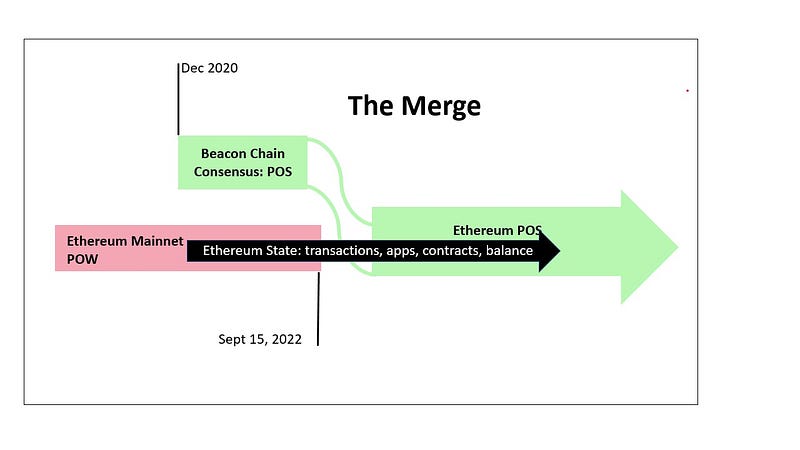
In Dec 2020, the Beacon chain was launched with a Proof-Of-Stake (POs) consensus mechanism. It was running in parallel to Ethereum Mainnet, with a proof-of-stake consensus layer. Beacon chain reached its consensus on its own state by agreeing on the validators and their account balances. After rigorous testing, there was a time to test it with real-world data; a time for the Merge of Ethereum to the Beacon chain.
The plan was that when Ethereum Mainnet reached a certain level of difficulty, client nodes mining on the Mainnet (POW) would stop mining the blocks altogether. The Consensus layer from the Beacon chain would take over the responsibility of producing the Blocks using POS.
On Sept 15, 2022, the Merge was complete. The Beacon Chain became the consensus engine for all network data, including execution layer transactions and account balances, an engine of block production on Ethereum Mainnet. The entire transactional history of Ethereum is merged with the Beacon chain. The proof-of-stake validators are responsible for processing the validity of transactions and proposing blocks instead of miners in the old POW system.
This merge is like hot-swapping an old fuel engine with a new energy-efficient electric engine while the car runs at full speed.
With the Merge, Ethereum energy consumption is reduced by 99.95%, and the world’s total electricity consumption is reduced by 0.2%.
What has not changed with the Merge?
The block creation time remained approximately the same, not changing much. This merge didn’t plan for a reduction in gas prices or scalability. Running a node is still free and does not require staking ETH.
If you own Ethers (ETH), you don’t need to do anything on your end after the merge. If you are a Smart contract or DApp developer, be assured that the merge was designed to have minimal impact. We3 API developer, you may need to recompile and be ensured nothing is broken with the merge.
‘The Merge’ is the first initial phase of transitioning to Ethereum 2.0- visioned as a scalable, sustainable, and secure network- which swaps out proof-of-work consensus with proof-of-stake, thus, setting the stage for future scalability upgrades.
Reference: