
The Mental Health Benefits of Digital Minimalism
We’ve all heard of Minimalism, but have you tried out Digital Minimalism? This tactic allows you to destress and improve your mental health for good.
So we’ve all heard that too much social media & screen time are bad for us right? Increased anxiety, loneliness, the comparison trap, FOMO… I could keep going. But does that make us want to quit and start practicing digital minimalism? Or are we already in too deep when it comes to modern technology?
DIGITAL MINIMALISM VS. ENDLESS SOCIAL MEDIA
I always knew on some level that social media use wasn’t good for my mental health. But I wasn’t ever the type of person to be on my phone 24/7, so I thought I was doing better than the rest of the world!
Compared to other people, I never really check Facebook, only spend a moderate amount of time on Instagram/Snapchat, and don’t have Twitter etc. So I’m good right? Whatever “negative impacts” social media has on other people, must be missing me, because I’m not that bad!
Sadly, I was so wrong. I’m sure some of you guys have felt the same as me regarding “being immune” from the effects of screen time. It seems like everyone else is *constantly* checking their phones, so if I’m not *always* on mine, I must be okay!
While it’s true that being cognitive about your phone use does put you in a much better spot than some people, there are still negative effects. It took me my teens and young adulthood to realize that it was even having a negative impact on my mental health…
HOW MUCH PHONE USE CAUSES A NEGATIVE IMPACT?
When it comes down to it, even used in minimal doses, social media isn’t really great for anyone. Sure, it’s nice to catch up with people you haven’t talked to in a while. Or to see your friend’s cute baby or puppy pictures. But overall, social media can cause a lot of mental distress.
I read the book Digital Minimalism recently and it completely changed how I view technology and social media. Social media use has not only drastically increased anxiety in recent generations but ironically increased feelings of loneliness as well. Which seems odd, since we’re more connected than ever, but he explains that in much greater detail in the book!
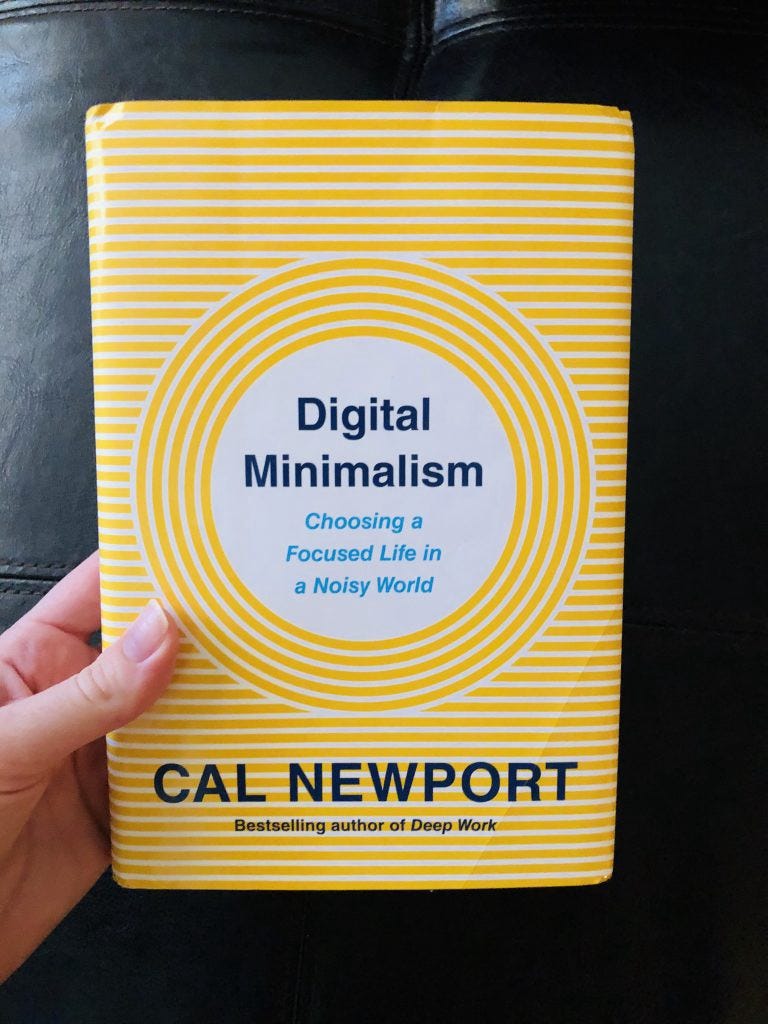
A big part of Digital Minimalism is a 30-day challenge to cut down on your technology use. I’ve been doing this for the past month and wanted to share my experience with the 30-day detox. It’s not meant to be a temporary detox either. The whole point is to understand which aspects of technology are aligned with your values and guiding you towards your goals.
WHY TAKE PART IN THE DIGITAL MINIMALISM 30-DAY CHALLENGE?
I didn’t realize fully at first why I was doing this digital minimalism challenge. I realized that too much phone/social media use could have negative consequences… But honestly, I didn’t fully understand what they were.
I thought the challenge sounded fun and would probably help me be more productive & waste less time. And maybe it would change my mental state a little too? I wasn’t sure — that just sounded like an added benefit at the time.
But throughout the past 30 days, I’ve learned how much different my life can be, by decreasing technology use. I decided to cut way down on my social media and phone use. I disabled notifications on most of my apps and only check messages when one of my friends/family members reaches out to me.
I’m not going all out with the digital detox, but I’m drastically decreasing the amount of time spent on it. I cut out useless websites/apps that I used to spend a lot of time on and don’t check Facebook, Reddit, TikTok, or Poshmark at all anymore.

I also stopped mindlessly scrolling through Instagram and won’t allow myself to get on the app, other than to respond to messages. Before all this started, I thought that I didn’t spend that much time on social media in the first place. Looking back, I honestly don’t know how much time I was spending because I was never tracking it.
THE URGE TO MINDLESSLY SCROLL IS REAL
But regardless of how much time I was spending on social media, the urge to check it and mindlessly scroll was STRONG. Seriously, when I first started the 30-day challenge, I felt the urge to check my newsfeed multiple times an hour. Any time I had a split second of downtime, I would immediately want to check my phone.
It’s crazy because most of the time I had absolutely no reason to check it. I didn’t even have anything in mind that I wanted to look for… I just wanted something easy and fast to occupy my attention.
After the first week or so, the urge started to dwindle a bit. I felt more at ease and didn’t feel anxious if I wasn’t checking Instagram every 15 minutes. And honestly, I didn’t feel like I was missing out on anything. Until about halfway through the challenge…
COME ON… THERE’S NO WAY YOU FULLY GAVE UP SOCIAL MEDIA, RIGHT?
2 weeks into the challenge, I caved and decided to check Instagram. It was a long weekend and I hadn’t heard from my friends much, so I wanted to check what they were up to. It was nice at first, just seeing what people were doing over the long weekend.
I felt inspired by my cousin’s baking business she had started. Seeing people still hitting their fitness goals during quarantine was also motivating. Someone had started a photography business that I was also in awe of. I only scrolled for about ten minutes then got off Instagram.
Without even thinking about it, I almost immediately started feeling down on myself. I was thinking about all of the great things that other people were doing and how accomplished/successful they seemed.
THE COMPARISON TRAP
I started comparing myself to other people and feeling bad about myself. It felt like their endeavors were somehow better than my own and that I needed to do more. Somehow, I forgot about everything I’m accomplishing in my own life and was only focused on everyone else’s endeavors.
The sad thing is, everyone only posts the best parts of their life on social media (for the most part). Sometimes people will talk about hard things or express more vulnerability. But for the most part, Instagram is a highlight reel of people’s lives.
So by comparing myself to anyone on social media, I’m comparing everything about my life to their highlight reel. That’s a recipe for disaster (and feeling terrible about yourself).
A few minutes later, when I realized I was comparing myself to others and feeling bad, I took a step back. It clicked for me that I was feeling that way due to social media. Now, I’m not saying that social media is overall terrible — not at all. It has plenty of positives!
Staying in touch with people you otherwise wouldn’t, can be amazing. It’s just the way you go about it (and your mindset when using it) that can play a big factor. While social media has its perks, it obviously has its downfalls as well.
HOW DO YOU AVOID THE DOWNFALLS?
After realizing I was in a bad mindset, I started breaking down the thoughts I was having. Why was I comparing myself to others’ accomplishments and completely forgetting about my own?
I wasn’t even thinking about the fact that I had started a blog I love, was working on my Master’s degree, and still working full-time. The fact that I just moved to a new city I love completely slipped my mind. Everything was focused solely on other people’s accomplishments and comparing them to my own.
Now don’t get me wrong, I think you can have a much better mindset than that when it comes to other people’s success. If someone would have told me one of their accomplishments in person (or over text etc.), I would have felt happy for them!

Unless I was already in a bad frame of mind, I wouldn’t have fallen into the comparison trap so deeply. It seems like the immediate comparison was due to seeing so many different versions of other people’s success (in a small time frame). That’s not normal and probably not something that the human mind was trained to do.
With technology and social media still being so new (in the past 10–20 years), we’re still figuring it out. Our brains evolved throughout history to expect in-person communication. We weren’t necessarily ready to be bombarded with social media & technology taking over our lives.
THE IMPACT OF SCREEN TIME ON OUR MENTAL HEALTH
Digital Minimalism talks about the rates of anxiety that have drastically increased for the previous generation. That completely makes sense with how much social media & screen time Gen-Z was exposed to from a young age.
As far as Millennials go, we had a confusing setup. We were born into a world that wasn’t as focused on technology, smartphones, and social media. In our childhoods, we still played outside, read, played with other kids, and did other non-technological activities.
I can’t speak for everyone, but I pretty much ignored technology until junior high. Of course, I still watched movies, TV shows, etc. as a kid, but it was by no means a priority.
Now, my phone and I are basically attached at the hip. It’s hard to remember a time when I would go out anywhere without my phone. And until now, I didn’t really see the benefits of doing a technology cleanse or adopting a different lifestyle. I don’t think I would have without reading Digital Minimalism.
Even if you don’t fully want to do the 30-day challenge, the book is still incredibly informative on the pros & cons of modern technology. It’s also even more interesting than I expected. It’s the type of book you don’t want to put down!
BENEFITS OF PUTTING DOWN YOUR PHONE (& PRACTICING DIGITAL MINIMALISM)
Over the past 30 days, I’ve experienced a much more relaxed (but focused) mindset. I freed up more time than I ever thought possible, and have been able to use it on things that actually matter to me. I’ve been blogging, exercising, cooking, and talking to friends/family more.
I’ve felt way less stressed, even though I’ve been working much more. Since I haven’t been wasting time scrolling through social media, I’ve actually had free time for the first time in forever! I’m getting all my school work done, working 40 hours a week, and still have plenty of time to blog.
It’s been way easier to accomplish my goals and it’s felt like a breeze. I used to get stressed easily and feel like I constantly had way too much on my plate. (You can read all about it here, along with some ways I learned to beat stress!) But looking back on it, I feel like a lot of that had to do with how much time I spent on social media.
I would 100% recommend reading Digital Minimalism and trying out a 30-day challenge. If you’re looking to reduce stress, improve your focus, decrease anxiety, and improve your overall quality of life… This book is for you!


