
The Men of Oregon
My father was coached by the legendary Bill Bowerman
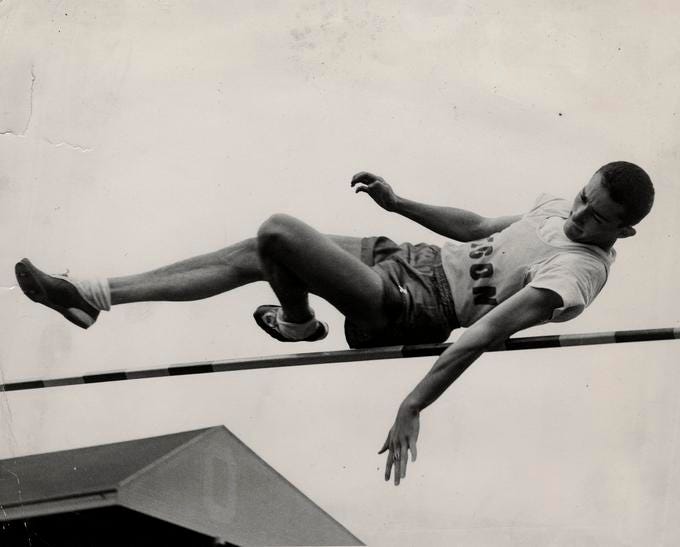
My father is an Oregon man. He was a member of the University of Oregon Track and Field team from 1957 to 1959. His event was the High Jump. He was recruited by Head Coach Bill Bowerman and granted a full scholarship. Upon accepting the scholarship, he packed up his car, and left Vancouver for the University of Oregon campus at Eugene.
As the son of a longshoreman with a grade six education, the athletic scholarship was a significant event in his family. But to be recruited and coached by Bill Bowerman was something else, entirely. You see, Bill Bowerman was a track coach and then some. Once you entered his world, you were never quite the same.
Before his coaching career, Bill Bowerman enlisted in the US Army. His training included leading supply teams of pack mules through cold, forbidding terrain near Camp Hale, Colorado at a 9200-foot altitude.
By the time training ended, he was promoted to battalion commander. In battle, he led his unit to three key victories over the Nazis in Italy. He was nominated chief negotiator for the Americans and successfully obtained a German surrender of the Italian Alps.
The experience leading mule teams would influence his coaching methods. For a mule to carry many times its weight up and down mountains you must first get its attention.
How do you do that?
You start with a 2 x 4 and you grip it with both hands. When you think you have a good grip, you wind up and you hit that mule between the eyes as hard as you can.
That’s how you get a mule’s attention!
After that, your words seem to carry a little more importance. And so, it is with athletes….as distance runner, Ken Moore, soon learned as a member of the Oregon track team.
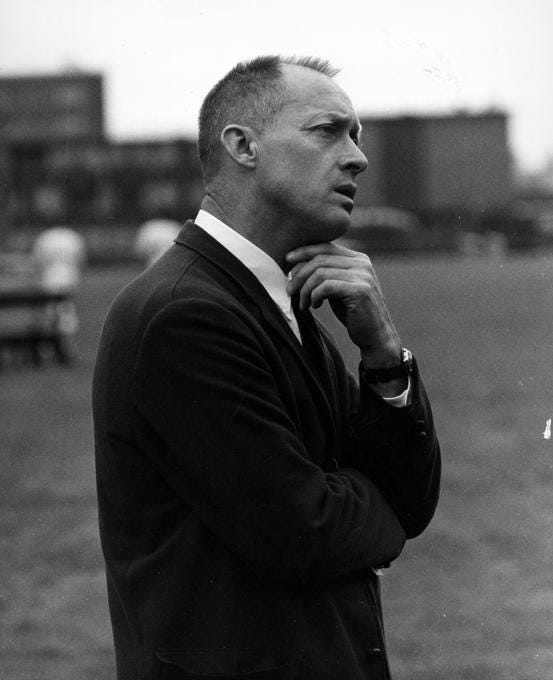
Bowerman learned that Moore was training more than directed by doing extra workouts in secret. He grabbed him by the windpipe, pushed him up against the wall, lifting him off the floor and said “you’ll run as much as I tell you to run, when I tell you to run and how I tell you to run or you will run somewhere else…is that clear?” [1]
But if you think he was a sadist, you would be wrong. He knew that the greatest risk of failure in track and field was from injury. Injury almost always occurred through overexertion. He maintained that proper training consisted of three things: stress, recovery and improvement.
These methods brought him four NCAA championships.
He developed:
- 64 All-Americans
- 16 milers who broke the 4-minute barrier
- 33 Olympians like sprinter Harry Jerome, distance runner Steve Prefontaine, discus thrower Mac Wilkins and world record holder Otis Davis
His control over athlete’s lives was domineering and all-encompassing. He knew everything you did outside of practice and when. He had spies throughout the town of Eugene. He knew if you smoked a cigarette, went to the beer parlour, or snuck in past curfew.
Before it became a dirty word, he was not above hazing his rookie athletes. One ritual was to bring a rookie in for a one on one talk in the sauna. Bill would put his key ring on the sauna rocks and when the talk was over, he would drop the hot keys on the rookie’s thigh making a nice brand that stood out for all to see.
Throughout his career, Bowerman was ahead of the curve. At the 1968 Olympics in Mexico City, he saw that sport was becoming a vehicle for political expression when members of the USA Track and Field team raised their fists in solidarity with the Black Panther movement. He prophetically remarked, “We haven’t seen the last of this kind of demonstration.”
As Head Coach for the USA Track and Field team, he was concerned about lax security at the 1972 Olympics in Munich. The government of post war Germany wanted to erase images of Nazism by staffing the Olympic Village with unarmed guards.
Bill learned of the kidnapping of Israeli athletes, seventy-two hours before Olympic officials acknowledged it. With one phone call to the US embassy, he had the US Marines take control of the building that housed Team USA while the Black September group was murdering Israeli athletes within earshot.
Being Head Coach of the USA Olympic Track and Field team would be accomplishment enough for most of us. Not for Bowerman. He was always on the lookout for an edge in training or equipment.
He networked with other coaches to share ideas. During a track meet in New Zealand, Bowerman learned that their medical community looked to coach Arthur Lydiard to rehabilitate ex-cardiac patients. Lydiard designed slow running workouts that dramatically improved cardiovascular health for these patients and others who joined his so-called slow running clubs. Bowerman took part in a few practices and was shocked to find men ten and twenty years his senior outpacing him.
Back in Oregon, he established the first slow running club in North America and soon attracted nationwide attention. Letters poured in, asking about this new form of exercise. Bill sent them a brochure that he and his wife, Barbara, put together.
Still, the inquiries kept coming, and, at his wife’s suggestion, they co-authored a book on the subject. Their book entitled “Jogging” sold a million copies and started a fitness revolution across North America.

Bill also experimented with running shoes. One experiment involved taking his wife’s waffle iron into the garage and melting sheets of rubber in a waffle pattern. He cut and attached them to shoe bottoms for better traction. His runners loved it. He struck up a business partnership with his former athlete, Phil Knight. This partnership became the company we know today as Nike.
Some of his athletes loved him and some hated him but, to a man, they all said that no one else could have gotten out of them what Bill Bowerman did.
Before every season, he would gather the team together and start the meeting, “Men of Oregon…. If there are limits to what we can do, I don’t know what they are.”
As for my Dad, he completed his undergraduate degree and, at his peak, was the ninth ranked high jumper in the world.
That year, he and other Canadians studying at American universities, received a letter from Prime Minister John Diefenbaker. In an appeal to nationalism, Diefenbaker’s letter told the students that they owed it to their country to return home and give Canada the benefit of their education.
My Dad did so. He returned home to train for the Commonwealth Games only to break his ankle. It never fully recovered. That was the end of his track and field career.
But he was always struck by how strangers from Oregon gave him the chance of a lifetime when his own country, Canada, offered him nothing. To this day, he will tell you that being A Man of Oregon was the best thing that ever happened to him.
[1] https://www.amazon.com/Bowerman-Men-Oregon-Legendary-Cofounder/dp/1594867313