
Medium
The Medium Updates Have Been Nothing but a Colossal Failure, and Everybody Knows It
I’d like to implore the platform to reconsider its direction

Earlier this week, I read the story titled The Medium Update for 2022 by Zulie Rane. In her piece, she described 12 minor changes on the platform throughout 2020 and 2021, that she believes are leading up to a “big directional shift” for 2022.
Her story was well-written, well-thought-out, and hit the nail on the head in terms of what changes have happened.
She discusses that Medium has acquired a couple of companies to try and work them into Medium’s larger strategy.
On the platform itself, they’ve implemented Blogrolls, where we can now see who other people are following, along with Lists so we can now make lists of various types of articles (i.e., relationships, money, etc.)
And as most of you know, we’ve now got an email subscriber list that’s exportable so that people can stay up to date with our work. Readers can even email us back at our own personal email addresses should we opt to turn that feature on.
For brevity’s sake, I won’t go over all twelve changes here. I’ll attach Zulie’s piece at the bottom so you can read it at your leisure (it’s quite good).
The most significant and problematic changes came in two chunks.
And the problem with the second chunk significantly hinders the benefits of the first, as you’ll soon see.
First Chunk: The Referral Program
First, there was the change to the Medium Partner Program, where we now get paid through a referral system.
It’s pretty simple, and it works like an MLM (multi-level marketing company).
You refer new Medium subscribers through the link provided in your settings, and you’ll get a cut of their monthly payment to Medium. This amounts to $2.26 per new subscriber you sign up.
If you pull in 1,000 new subscribers, you’ll make roughly $2,260 per month so long as those subscribers are signed up and actively paying for their Medium subscription.
The fact that it’s ongoing is kind of cool. It’s a truly passive income stream for as long as the people you sign up remain subscribed.
I love this idea!
But what’s the cost of doing it? And how easy will it be?
The Death of Viral Content?
Zulie mentioned that virality seems to be dead. And all of the content creators of old that I know are reporting they’re struggling to make ends meet or gain traction on the platform these days.
As Zulie put it:
Medium is focusing on building smaller, stronger audiences instead of bigger, viral, more impersonal ones. This means people like me find it harder to go viral, reaching 1000s or 10000s of readers. But it’s easier to build a connection with a smaller group of dedicated readers.
Is this the trade-off, where now we get a chance to bring on new readers at the expense of not having our highest quality articles go viral, gaining exposure to a wide audience?
Great.
So they’re basically diminishing the one thing they did the best out of any platform on the web, curation (now called distribution), in exchange for us building smaller, more personal audiences.
Bad for Readers, Bad for Writers
This is going to be awful for readers. The quality is going to drop, as I’ll get to in just a minute. But it’ll also be horrible for the content creators of Medium, we the writers.
They’re trying to reinvent the Substack wheel here, and they’re going to try and pay us significantly less than Substack in the process.
Substack charges 10% of the subscription price. Medium charges approximately 50% of the subscription price.
Meaning if you do the exact same thing for Substack, building an audience externally, signing them up to get notified by email every single time you publish something, and bringing that audience to the platform for your content, you’ll keep 90% of the cash your followers pay.
If you do that for Medium, it amounts to about half of the cash your followers pay.
Hmmm, do I bring my external audience to Medium where they’ll be exposed to garbage content (more on this later) for 50% of the money they’ll pay to access me, or do I develop a one-on-one relationship and keep 90% of the money they’ll pay to me on Substack?
This is a no-brainer.
Second Chunk: The Relational Model of Medium & Tags
And here’s where it all comes together beautifully to spell the perfect disaster. For those who are new, Medium used to operate on a system where they carefully curated the best pieces and placed them on the home screen for readers to read.
The stories were curated in topics.
There were a series of publications, some of them Medium owned, some of them user-generated, and many flat-out fantastic, providing an additional filter through which readers could find the great content they loved.
But Medium has functionally decided to do away with paid publications. Paid publications were publications that were run by paid editors. Now those are gone, for the most part. Almost all of them have been stripped of their funding.
And getting rid of paid publications will leave only the amateur publications (by that, I mean working for free in their spare time) or hobbyists.
I can only see this driving the quality of the content down.
When it comes to content, you get what you pay for.
P.S. I Love You closed, along with The Ascent, Post-Grad Survival Guide, and more. Some of the best places on Medium have shut their doors.
Zulie suggested that perhaps publications are being put on the back burner to play a much more minor role in the process of finding content if they aren’t done away with altogether.
This is like Facebook willfully getting rid of its Groups feature all of a sudden. I can’t see it going over well.
And the process of being curated in topics has now taken a backseat to a new tags model. There were about 100 or so topics that a story could be curated in by Medium’s curators, stories that were hand-picked for their quality.
Now, there are millions of possible tags, and the tags are user-defined.
Anything can be a tag, as long as a user picks it!
There’s even a “poop” tag. And no offense to those who read or write under the “poop” tag, but I’d rather not read about your excrement; thank you very much.
If you want to read or write about poop, by all means…please do. I’m glad the option is there for you. I hope the readers and writers of all things poop find each other and live merrily in digital wedlock.
But Medium really needs to figure out a way to distribute those stories to the people who actually want to read them.
They’ve taken away Tim Denning from my feed and replaced him with poop. Scarcely do I see Jessica Wildfire, but I’ve got stories about people who’ve made their first $121.67 flying up in my feed all day long.
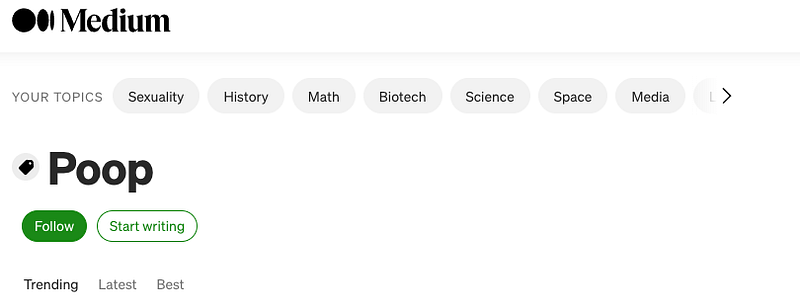
Articles are still distributed into topics, as of now, but it’s obvious to anyone with eyes that distribution has become much less meaningful than it once was.
Now, we’re getting “suggested for you” articles in our main feed as readers, and let me tell you, the quality of the writing has gone way, way down.
Stories go less viral, and we get an array of stories in our feeds (as readers) that have nothing to do with the content we want to read.
It’s called a power-law dynamic, where a handful of users on any platform get most of the views, reads, and, yes, money. But that’s because those people are creating high-quality content.
Power-law dynamics are replete throughout nature, from solar flares to the number of times single words are used in any given language (we use “the” more than we use “orangutan” because “the” is a more useful word).
And you can’t level things out without trying to shove lower quality content in our faces.
The Quality of Stories Has Plummeted
A month or two back, as Medium shifted to tags instead of topics, I got a recommendation to read an article under the “poop” tag.
And that’s when I knew it was going downhill fast.
I’ve never written about poop. I’ve never read about poop. Nor do I want to start now.
As of this point, it seems that Medium is employing an algorithm to decide what topics we *might* be interested in, rather than curators, it seems.
And at this task, it’s failing as miserably as a drunk trying to flirt with women at an AA meeting — after his ninth brandy and Coke.
But the “poop” tagged article that showed up as the #1 suggestion on my homepage one day was just the straw that broke the proverbial camel’s back.
I’d been collecting screenshots of articles with headlines in broken or incomplete English, articles that read like they could’ve been written by a 5th-grader, and worse.
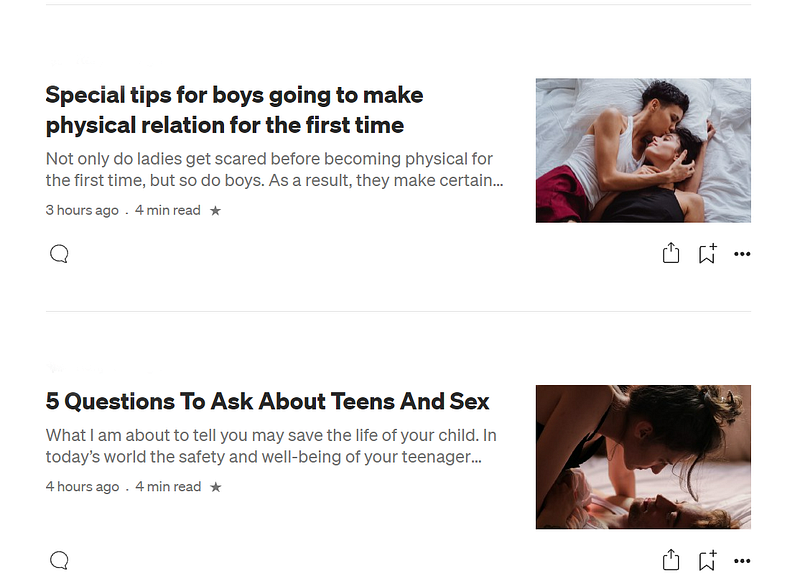
Now I’m not here to call out anyone’s writing style or what you may or may not like to read. But we can’t pretend that there’s no such thing as objectively good quality when it comes to literature.
Observe the first several paragraphs I found in, yet again, another article on the top of my homepage:
The individual case is different and everybody has a certain preference, sometimes you have a black man who only dates a white woman and you see him with an overweight white woman so why do black men like fat white women.
When you meet someone, you’re normally into them because you’re into the person, you’re not like ooh that’s a fat white woman whoo that’s a black girl, that’s not how it goes.
You have to be into the person too now you can barely have your preference which is a thing that people have.
You see this quite often it’s not in all cases. Why are these men going after these big fat white women?
There’s a big difference between dating a white woman versus a black woman.
Listen, I’m not here to punch down at writers who may not have their English skills together. Ask the many people I’ve helped get their English skills together enough to write on the platform, volunteering my valuable time and effort to help someone out.
Hey, I get it, as a language learner myself, I understand the difficulties involved.
But under no circumstances should butchered or broken English be served up on the top of the very front page of Medium. Nor should articles about “poop” that I don’t want to read about and have never done anything to suggest I might be the first thing I see when I log in for the day.
I used to feel inspired when I logged into Medium. There used to be refreshing content that made me think. Now it’s just as bad as social media platforms.
Medium has stripped itself of the very thing that made it great — its curation process and standards.
It’s really bad for the readers of the platform, so much so that I feel it will put Medium’s future in jeopardy.
Wrapping it Up: Moving Forward — or Jumping Ship?
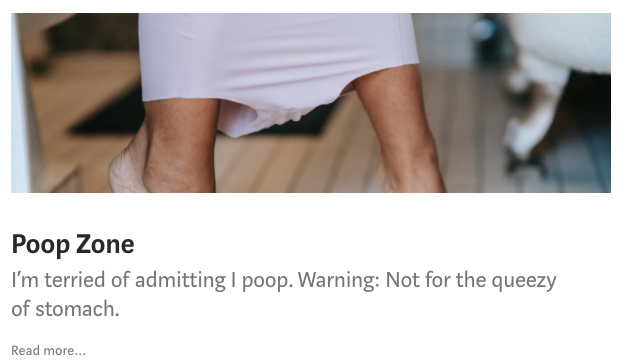
After the “poop” article, I decided enough was enough and canceled my Medium monthly subscription. Why am I going to pay $5 per month for broken English, served up by a broken algorithm and low-quality articles?
Why should anybody?
It’s like a significantly lower quality Reddit that they’re asking people to shell out hard-earned American dollars for.
And there’s the rub…
It’s the worst possible impression subscribers could be getting.
They want us to go out and promote the site, bringing in new readers, writers, and users, to a lackluster experience that’s awful for those of us who’ve been around here for years.
And I’m not saying this because I don’t like change. I love change!
But I don’t want to read articles in broken English about people’s excrement to be the first thing I see when I sign in! That’s not a big ask!
And here’s where it comes full circle. How do they expect us, content creators, to keep the subscribers we recruited if the quality of the content on Medium itself, especially on Medium’s own homepage, is absolutely god awful?
Now, to be fair to them, I don’t think they know just how bad it’s gotten for us as readers. I contacted Medium through their feedback section, but I’m sure they’ve spent a lot of time and money investing in this new “relational” model that they announced in the middle of last year, and it’ll probably be too late for them to turn back.
But yes, the platform is almost as bad as Facebook. Which says a lot. And the whispers are certainly happening, whispers as people wonder how long Medium can stay afloat with this new platform they’ve built.
I may not know everything there is to know about the business of running a platform. Still, I know that making users actively want to cancel their subscriptions and leave your platform or spend as little time on your platform as possible isn’t a good business strategy.
Hopefully they can turn this ship around. Otherwise, a lot of us will have no choice but to jump ship and find better opportunities with better platforms elsewhere.
Since I hate to be the guy who can only criticize, without offering helpful suggestions, I came equipped with a few ideas that could help the platform:
- The new features are mostly great. Keep them! Keep all except the tags feature replacing the topics feature. If you can’t curate quality content (because it’s not affordable or whatever, expect people not to want to pay hard-earned money to spend time on your platform).
- Bring back virality. Content goes viral because it’s good. I miss the old days of opening my Medium feed and having bountiful options from tons of the Medium giants like Tim Denning, Sean Kernan, Jessica Wildfire, Shannon Ashley, and more. I honestly thought Zulie had quit writing for Medium for about 8 months until I found her on YouTube, only to find out that she’s still in fact writing for Medium, I just never, ever saw her content.
- Related to virality, stop stripping articles of distribution once they get going. I sense this is why we’ve lost virality on the platform, but basically, it’s a bad look for the platform. It makes you look greedy — like you don’t want to pay your content creators and like you want to get as many headlines out of your writers as possible while paying them the least amount possible.
- Fix the way we see Medium’s content. Even the writers who weren’t Medium giants, the part-time writers I love to death, have proved impossible to get in my feed. The people I love to read have been replaced by objectively awful articles that I can’t even fathom anyone wanting to read.
- Give up on relational content. Or at least scale back on it significantly in favor of quality. This has been Facebook’s model forever and it’s obviously problematic. Content creation and consumption should be about quality, not who happened to clap on my articles last or what have you.
- The Medium of 2019 was the best Medium. Go back to that. The change that everyone felt like an earthquake in August of 2020 was bad and it’s been all downhill from there.
Thank you for reading.


