
The Matter of Thought
Can we claim ownership of the thoughts we are conscious of?
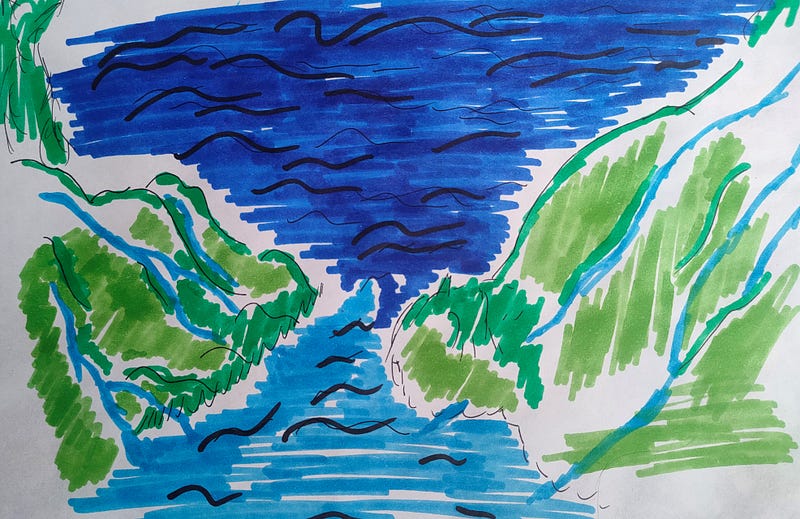
Are “our” thoughts actually ours?
Thoughts come to us effortlessly like a stream of water running down a mountainside, but can we claim ownership over them? This is a philosophical question I want to focus on here from the perspective of someone with a mental illness in which the main symptom is relentless and unbearable thoughts intruding on my mind every waking moment.
We commonly speak of the thoughts that come to us in a possessive context, e.g. “I had a thought”. But can we really say this is true? If we consider the thoughts that we are conscious of as that running stream of water, where does that stream starts, and do we have control over what thoughts actually come to us? And if we can’t know for sure if we are in control of them, do we actually own them? When you start to think about this, it’s easy to start spiraling into deeper and more complex existential questions that dismantle our sense of being and make us revaluate the nature of our existence. The idea of existentialism is that existence precedes essence. For example, if you take the ink out of a pen, is it still a pen, or is it now just a long plastic stick? I bring this up because if we apply this to ourselves and our thought process and if we take the ownership of our thoughts away from ourselves, are we still who we think we are, or simply just physical bodily vessels that receive and respond to thoughts controlled by something else?
We don't know where that stream of thought comes from, but in keeping with the body of water analogy, we know that it always finds its way to an even greater body of water we know as our consciousness. I recently read an article by a professor of neurology in which he said that we are only conscious of a very small fraction of the thoughts in our brains, and the rest is kept at a subconscious level. So if we thought of our consciousness as a vast body of water, it is only a small lake compared to an even greater ocean that we aren’t even aware of.
This is starting to get overwhelming, so let’s go back to something smaller: what is a thought? The philosopher Krishnamurti said that thought was the reaction of our knowledge, experience, and memory. In this way of thinking about it, these three attributes shape the very way we react to everything our bodily senses perceive in the world around us. Simply, our emotions are a proceeding response to a preceding thought.
On mental illness
To take this discussion to another level, what happens if you have a mental illness in which the main symptom is obsessive intrusive thoughts? As someone with OCD, I can use what I have learned from the illness to understand the relationship between thoughts and emotions.
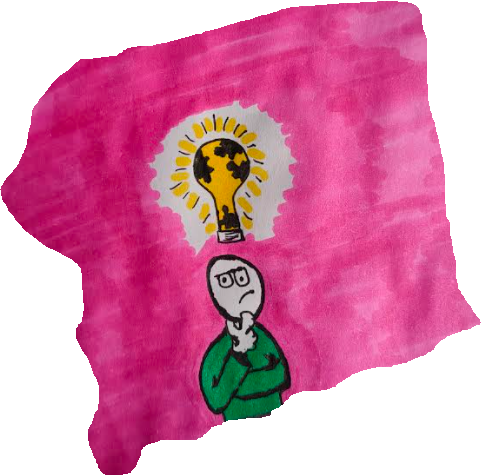
The way I experience it, it is as if thoughts run through my mind constantly, and some that are more horrific than others attach themselves to my emotions like a parasite and make themselves home there. Once they are attached to that emotion, there is no ignoring it or moving on, it has to be killed. Similar to how our bodies raise their temperature to kill a virus, the OCD sufferer will create a defense mechanism of its own to fight away the obsessive thoughts, usually in the way of compulsions. I’m not conscious of, or in control of, the thoughts coming to me, and I am also not in control of my emotions towards those thoughts. I am so overwhelmed with fear and anxiety that I undergo compulsive actions (turning a switch off and on repeatedly or saying certain phrases over and over in my head) until the intensity of those thoughts goes down.
There are many theories about what causes OCD, but we still aren't definitively sure what those causes are. Many different theories share a similar thread of belief that life experiences, especially at crucial developmental stages of one’s life, can either cause the OCD itself or trigger the onset of a dormant OCD response in the brain. This is where I relate more to that idea from Krishnamurti that thoughts are reactions to our experiences; if my brain at an early stage of development experienced difficult intense emotions that didn’t get resolved in a safe way, then memories of those experiences will be infused with a sense of danger, and OCD could be the defense response my brain learned from those experiences to seek that much sought-after sense of safety it never received.
The monster within
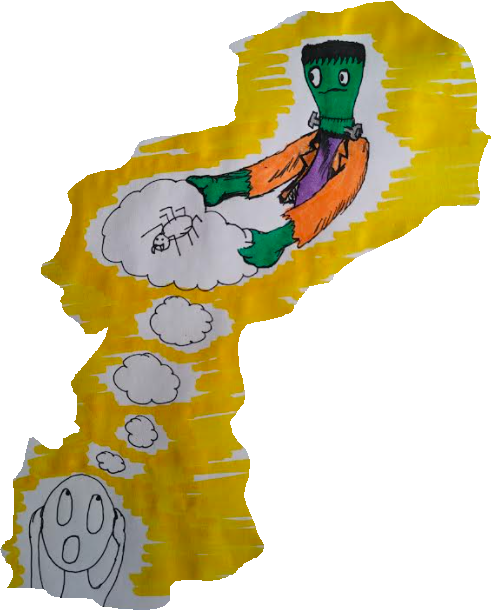
When we think about Mary Shelley’s classic, we refer to Victor’s creation as “Frankenstein’s monster”, and let his morally reprehensible creator get away with simply being referred to as “the scientist”.
Obsessive-compulsive disorder is often described by those that suffer from it as a monster. In this metaphor, it is the monster that is the source of our thoughts. Personally, I don’t use this metaphor because I don’t feel like my OCD is a monster. My OCD is a coping mechanism that my brain developed to try to protect me the best way it knew how; a mechanism learned from worldly experiences. My OCD is (probably) a product of the world around me. From our very first moments of life, we are confronted and exposed to experiences of danger and fear and pain and death. The world is that monster that makes us fear. And the more we experience, the more fearful we learn to become.
Wrapping things up…
So, can we claim the thoughts in our heads are ours? And if the thoughts are not ours, are we truly free? The existentialist philosopher Jean-Paul Satre famously wrote that “man is condemned to be free”, but perhaps we are really condemned to be free within a cage made from our own experiences through life.
Thank you for reading. If you would like to read more of my thoughts on mental illness, check out my publication: The Mental Illness Pages.