
The Mathematics of Nature
Mathematics is another sense you had not yet discovered — a sense of patterns and logical connections that allows you to perceive the realities of the universe with a new perspective.

The laws of nature are the mathematical thoughts of God. — Euclid.
Nature really does love mathematics. And I love both — nature and mathematics.
But the majority of people who love nature don’t fancy mathematics. They are called outsiders — who always struggle with math.
I was also a part of the outsider group.
But, when I completed my post-graduation in applied mathematics, my outsider’s perspective of mathematics completely changed.
And today, I want to change yours as someone who went from being an outsider to a mathematician.
It’s because, surprisingly, we are all deep down born to be mathematicians. Or maybe my love for nature made me a lover of mathematics.
When I was in school, maths was not really my thing.
I used to get the lowest scores in the subject. I never loved the xs and ys of math.
As I studied further, I discovered that mathematics wasn’t as difficult as I’d originally thought.
But still, that was only the start; I wasn’t in love with math.
As I studied further and engaged in a creative process that mathematics hold like solving equations, infinities, observing the world, I was hooked.
I started to love it, and for the first time, I realized I could swim in complex infinities of mathematics.
I used to think that maths was about rote learning inscrutable formulas to find the solution to abstract problems.
But at university, I started to look at mathematics from a different perspective — immensely practical and even beautiful.
Mathematics is not only about finding answers but also about learning to ask the right questions.
It isn’t about mindlessly crunching numbers but about developing new ways to see problems — by coupling intelligence with imagination.
It gradually appeared on me that mathematics is another sense human beings have, just like the sense of touch and sight.
Mathematics is a sense of patterns and logical connections that allows us to perceive realities of the universe that would be otherwise intangible to us.
It provides you a new perspective to see the world.
Now, I want you to ponder this point with some mathematical realities of Mother Nature.
Fractals in Nature
Fractals get their name from fractions and fractures — it refers to the broken and fragmented shapes we see around us in nature.
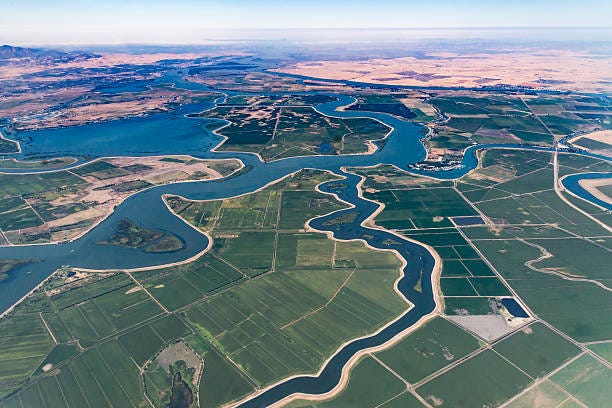
See the geography of river deltas. It’s a beautiful piece of geometry.
Most people think of geometry as in triangles and circles.
But geometry, in its actual essence, is the mathematics of all shapes, and this meeting of land and sea has created shapes with a definite pattern.
Scientists see the order in complex patterns of the river delta, which an outsider will never see.
River delta has entangled channels that split and rejoin several times before entering the sea.
It has a mathematically recursive structure.
With its twists and turns, every part of the river delta is a micro version of the greater whole.
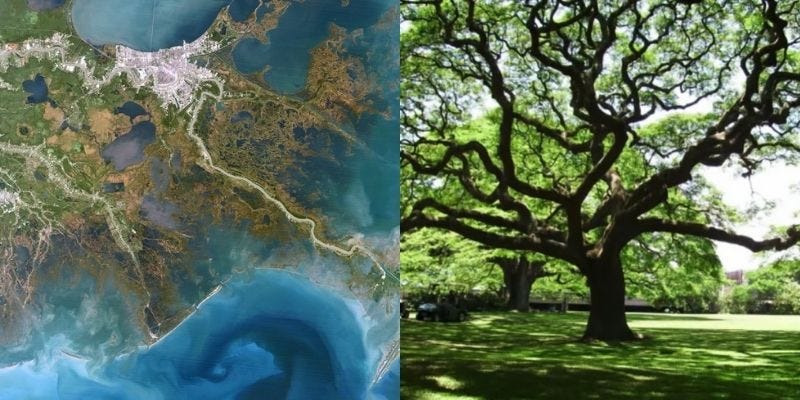
I want you to see the mathematics in this. Compare the river delta with a tree.
It’s a miracle in itself.
But concentrate with me on the similarities between this tree and the river.
Why on earth should these shapes look so remarkably alike?
Things get even more perplexing when you realize it’s not just water systems and plants that do this.
If you keep your eyes open, you’ll see these same shapes everywhere.
Ponder their geometry.
Their shape is so obvious and similar that one can’t help but be suspicious.
And here’s the rub.
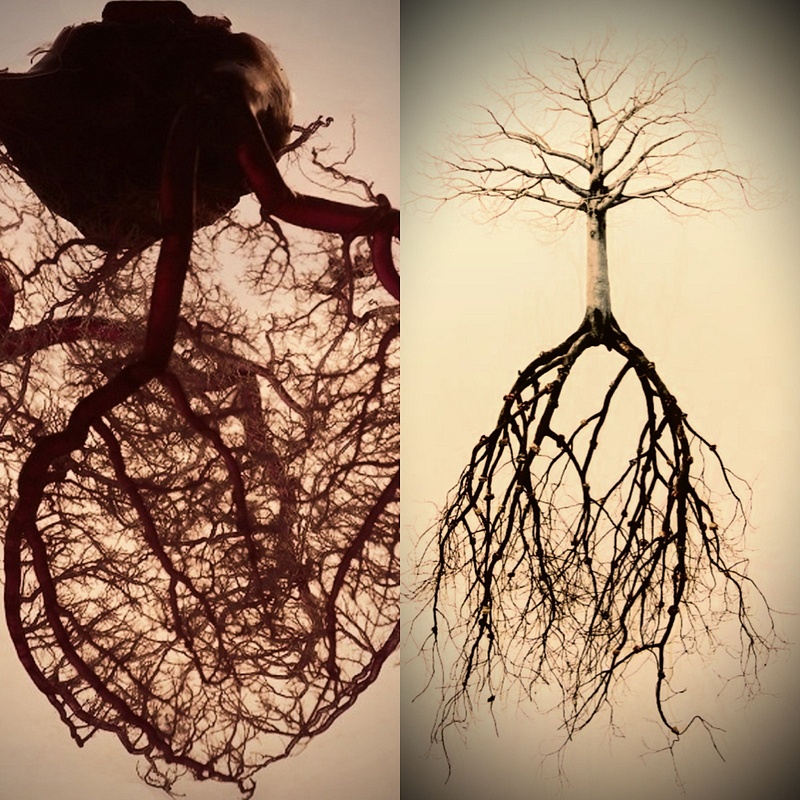
The pattern of the human body is similar to nature. Every cubic centimeter of our body is packed with blood vessels that trace out the same pattern.
Here’s an example of a human heart that looks like the roots of a tree.
It does not end here.
There’s a mathematical reality woven into the universe with:
Towering trees, raging storms, flowers, head of broccoli, leaves of a fern, clouds in the sky, and the list goes on and on…
These shapes are examples of “fractals.”
Once you get a sense of fractals, you will start to see them everywhere, believe me.
Like other senses, our mathematical sense can be refined with practice.
You can learn to perceive the mathematics around you with time and the right guidance.
Naturally, some people are born with sharper senses than the rest of us; others are born with impairment.
Mathematical Patterns in Nature
We live in a patterned universe called the cosmos, and we all are wired to see the patterns.
We humans are so good at seeing patterns. Our brain loves making patterns. We learn and make decisions by detecting patterns in the information they are presented.
According to Neuroscientists,
Humans try to detect patterns in their environment all the time as it makes learning easier.
People who are experts in creating patterns or use their creative side of the brain more often have a special name.
They are called artists, musicians, sculptors, painters, cinematographers, writers, and of course mathematicians — they’re all pattern creators.
You will see some fascinating examples of mathematical patterns in Islamic art and design.
An aversion to depicting humans and animals led to a rich history of intricate tile arrangements and geometric forms.
Patterns in flowers — Rational Symmetry
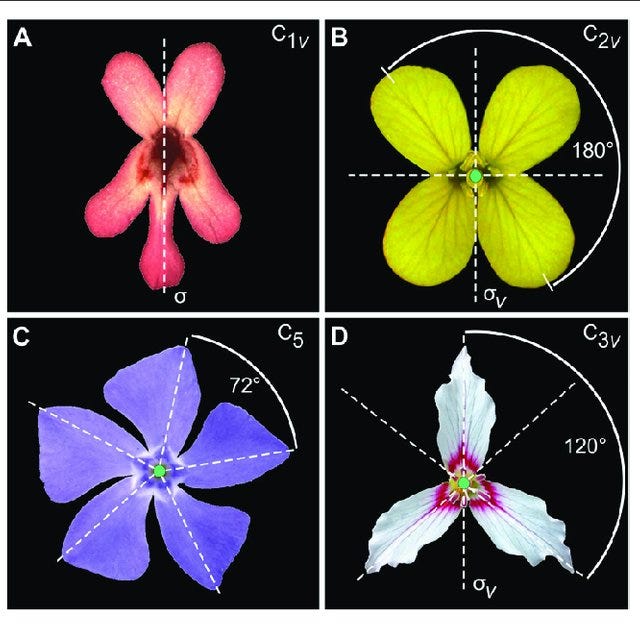
The aesthetic side of mathematical patterns brings us back to nature itself.
For instance, flowers are a universal symbol of beauty.
And one aspect of their beauty is that they exhibit a special kind of symmetry.
Flowers grow organically from a center that expands outwards in the shape of a spiral, and this creates what we call “rotational symmetry.”
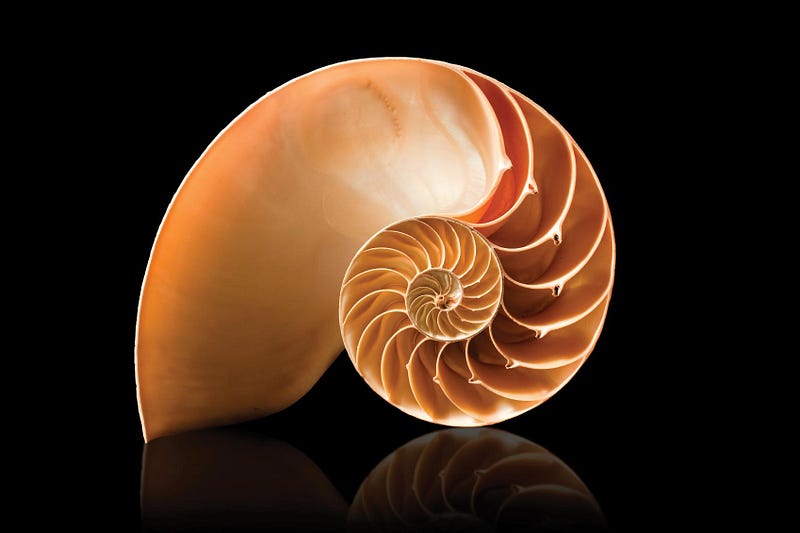
You can spin a flower around and around, and it still looks basically the same.
But not all spirals are created equal.
It all depends on the angle of rotation that goes into creating the spiral.
For instance, if we build a spiral from an angle of 90 degrees, we get across something that’s neither beautiful nor efficient.
Huge parts of the flower’s area are wasted and don’t produce seeds.
Using an angle of 62 degrees is better and produces a nice circular shape, like what we usually associate with flowers.
Fibonacci Sequence — The beautiful pattern of Sunflower
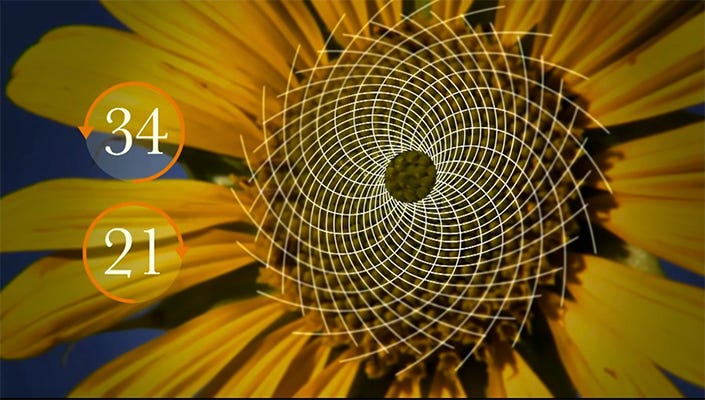
We also see a beautiful pattern used by that most majestic of flowers — the sunflower.
Sunflower follows a special number known as the “Fibonacci sequence” or “golden ratio” in mathematics.
A Fibonacci sequence is a set group of numbers in which each number is the sum of the previous two. It can go onto infinity and creates a complex swirling effect. It is also called the golden ratio.
The golden ratio is a mathematical reality you can find everywhere in nature — from your face and the phalanges of your fingers to the pillars of the Parthenon.
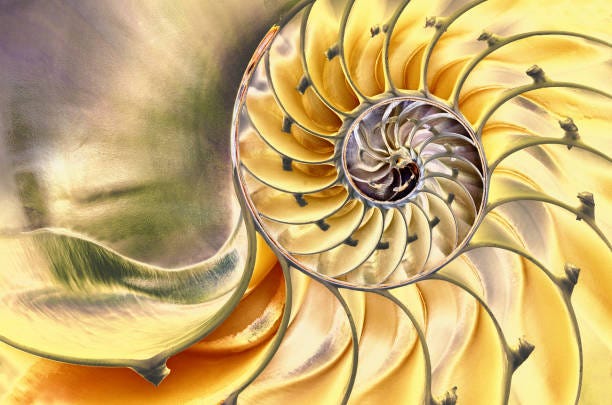
Mathematics is everywhere in nature. There are endless patterns you will see in waves, snowflakes, spider webs, beehives, Nautilus shells, and tree trunks.
That’s why I’m proud to declare,
“I love mathematics.”
Do You?
Suggested Reading:


