
The massive disruption nobody is talking about, yet.
Bold prediction: the evolution of machine learning models (GPT, Gopher, …) combined with the ubiquity of messaging apps (WhatsApp, Telegram, …) will eventually intersect and converge to create enormous business disruption.

The intersection of 2 innovations is often what causes the BIG disruption, not either of them alone.
Messaging app ubiquity
Messaging apps have become ubiquitous, especially outside the US, consumers are increasingly interacting with businesses using WhatsApp, WeChat, Telegram and other messaging apps. I wrote about this in 2016…
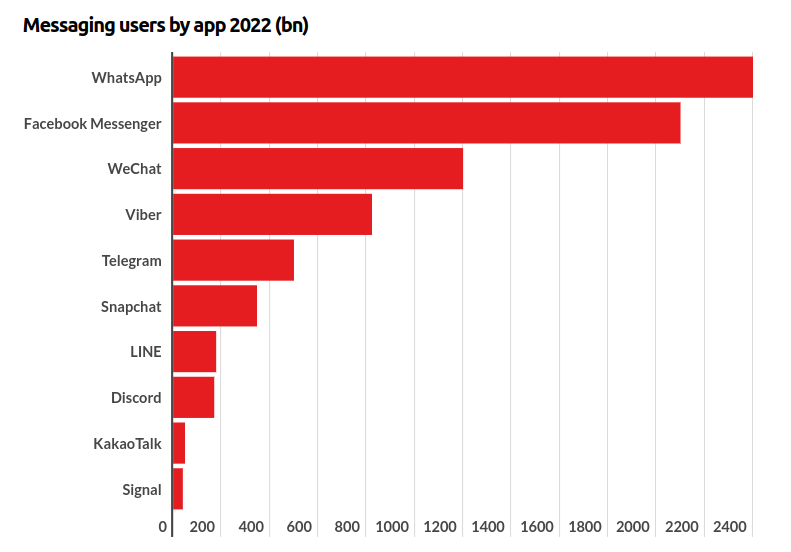
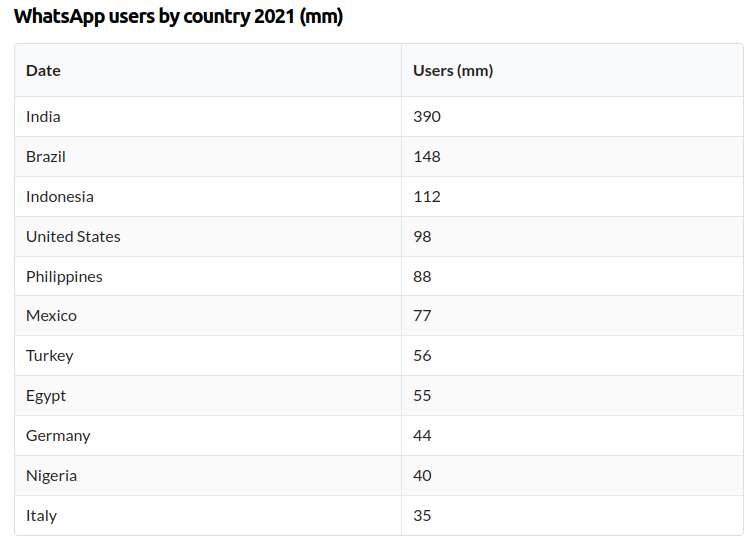
Let’s take Italy as one example: with a total population of 63M, more than half are using WhatsApp and with 63% of its population between 15–64 years of age (2021 census) this means 90% (35M of 39M) in this age range use WhatsApp.
Meanwhile Generative LLM’s (Large Language Models) are evolving to reach levels of language understanding and language composition that represent significant advancements in NLP (natural language processing).
Messaging between people is obviously important in terms of market penetration (SMS costs money in most places outside the US and has fewer features than messaging apps) but the really interesting trend is consumers messaging small businesses to conduct business/commerce/services/etc. This is not captured in the user/download statistics.
Outside of the US most small businesses interact with customers not on web sites, not over the phone but in messaging apps like WhatsApp.
I spent 3 months in the Caribbean and then 2 months in Italy in 2022, every interaction with small businesses was NOT websites, NOT phone calls and NOT SMS, it was all via WhatsApp…
- renting an automobile
- support for a rented apartment
- reserving days at a dog kennel
- coordinating boat maintenance
- scheduling rides with a driver (there’s no rideshare in Italy)
- …
So we have two trends with significant momentum: messaging app market penetration and large language model (LLM) evolution. How these 2 trajectories intersect in the future is something nobody is talking about, until now, here.
There will be an enormous disruption of so-called ‘front office’ human work once these 2 technologies converge.
ML models still have contextual reasoning to deal with
Generative ML models like GPT-3 are not yet able to handle ‘contextual reasoning’ sufficient to handle even rudimentary front-office tasks…
But reasoning functionality will inevitably combined with language processing for common front-office functions such as:
- calendar scheduling
- pricing questions
- managing reservations
- process workflow questions
- FAQs
Much of this won’t come from increasingly large models but rather from specialized modules merged with (added to the functionality of) the ML system. Some of this (eg. Frequently Asked Questions) will come from contextual training applied to the model. Contextual details provided on top of the XXL training data will ‘fine-tune’ a model. This is already possible in GPT-3 albeit a bit crude. Think of these are functional modules created to work with specific information with language. A machine learning language model has tons of language around a ‘calendar’, for example, but it does not yet have a structured way of reasoning about it.
Understanding how to work with structured information and structures systems such as a calendar, a price sheet, a reservation system, etc. is not a matter of language but of specific training. A fluent English speaking person not trained in a business’ reservation system would need to be trained, same with a machine.
Disruptive technology never stands on its own
The rise of GPT in late 2022 was meteoric. “ChatGPT will kill Google” many proclaimed. Ultimately other large models will surface and the way people search online will evolve. But the deepest disruptions and paradigm shifts come from a combinatorial effect. For example: smartphones would not have been as big a paradigm shift had they not also had internet access. In fact much of what we consider a ‘smart phone’ modulo internet access was available before the iPhone and Android and those launches have long since been forgotten.
No matter how sophisticated or capable a chat system is, as a web experience or an app, it won’t disrupt businesses until combined with an existing, ubiquitous messaging app. Consumers interacting with businesses, especially local small-businesses, don’t want to install another app or deal with another website with login credentials. They want to message and tell the business what they want, simple.
And there is one more crucial ingredient few are thinking about: human experts. The assumption that the entirety of the conversation between business and customer can be automated is fundamentally flawed.
The 3 ingredients to the ultimate front-office business disruption
So we arrive at the 3 ingredients, 2 of which are not yet there today:
- Ubiquitous message apps (we are already here in most places)
- ML models capable of front-office conversations (not yet ready)
- Chat systems integrating automated response and human experts (TBD)
Part 2 isn’t ready and neither is 3.
Some messaging app APIs do not allow for human/computer blending, most notably: WhatsApp ‘Cloud API’. In the WhatsApp API from Meta, a business # must be fully automated, the business owner cannot be part of the conversation from their phone on the same #. There is no opportunity to blend. This is a critical design flaw which will force workarounds until Meta groks the outage.
Once these 3 ingredients are combined we will see a huge disruption in so-called ‘front office’ work. People hired do handle functions such as:
- managing a calendar/schedule
- answering pricing questions
- answering project workflow questions
- onboarding a new client
- providing status of an order/service
- answering basic (frequently asked) questions
- reminders
Will no longer be needed, these will be done automatically in the messaging app used by customers already interacting with the business.
Of course the deeper, more nuanced, more contextual conversations will still be driven by people working in the business, but they will have more time to devote to other things as the mundane tasks are reduced.
How long will this take?
Best guess is approximately 7 years: 2030.

Fasten your seat belts, keep in mind the nearest exit may be behind you.


