
The Mass Killings in Cambodia That We Don’t Talk About
G is for Grey and Genocide
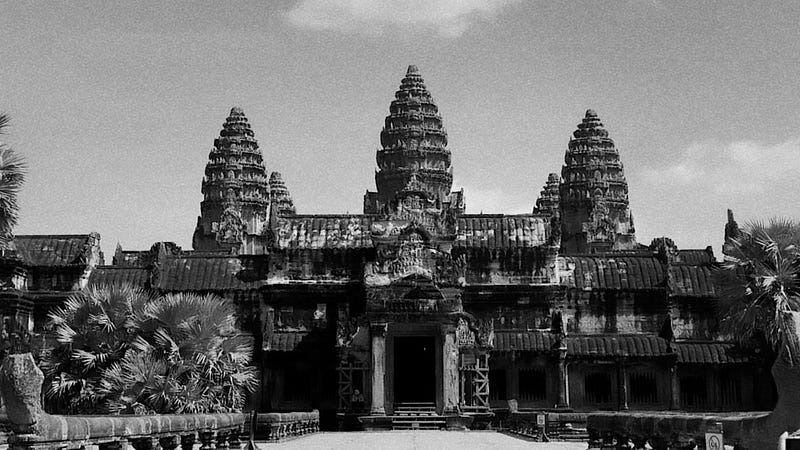
It had been raining non-stop for days in Koh Phangan. Sick of the weather, in December last year, I made the last-minute decision to leave Thailand and visit Cambodia.
The rain is not the kind of grey I’ll be talking about, though.
I was lucky that a Portuguese traveller I had connected with on Facebook was spontaneous enough to come with, even though we hadn’t met in person yet. We met a couple of days later and crossed the border together by bus.
For some reason, there was widespread chatter about Cambodia being unsafe for female solo travellers. That girl I ended up travelling with was full of them. I typically prefer to approach countries (and people) with an open mind and no previous misconceptions, but I was relieved to have someone to do it with. We ended up being joined one day later by another Portuguese girl I had met in Pai weeks before.
Exploring Angkor Wat and visiting the killing fields in Phnom Penh were the main reasons for our visit to Cambodia.
I’m not going to sugarcoat it — Cambodia has a dark history.
While I had some knowledge about the Khmer Rouge, the extent of its cruelty didn’t fail to surprise me. What was supposed to be a two-week getaway from rainy Thailand turned out to be a sad, eye-opening, and very, very grey trip.
Cambodia was officially a neutral country during the Vietnam War between the U.S. and Vietnam. However, in March 1969, President Nixon started suspecting there were communist base camps and supply zones in Cambodia, leading to the approval of secret bombings.
Known as the Secret War, this aimed to disrupt North Vietnamese troop movements through Cambodia’s northern regions. Similar secret bombings happened in Laos in 1964, making it the most bombed country per capita in the world.
Between 1969 and 1973, Cambodia experienced more U.S. bombings than any country faced from the Allies during World War II. Over 100 thousand people were killed and millions were left homeless.
During this period, a new communist party, the Khmer Rouge, emerged with the intent to overthrow the government at that time. It started as a small movement led by Pol Pot, but when Prince Sihanouk expressed his support in 1970, believing it could return him to power, people began to join.
The Party declared that everyone had to evacuate the big cities in order to escape the bombings. People complied out of desperation. Everyone was ordered to leave immediately, carrying only the few items they had in the fridge, and walk for days until they reached rural communities. The cities were left completely deserted.
Once they reached these remote locations, they began to be severely overworked by the Khmer Rouge.
Pol Pot wanted the nation to revert to a self-sufficient way of living, free from reliance on any other country and where money had no influence in society. They forced the evacuation of cities into the rural communities for a fresh start.
To achieve self-sufficiency, highly unrealistic harvesting goals were set, forcing people to overwork—sometimes to death — in the rice crops. Many of them had never worked in the rice fields, making the entire process inefficient.
Their food rations were miserable. I remember hearing a testimonial of a woman who was only a little girl when it all happened. They were a family of six, but her mother lied about her being there, hiding her so that she wouldn’t be imprisoned. This meant they were getting food rations for five people only. She vividly remembers her grandma sharing her small rice portion with her, and turning her pockets upside down to pick out the remaining grains…
The Khmer Rouge rejected any Western influence, so cars were not allowed. Additionally, they aimed to exclude foreigners and educated people — doctors, teachers, etc. — fearing their potential interference through questioning or influence, so they began sending them to prisons.
The most notorious prison and interrogation centre in Cambodia was S-21, a former high school in Phnom Penh, where they would starve and torture all these innocent people. Now called Tuol Sleng Genocide Museum, it was the first thing we visited when we arrived in the city.
They would kill not only innocent intellectuals but also their entire families, to prevent them from seeking revenge.
“Pull up the grass, dig up the roots“
was one of their slogans.
I will share with you some of the horrific facts and events I remember being described throughout our visit to S-21.
Sensitive Content Disclaimer: This content dives into historically distressing events, touching on violence and human suffering. Reader discretion is advised.
Prisoners were forced to pee in plastic bottles. If they missed, they’d have to lick it from the floor. A prisoner was beaten for 12 days straight because he was found with socks. If they moved and their chains rattled during the night, guards would beat them more. Another prisoner, driven by extreme hunger, was caught eating a cricket; the guard hit his ears with a shoe until they bled.
Since they had no doctors left for whenever prisoners got severely sick, they had to train people to be medics in as little as four months. These people learned how to give injections practising on pillows, and learned anatomy by cutting live prisoners open. They ‘cured’ wounds with salt and water and ‘cured’ exhaustion with a mix they called Vitamin C: flour, sugar and vinegar.
The treatment in the prisons was so horrific that they had to build fences on higher floors to prevent people from jumping and killing themselves. One prisoner stabbed himself to death with a pen during a confession. Another one died by pouring the flame from a kerosene lamp on himself.
Those who didn’t die in the prisons would be sent to killing fields like Choeung Ek, to be killed overnight. It was the second place we visited, and the memories I have from it are equally horrifying.
The Khmer Rouge would hang loudspeakers and play revolutionary slogans and music to hide the sound of executions. I remember how sick I felt walking alongside the graves, imagining these mass killings happening with loud background music in an attempt to mask it all.
I vividly remember the description of how they treated babies, holding onto their legs while hitting them against trees.
People were sent to the killing fields regularly, and the Party would often try to get rid of the evidence. But in 1978, as they were running out of time, they started sending more trucks. Every single night 300 people were sent to be killed.
“To keep you is no benefit, to destroy you is no loss”
was another one of their slogans.
For four years the Khmer Rouge was under the control of former Prime Minister Pol Pot, who created one of the most devastating mass killings in global history.
In 1975 — can you believe how recently?! — the Khmer Rouge gained control of the Cambodian government, intending to transform Cambodia into a communist state.
As a result, millions of civilians were evacuated from the cities into labour camps and execution sites where an estimated 1.7 million died from starvation, torture, abuse and execution.
Unlike other genocides in which specific ethnic groups were targeted for execution, the Cambodian genocide had no exceptions.
One-quarter of Cambodia’s population died between 1975 and 1979.
Let me say that again.
One in every four Cambodians died, killed by their own people.
This was one of the worst mass killings in history, and it was happening only 45 years ago.
This month’s Globetrotters monthly challenge is grey. It didn’t take me long to decide it was the perfect opportunity for me to share my time in Phnom Penh. To share a bit of Cambodia’s dark history with those who didn’t know about it, or who did but weren’t aware of its severity.
Important note: While my intention was to raise awareness on this topic, I need to leave a reminder of the harsh realities our world is facing right now. My thoughts and heart are with all of those who are suffering in the war. Sending strength and hope.
One of my favourite travel stories this month was by Pablo Tovar, who shared his firsthand experience with the kindness and hospitality of the Vietnamese people.
Another story that I loved reading was written by Warren Thurlow, describing his visit to Robben Island. He too found grey in humanity’s darkest side.
His words say it all.
“I left with a lingering thought about the human capacity to inflict pain and suffering on others. It is beyond comprehension.”
The depth of cruelty that people are capable of reaching truly is the darkest shade of all.
Hi, my name is Rosa, I’ve been travelling solo for over 1 year now. I share stories, experiences, or musings every week.
If you enjoyed the read, buy me a coffee ☕️ or follow along ❤


