The March of the Murder Hornets
Media madness and the wisdom of bees.
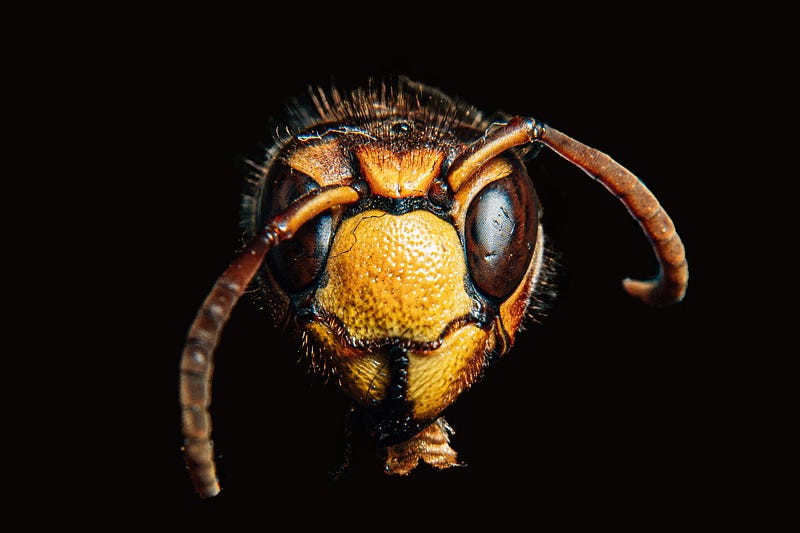
The Murder Hornets are coming.
If you keep quiet, you can almost hear them. Not just the buzzing of their vascular smoke-colored wings, but the creepy creaking of their armored joints. While the world reels from one disaster, we hover on the brink of another. The invasion is coming. Mindless and merciless and heedless of destruction, black-thoraxed phalanxes of murderous insects are coming for us.
I’m not allowed to call myself an entomologist anymore.
That doesn’t mean I’ve forgotten everything I knew. The knowledge is still in there somewhere, gathering dust in some gloomy basal basement of my brain until a hapless headline bumps up against it and shakes something loose.
I’ve heard of these creatures before. Back when they were still called Asian Giant Hornets instead of the more sensational name they go by now. There’s been a rebranding by parties unknown. A punching-up of these aggressive arthropods in the never-ending quest for clicks and eyeballs.
The truth is, all hornets are murderers. Most of us are too.
It started in September.
Late last year, murder hornets were found in Nanaimo on Vancouver Island, the cloud-wreathed mass of mountain and forest that sits off Canada’s wet west coast. They came from Japan, the fading glow of the Land of the Rising Sun encoded in their DNA to tell us where they had been.
Probably they made the long Pacific voyage hidden in some cargo, perhaps some soil at the bottom of a plant. In December 2019, there was a reported sighting in Washington state, and two hornets were found in the town of Blaine close to the Canadian border.
After that, things were quiet. But now that spring has come to the West Coast, entomologists and other bug experts are looking again for murder hornets. In April, the Queens rouse themselves from hibernation and begin digging out an underground nest to lay their eggs. If you see a murder hornet, you are urgently requested to report it to the authorities.
Murder hornets are striking creatures.
Hornets usually are. And you can always count on a murderer for a fancy sartorial style.
The black and yellow color scheme is intended to be noticed, after all. A way of telling creatures like us that an insect is not to be messed with.
But with workers around one and a half inches in length and carrying a stinger a quarter of an inch long, these hornets are twice the size of the wasps we’re used to. They also have a more powerful venom than indigenous species, making them more dangerous.
But how dangerous? To a human, not very. In China, where the hornets are common, it’s recommended to seek medical attention if you get more than 10 stings. Thirty stings is an emergency.
It’s true that these hornets could kill a human, even one who’s not allergic, if they stung the unfortunate person enough times. Then again, that’s true of every bee and wasp that stings. The dosage makes the poison, and even water, so necessary for human life, can be fatal if there’s too much of it.
Murder hornets rarely murder people. But they are dangerous to the already beleaguered bees. The much larger hornets are immune to the defensive stings of honeybees. Once they find a hive, the hornets will wait outside and decapitate bees as they leave the nest. After the adults are gone, the hornets swagger inside to eat the bee’s defenseless young.
It’s horrific in its way. The way that so much life is built on cruelty. But we pick sides in these conflicts when it affects us. Bees make honey for our tea and pollinate the plants that we eat, so we class them as good guys and instinctively dislike anything that threatens them.
Yet our cute, friendly honeybees are also perfectly capable of killing us if they wanted to. But they’re sweet and furry and useful to us in a direct way that hornets are not.
We are entering the season of the wasp.
And these are some of the slowest news days in my lifetime. Bugs are a reliable source of soft news because we have a visceral reaction to them. That’s how I ended up giving some TV interviews in my previous life as an exterminator.
But to listen to the reports about the stupid ‘murder hornets’, you would think we were all on the cusp of being stung to death in a week’s time. Can 2020 get any worse, the headlines ask? Yes, of course it can. It could be 1940. Or 1918. Or 1348. Or 536.
I’m still allowed to call myself a writer.
If only because there’s no one to stop me. And I know the importance of a good headline. Murder hornets tap directly into the fear center of the brain, the ancient part we share with our scaled and gilled ancestors, for whom panic was often an appropriate response to a cruel and homicidal world.
Maybe, as some entomologists fear, murder hornets will establish a presence in North America and add to the long list of problems honeybees have to face. But they won’t be doing any murdering unless you consider predation murder. And if you do, you have to acknowledge that even plants are murderers.
The honeybees aren’t defenceless.
In Japan, honeybees have learned to kill murder hornets by using what has always been a bee’s greatest asset. Cooperation and a complete disregard for personal safety.
When a murder hornet approaches a hive, the defending honeybees pile on top of it. Probably a few get killed on the way in by the hornet’s powerful jaws, but there are always more bees to replace them. Soon, the hornet is immobilized under a pile of bees, who begin to vibrate their wings to generate heat.
A ball of bees can create an inner temperature of close to 46C. In normal circumstances, a hornet could survive that. But the pile of bees also creates a concentration of CO2 that proves lethal to the hornet. The bees, however, can survive it.
Somehow, these tiny creatures that barely even have anything we could call a brain have figured out a weakness in what should have been an unbeatable foe. By working together and being willing to sacrifice, the Japanese honeybees have found a way to protect themselves against predatory monsters.
Instead of panicking and selling each other exaggerated fears, we ought to be more like the bees. Stick together. Be brave. Co-operate. Every monster has its weakness. Every threat can be overcome.