
Creator Spotlight
The Management Strategist Who Wrote For a Year Straight
Roger Martin has written an article on Medium every week for 52 weeks
Writers of all stripes have found countless innovative ways to use Medium — whether that’s creating communities, sharing expertise, posting comics, or making official statements.
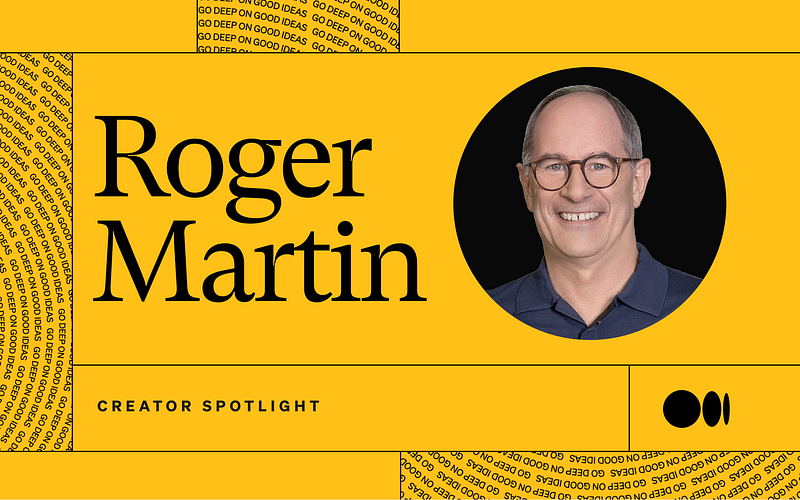
So every month, we’re going to feature a creator who is doing something really cool on the platform. First up: Roger Martin, a writer, strategy advisor, and top management thinker, and co-author of Playing to Win: How Strategy Really Works. As Martin explains here:
I wrote The Role of Management Systems in Strategy … and published it on October 5, 2020. The response was so overwhelming that I decided to write more pieces for Playing to Win enthusiasts who wanted tips on how to apply the framework in practice. The series built a momentum of its own and an increasingly large audience. I established a weekly rhythm and published one Playing to Win/Practitioner Insights (PTW/PI) piece every Monday morning for 52 consecutive weeks: A Year of Strategy.
We wanted to know more, so we asked Roger a few questions via email:
Creators Hub: If someone only read one of your Medium posts, which should it be and why?
Roger Martin: It would be Strategy vs. Planning: Complements not Substitutes. It represents the best of what I try to do with my writing. I try to help readers by giving them a better way of thinking tomorrow about something that vexes them today. Often, they think that the current state is the natural order of things and that they must accept its downsides. I seek to help them recognize that the current state doesn’t have to be. Rather, it can be different and a lot better.
In the case of this article, I attempted to help readers understand that when they are sorely disappointed in what little they gain from doing ‘strategy,’ there is a reason for the disappointment. They are actually engaging in planning, not strategy. Planning is a useful complement to strategy but it most certainly not a substitute.
I loved the reactions to the post. There was lots of appreciation for clarifying something that perplexed and frustrated them previously.
What made you want to write the stuff you’ve been writing?
It was the overwhelmingly positive reaction to my 11th Medium post — and first in what came to be the Playing to Win/Practitioner Insights series. The post was inspired by a client’s question. He liked the post a lot because it answered the question that was perplexing him. But lots of other readers liked it too. So, I thought that I should write more on the practical application of the Playing to Win framework that I had laid out, with co-author AG Lafley, in our 2013 book Playing to Win.
Medium readers kept appearing to enjoy and find the pieces helpful, so I kept on writing. As I built momentum, I got psyched about the idea of doing one per week for an entire year — and just did it. It was a big expenditure of time because the task is in addition to a very busy day job. But it was a fun challenge — could I produce one 1600-word (on average) piece for publication every Monday morning? And it turned out that I could!
What are the last 3 profiles you’ve followed on Medium?
This is one of my weaknesses. I write too much and read too little. I don’t actively follow anyone — my bad. If I did, I would follow Scott Galloway. People occasionally send me his pieces and he is full of insights — many of them counter-intuitive, which is always both helpful and entertaining.
How did you manage to write so much, so frequently? How did you avoid blocks and burnout?
Probably the main reason is that I really enjoy it. And last time I checked, no one gets burned out doing something that they really enjoy. They get burned out doing things they feel that they have to do.
In addition, I buy the argument that some of the folks at Harvard Business Review (HBR) have made about me. They call me a unicorn because most people either have ideas but can’t write well or, alternatively, they can write well but don’t have ideas. They say I write well and have ideas galore, which is why I have written the most HBR articles in the 21st century. I think that I appear to write well because I am always game to be edited or to edit myself. I don’t think of what I have written as precious. I know it can always be better, so I keep on improving it through multiple rounds of edits.
In terms of the flow of ideas, they all come out of my practice — which is advising CEOs on strategy and management in general. At any given time, I am advising about a dozen CEOs and have been doing so for 40 years. They have things that annoy, worry, and confuse them. The issues that arise from multiple CEOs are the ones that I am most inclined to write about. There are always plenty of those ideas.
If instead I sat at my desk all day thinking about what to write, I would quickly run out of ideas to write about. That is why I think that many business academics don’t have many good ideas. They don’t interact with businesspeople enough to figure out what is useful to them.
So, I have a flow of ideas, love writing and am game to edit until the stuff is good enough for Medium readers to read.
What’s the best piece of writing and/or creativity advice you’ve ever gotten?
The most important advice I ever received on writing was from a fellow named Bernie Avishai, a great writer/editor and friend, to whom I was complaining about how much editing my writing took. He observed that the reason that I was complaining about editing was that I probably believed that I thought in order to write. My response was “Duh, of course, I think in order to write.” Bernie explained that instead, one writes to think. The human mind can only think so much without seeing a written manifestation of its thinking. You need to write down your thinking, however primitive, in order to be able to look at it and say: “That is not quite right.” Then you will be able to figure out how to make it better. And then by looking at the resulting improvement, you will be capable of saying: “That is still not quite right.” And so on, until it is a much more sophisticated view of your thinking.
The lesson for me is that editing is a feature of the writing process, not a bug. Now, I don’t begrudge editing. I realize that it is just part of the process of helping me think. I love the process of editing! Nothing that anyone sees from me on Medium has been edited less than a dozen times. Each time, it is a slightly better expression of what is in my head.
If you could write any book, what would it be called?
It is a book that I will write someday. It will be called Why Things are the Way They are, and not Some Other Way. I have made my life’s work, such as it is, to help people, and the organizations in which they work, change for the better.
But when it comes to achieving change, there is much more frustration than success. My view is that a key reason for the modest record of success is that the status quo is much more tenacious than those leading the change believe it to be. They imagine an exciting future and create plans to make it happen. And they imagine that the change will just happen because they have a plan for making it so.
But they just don’t understand thoroughly enough why things are the way they are. And they are always the way they are for a reason — not just by accident. To bring about change, that needs to be clearly understood. It needs to be understood to the extent that you know, and know clearly, why things are not some other way.
Only then can you take the steps that you need to take to unwind, to overcome, the things that currently exist — by understanding why they are the way they are — and start building toward the future that you want. The book will explain how to diagnose the dynamics of the now in order to create the future.
Follow Roger Martin for more! And be sure to stay tuned to Creators Hub for next month’s Creator Spotlight.


