avatarLinda Acaster

Free AI web copilot to create summaries, insights and extended knowledge, download it at here

3370

Abstract

him volunteers, and four years after first visiting the dilapidated site, <a href="https://www.houghtonstmarys.org.uk/"><b>The Friends of St Mary’s</b></a> was formed. With the ivy gone, a new pantile roof on the nave, and money being raised for replacement windows, cleaning work could start on the inside.</p><p id="928d">The decaying plaster walls were covered in a green sludge-like mould, which had to be scrubbed clean to view the extent of the damage. When a piece of plaster fell away, as Bob put it, “…the first thing I saw was the head of an angel.”.</p><figure id="ea97"><img src="https://cdn-images-1.readmedium.com/v2/resize:fit:800/1*u1QE7bxAzvRqzPris_tz6A.jpeg"><figcaption>Click for a larger image. Left of the chancel doorway, an archangel blows a trumpet on Judgement Day and the Blessed rise from their graves. Every face is different, yet all have been depicted with almond-shaped eyes, in the Byzantine style. Photo by author (2018)</figcaption></figure><p id="773a">Up until the Reformation in the late Tudor period, the plastered walls of British churches were used as instructional tools by depicting stories from the Bible. Seen in the flicker of rush- and candle-light, they added weight to sermons and the rituals of the Church for a mainly illiterate congregation.</p><p id="399a">Upon the Reformation, when the country shifted from Catholicism to Protestantism, most church walls were limewashed, which would not have protected the paintings against the elements. At St Mary’s the walls had been replastered, at least twice, hence the uniform holes used as a key to bond the new plaster to the old. Bob had seen a fragment of a medieval wall painting. Beneath the top greened layer of plaster, the layer that covered the angel was found to hold large-scale post-Reformation texts dating from the Elizabethan period, which the then mainly literate congregation could read.</p><p id="c6e6">DIY work on the church stopped immediately as the authorities finally took notice. A lottery grant was secured and conservation experts came to work on the plaster. Beneath the Elizabethan texts, and wall paintings from the 14th, 13th and 12th centuries — five layers in all — are believed to be the oldest Romanesque wall paintings in Britain, dating from the Saxo-Norman period.</p><figure id="9880"><img src="https://cdn-images-1.readmedium.com/v2/resize:fit:800/1*rqMyziJRzEC5GWsMJZ_xwA.jpeg"><figcaption>Part of a frieze to the left of the chancel doorway. All figures hold… experts are divided, perhaps scrolls, or dead snakes symbolising Good having conquered Evil. The figure on the far right is considered to be Jesus. He’s the only one facing forwards, to the congregation, the rest look towards him. Beside him is Peter, painted with a miserable expression after denying Jesus prior to the crucifixion. Image by author (2018).</figcaption></figure><p id="39de">Spread across the wall leading to the chancel is a depiction of the Last Judgement. The Holy Trinity is set within a triple mandorla, with God enthroned holding the crucified Christ, and a dove denoting the Holy Spirit. To God’s right, our left, the blessed rise naked from their graves on a trumpet call from an archangel. To God’s left, our right, the damned are ushered down to Hell. The colours, now faded to pastel, would have been vivid at the time.</p><figure id="59a7"><img

Options

src="https://cdn-images-1.readmedium.com/v2/resize:fit:800/1*9piDHtoQROWkzY4bUlZCEA.jpeg"><figcaption>The triple mandorla in which is shown the badly eroded Trinity. Note the Blessed in Heaven outside the left base of the curved mandorla giving adoration. Follow the in-line links for better, copyrighted, images. Photo by the author.</figcaption></figure><p id="7f4c">As work progressed, more paintings came to light on other walls: God creating Eve from Adam in the Garden of Eden; Noah’s Ark, looking less the accepted shape we recognise and more like a Viking ship; and the Wheel of Fortune/Wheel of Life. There may be more, but to find them would destroy others. Perhaps in time technology may offer an answer. More important to Bob, the church returned to Christian worship, and as a Chapel of Ease it welcomes all denominations.</p><p id="6ba8"><a href="http://www.saintmaryschurch.uk/"><b>The Church of St Mary the Virgin</b></a> slowly revealed its lineage. A search of manuscripts proved that a wooden church had been on the site in 639AD. The 8th century cobble-built nave was found to incorporate tiles and dressed stone from a Roman villa discovered by archeologists in the valley below. This incarnation of the church had a rounded apse behind its altar, now marked in cobbles in the grass, as is a demolished later aisle. Its round Saxon tower was replaced in the 14th century with the more fashionable square tower seen today.</p><p id="ce51">Despite its church, Houghton-on-the-Hill had never been a large village and, as the centuries passed, the congregation dwindled. There were only two marriages in the 1920s, a single christening in the 1930s. The last service was probably in 1944 for USAAF servicemen stationed at a nearby airfield who used the tower as a sighting point back to base. When the final cottage was demolished, leaving only a nearby farm, the Diocese scheduled the building for deconsecration and demolition — and thankfully forgot about it.</p><p id="c837">Gloria Davey died in 2006; Robert Davey MBE followed in March 2021, aged 91 years. Their ashes are buried in the churchyard of St Mary the Virgin, Houghton-on-the-Hill. Little did Bob realise when he began to cut through the undergrowth to reveal the building, that he would give so many years to its preservation, or be rewarded for his persistence and determination in such historic fashion.</p><p id="8f81">But, as he once observed when interviewed, “You’ve got to do something when you retire. You can’t just sit about or play golf.”</p><p id="3e72">My husband and I, on a driving holiday in Norfolk in 2018, passed a small brown roadsign pointing down a narrow lane: ‘To Ancient Church’. It wasn’t on our schedule. But we passed it again. And again. At which point we looked at each other and decided to follow the sign. Just as Gloria followed her sign, and Bob followed his. I’m not a believer, but it is interesting to muse on how these things seem to work. It is certainly a place I shall remember.</p><p id="34ea">Thanks for your interest in reading this story. <a href="https://linda-acaster.medium.com/subscribe">Sign up to my <b>newsletter</b></a> to be notified of new stories without having to hunt for them; back stories, especially History stories, can be found in my <a href="https://medium.com/@linda-acaster/lists"><b>Lists</b></a>.</p></article></body>

Satanists 0 — God’s Servant 1

To be rewarded with Treasures from Heaven
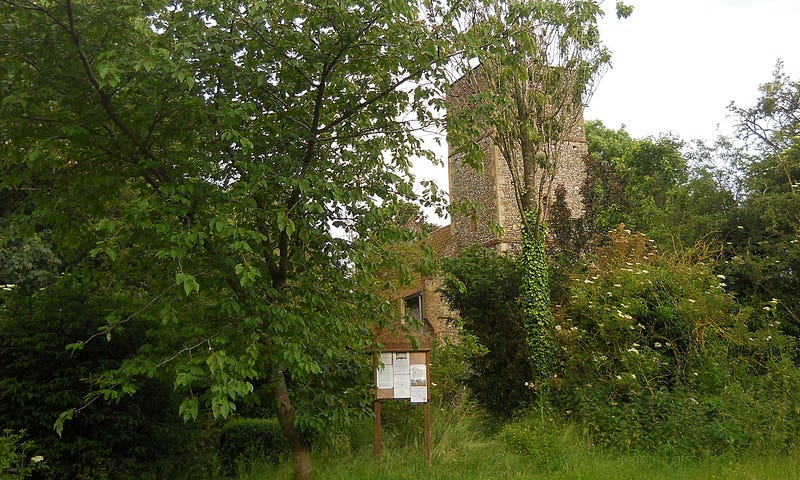
Even today Nature embraces the Church of St Mary the Virgin at Houghton-on-the-Hill, Norfolk, England (Image (c) Linda Acaster)

Appearances can be deceptive —landscapes, buildings, people — and at Houghton-on-the-Hill in Norfolk, England, all three quietly came together.

On their retirement, Bob and Gloria Davey moved to North Pickenham for the quintessential quiet village life. They joined the congregation of the local church where Bob became a bell-ringer and churchwarden. Gloria embraced the community spirit, and explored the surrounding countryside with a rambling group.

It was in 1992, while enjoying such an excursion, that through an overgrown hedge Gloria saw the shape of a church tower covered in ivy. Out of briars and waist-high nettle-beds, headstones peeped. A church from a lost medieval village, perhaps? She followed an animal track which, oddly, led to a broken door. Squeezing inside, she found the reason for the human track: the roofless ruin was being used by satanists, even to the extent of desecrating the grave of an 18th century rector interred in the nave. Once home, she informed her husband.

Bob Davey was outraged. Impelled to stop such sacrilege, he was appalled when the Church of England authorities did not agree, despite the property remaining consecrated ground.

Faced with the Church’s apathy and lack of help from other quarters, Bob took matters into his own hands. He organised a service of purification for the body of the church, and he and Gloria began clearing the graveyard of briars.

The satanists, however, were not to be dissuaded. Bob Davey stood his ground, even to guarding the church alone overnight when they were expected. They, in turn, made a visit to his home to warn him off by showing they knew where he lived. On another occasion he was involved in a near miss ‘accident’.

A pensioner, Bob Davey wasn’t a tall, robust man, but he had the determination of an Old Testament prophet, and a white beard to match. No one was going to deter him. Word spread. Members of the local Territorial Army unit used the churchyard for a ‘camouflage exercise’, choosing a known date. The satanists moved on.

It was with the TA’s help that the roots were cut to the ivy covering the tower, and the inside of the church cleared of debris. Bob then went on a fund-raising drive to have the nave re-roofed, sinking much of his and Gloria’s retirement savings into the project. As he later explained, “Put your own money in, and people start taking notice.”.

However, a lack of vehicular access was hampering efforts. Bob immersed himself in research. By law, a consecrated site could not be denied access. So he built one of crushed concrete, uphill, along the edge of a field, using a wheelbarrow and shovel. It took him three months. He later told an interviewer that it was seven-eighths of a mile.

Bob’s resolute attitude finally gained him volunteers, and four years after first visiting the dilapidated site, The Friends of St Mary’s was formed. With the ivy gone, a new pantile roof on the nave, and money being raised for replacement windows, cleaning work could start on the inside.

The decaying plaster walls were covered in a green sludge-like mould, which had to be scrubbed clean to view the extent of the damage. When a piece of plaster fell away, as Bob put it, “…the first thing I saw was the head of an angel.”.
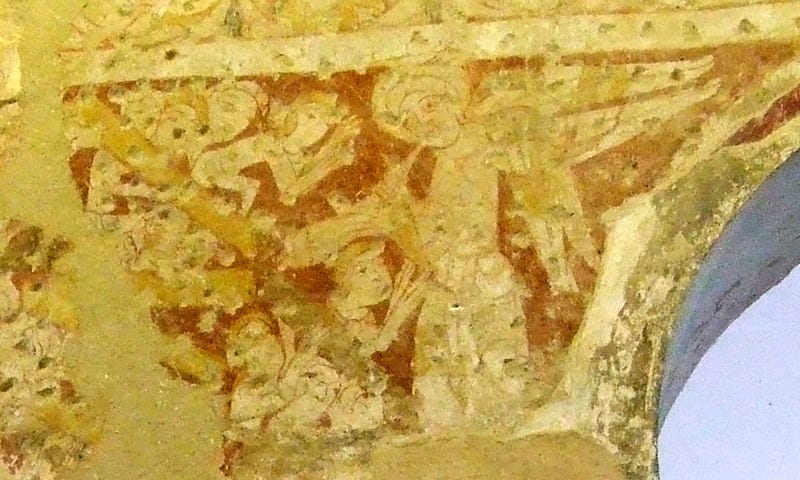
Click for a larger image. Left of the chancel doorway, an archangel blows a trumpet on Judgement Day and the Blessed rise from their graves. Every face is different, yet all have been depicted with almond-shaped eyes, in the Byzantine style. Photo by author (2018)

Up until the Reformation in the late Tudor period, the plastered walls of British churches were used as instructional tools by depicting stories from the Bible. Seen in the flicker of rush- and candle-light, they added weight to sermons and the rituals of the Church for a mainly illiterate congregation.

Upon the Reformation, when the country shifted from Catholicism to Protestantism, most church walls were limewashed, which would not have protected the paintings against the elements. At St Mary’s the walls had been replastered, at least twice, hence the uniform holes used as a key to bond the new plaster to the old. Bob had seen a fragment of a medieval wall painting. Beneath the top greened layer of plaster, the layer that covered the angel was found to hold large-scale post-Reformation texts dating from the Elizabethan period, which the then mainly literate congregation could read.

DIY work on the church stopped immediately as the authorities finally took notice. A lottery grant was secured and conservation experts came to work on the plaster. Beneath the Elizabethan texts, and wall paintings from the 14th, 13th and 12th centuries — five layers in all — are believed to be the oldest Romanesque wall paintings in Britain, dating from the Saxo-Norman period.

Part of a frieze to the left of the chancel doorway. All figures hold… experts are divided, perhaps scrolls, or dead snakes symbolising Good having conquered Evil. The figure on the far right is considered to be Jesus. He’s the only one facing forwards, to the congregation, the rest look towards him. Beside him is Peter, painted with a miserable expression after denying Jesus prior to the crucifixion. Image by author (2018).

Spread across the wall leading to the chancel is a depiction of the Last Judgement. The Holy Trinity is set within a triple mandorla, with God enthroned holding the crucified Christ, and a dove denoting the Holy Spirit. To God’s right, our left, the blessed rise naked from their graves on a trumpet call from an archangel. To God’s left, our right, the damned are ushered down to Hell. The colours, now faded to pastel, would have been vivid at the time.
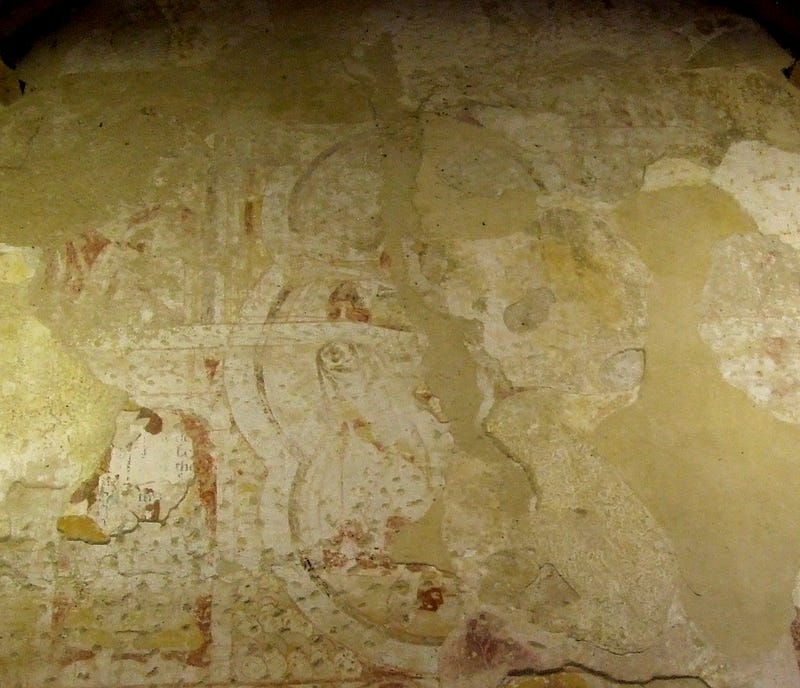
The triple mandorla in which is shown the badly eroded Trinity. Note the Blessed in Heaven outside the left base of the curved mandorla giving adoration. Follow the in-line links for better, copyrighted, images. Photo by the author.

As work progressed, more paintings came to light on other walls: God creating Eve from Adam in the Garden of Eden; Noah’s Ark, looking less the accepted shape we recognise and more like a Viking ship; and the Wheel of Fortune/Wheel of Life. There may be more, but to find them would destroy others. Perhaps in time technology may offer an answer. More important to Bob, the church returned to Christian worship, and as a Chapel of Ease it welcomes all denominations.

The Church of St Mary the Virgin slowly revealed its lineage. A search of manuscripts proved that a wooden church had been on the site in 639AD. The 8th century cobble-built nave was found to incorporate tiles and dressed stone from a Roman villa discovered by archeologists in the valley below. This incarnation of the church had a rounded apse behind its altar, now marked in cobbles in the grass, as is a demolished later aisle. Its round Saxon tower was replaced in the 14th century with the more fashionable square tower seen today.

Despite its church, Houghton-on-the-Hill had never been a large village and, as the centuries passed, the congregation dwindled. There were only two marriages in the 1920s, a single christening in the 1930s. The last service was probably in 1944 for USAAF servicemen stationed at a nearby airfield who used the tower as a sighting point back to base. When the final cottage was demolished, leaving only a nearby farm, the Diocese scheduled the building for deconsecration and demolition — and thankfully forgot about it.

Gloria Davey died in 2006; Robert Davey MBE followed in March 2021, aged 91 years. Their ashes are buried in the churchyard of St Mary the Virgin, Houghton-on-the-Hill. Little did Bob realise when he began to cut through the undergrowth to reveal the building, that he would give so many years to its preservation, or be rewarded for his persistence and determination in such historic fashion.

But, as he once observed when interviewed, “You’ve got to do something when you retire. You can’t just sit about or play golf.”

My husband and I, on a driving holiday in Norfolk in 2018, passed a small brown roadsign pointing down a narrow lane: ‘To Ancient Church’. It wasn’t on our schedule. But we passed it again. And again. At which point we looked at each other and decided to follow the sign. Just as Gloria followed her sign, and Bob followed his. I’m not a believer, but it is interesting to muse on how these things seem to work. It is certainly a place I shall remember.

Thanks for your interest in reading this story. Sign up to my newsletter to be notified of new stories without having to hunt for them; back stories, especially History stories, can be found in my Lists.

Church
Religion And Spirituality
History
Inspiration
Illumination
Recommended from ReadMedium