
The Major Airline That Offered Men Only Executive Flights For Nearly Two Decades
Cigars, bare feet, special gifts and no women allowed was the norm on special Executive flights for two decades
Airlines offer varying levels of flight accommodations with the intent of drawing more customers. Naturally, these have changed over the years, but could look very different in the past. For instance, for nearly two decades, United Airlines offered a regular Executive ticket from New York and Newark to Chicago, which provided First Class accomodations, all while simultaneously banning female passengers from these flights.
Jake Rosen of Mental Floss reported on the history of the chauvinistic Executive flights. Offered between 1953 and 1971, United offered a flight on all evenings except Sundays at 5 p.m. from New York City or Newark, New Jersey, which traveled to Chicago (and back). It was specifically designed for commuting. Only the high salaried would be going back and forth between these cities for work, so it was intentionally fashioned as a “good old boys” club, complete with extensive amenities and no women allowed. This was all vetted and approved by the Civil Aeronautics Board.
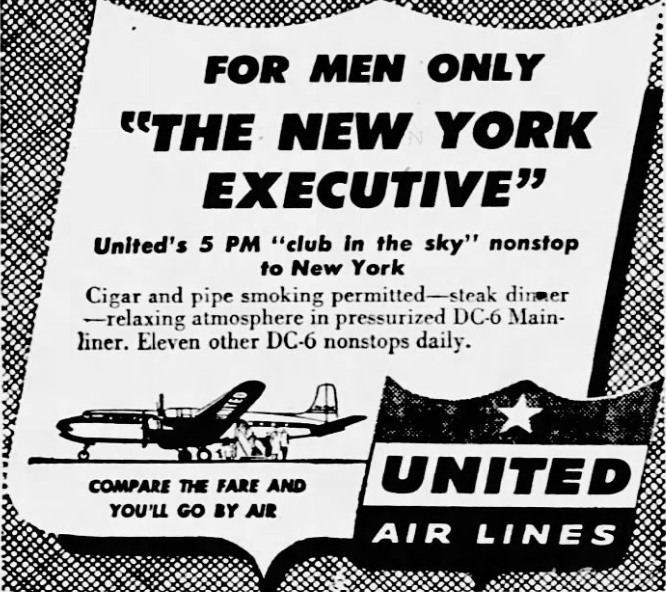
United boldly advertised these flights as “A Club in the Sky — For Men Only.” The Wall Street Journal was even involved as a branded partner for a time.
Furthermore, in 1954, one of the company’s representatives explained the reasoning behind the Executive flights:
“What we give men is an opportunity to get away from women. We don’t regard it as segregation. We regard it rather as a little luxury…
“As soon as a man gets in the plane, he can take off his coat and vest, if he wants to. And we give him a pair of slippers, so he can take his shoes off, too, and really relax. What results is a kind of smoking-car atmosphere. A passenger can smoke a cigar or his pipe, if he likes. He can’t do that on other flights. A lot of women object to sitting next to a man smoking a pipe; a lot of men object, too. Let those men ride with the women.”
Passengers who paid the $67 fare (In 1960, the average American weekly income was about $100) could take off their ties and shoes while enjoying cigars and cocktails. Onboard amenities included stock market quotations, work desk stations for those who still had to keep working, and even special gifts for passengers upon landing, such as glass ashtrays and cufflinks with built-in watches.
Less than a year after its launch, the Executive Flight could already claim success, with 19,500 passengers having taken to the skies with these special tickets. Some touted other perceived benefits of the seats being reserved exclusively for men. Notably the potential distraction of children were also absent.
Unsurprisingly, the exclusion of women from Executive flights sparked criticism and complaints. In 1958, Edythe Rudolph Rein, a vice president for National Telefilm Associates, was seeking to get on the next flight to New York, but was denied a ticket due to the men-only policy, leading her to file a complaint with the Civil Aeronautics Board. Incredibly, when she was trying to get on one of the segregated flights, United allegedly attempted to put her off by telling her that the cigar smoke and odor of feet from so many men with their shoes off would make her experience unpalatable.
Finally, the National Organization for Women (NOW) started to picket United Airlines’ headquarters in Chicago, and filed complaints with the Civil Aeronautics Board about the Executive flights. Additionally, they occupied a men-only bar, to help highlight the absurdity of gender-based discrimination.
Facing pressure from NOW and declining ticket sales, United Airlines announced the end of the Executive in January 1970. Although the airline attributed the decision to slow ticket sales and changing customer tastes, NOW’s activism played a clear and substantial role in challenging and dismantling this discriminatory service.
For those of us who fly and don’t have access to First Class or Members Only lounges, there’s arguments to be made that some degree of aviation segregation still exists. However, it was once much more blatant; where women were prohibited from being on special flights all under the ridiculous notion that banning them would make the experience more memorable for men.