
The Magical Concept of Expected Value
Several years ago, someone asked me what would be the one concept in mathematics that more people should know. After thinking it over for a minute, I came up with my answer: expected value. Expected value is a concept in probability and statistics that allows you to put a numerical value on an unknown quantity. It allows you to say something specific about something that is inherently vague. Allow me to explain.
Expected value is defined as follows: suppose we have a random variable Y. Suppose the possible values of Y are v₁, v₂, … vn. Let p₁ be the probability that Y = v₁, p₂ be the probability that Y = v₂, etc. The expected value of Y, denoted E(Y), is defined as v₁p₁ + v₂p₂ + … + vnpn. The expected value of Y represents the center (the mean) of the distribution of the variable Y. As such, it represents the value that you would expect Y to take on — hence the name “expected value”.
An example is necessary. Let’s say you’re gambling at a casino, and let’s say that the game is set up such that you can either win $100, lose $1, or lose $5, but the probability that you’ll win $100 is only 1%. And let’s say there’s a 49% chance that you’ll lose $1 and a 50% chance that you’ll lose $5. The expected value of your winnings (Y) is given by E(Y) = 100*0.01 + (-1)*0.49 + (-5)*0.5 = -$1.99. So your expected winnings are -$1.99. In other words, you are expected to lose $1.99.
It was no accident that the expected value was negative. Casinos deliberately set up their games to have negative expected value, because that’s how they make money. They know that as long as the expected value is negative and enough people play, then they will make money.
In that example, there were just three specific values that the variable (your winnings) could take on. You were going to get either $100, -$1, or -$5. But in most real-world applications, that’s not the case. In most situations, the possible values of the variable form a continuous interval, not just a few discrete numbers. In other words, in the real world, most random variables are continuous rather than discrete. As such, we have to redefine expected value for a continuous variable.
If Y is continuous, we have to use calculus to define the expected value. We also have to use the concept of a probability density function, f(y), which expresses the relative probability that Y might fall in some interval.
The most famous probability density function is that of the normal distribution — the famous bell curve:
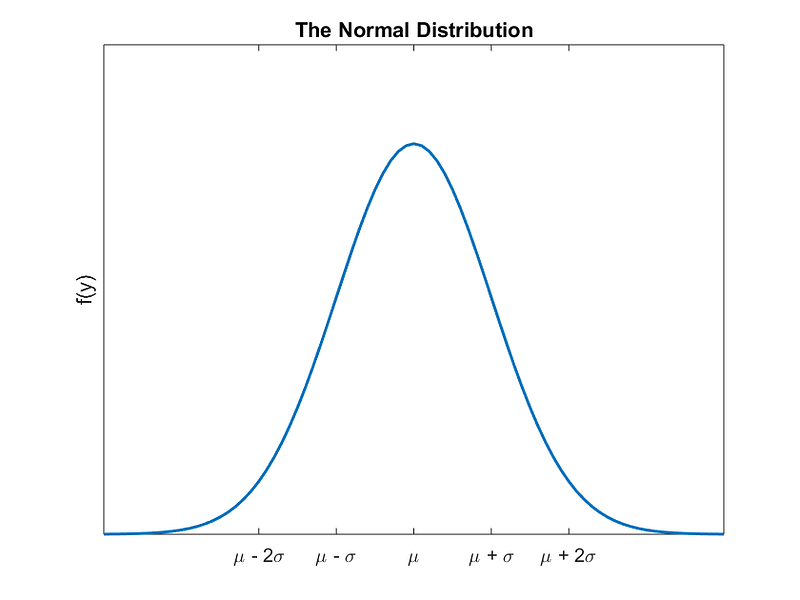
So for this distribution, the expected value is μ. It is very likely that Y will fall within 2σ of μ. The farther you go away from μ, the less likely it is that Y will land there. The function f(y) shows where Y is more likely or less likely to fall.
Once we have f(y), we can compute the expected value: for a continuous variable, Y, E(Y) is defined to be
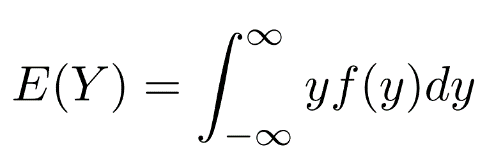
If you didn’t understand that equation, don’t worry: you can just think of it as the continuous analog of the discrete form of the equation: E(Y) = v₁p₁ + v₂p₂ + … vnpn. The purpose of using calculus was just so that we could still define and understand the concept of expected value even when Y is continuous. And again, the expected value represents the center of the probability distribution.
Now that we’ve expanded the concept of expected value to include continuous variables, we can continue of our discussion of how it is used in real life.
Any time you make an estimate of an unknown quantity, you are, in some sense, using the concept of expected value. This is especially true when the unknown quantity is the outcome of a future event. One very common example of this is when you estimate your time of arrival. Let’s say you tell someone, “I’ll be home at six-ish.” To translate that into mathematical terms: “My time of arrival is a random variable. Its expected value is 6:00.” Or let’s say you have to take an exam tomorrow, and you don’t feel prepared for it, and you tell your friend, “I’m gonna get, like, a 50.” In mathematical terms: “My grade on tomorrow’s exam is a random variable. Its expected value is 50.” (By the way, we humans are remarkably bad at estimating these expected values.)
But there is one real-world situation in which the concept of expected value is especially useful. I’m talking about arguments about alternative history. People are always having arguments about what might have happened if someone had done something differently in the past. These debates are usually difficult to resolve because alternative history is so speculative, and different people can come to very different guesses about what might have happened.
However, if you use the concept of expected value, the exact nature of what is being debated becomes so much clearer, and it becomes a little easier to make a guess about what might have happened. Allow me to explain.
Let’s say you were having a discussion with your parents about their regrets in life. Let’s say your dad said, “I would’ve made more money if I had gone to grad school.” Your mom might respond, “Nah, that didn’t make any difference — you would’ve ended up in the same position anyhow.” This debate would go on for a while, until eventually one of them would say, “Well, we’ll never know because it didn’t happen.”
But if we use the concept of expected value, it doesn’t seem so foggy, because we can identify the crux of the argument. Let’s rewind to the time when your dad was young and was making a decision. He had two choices: go to grad school or don’t go. For either choice, there were still thousands of ways that the future of his life might have turned out. That means we can define two random variables: let Y be the amount of money he would end up making if he went to graduate school, and let Z be the amount of money he’d make if he didn’t go. The question is: which is higher, E(Y) or E(Z)? If E(Y) is significantly higher than E(Z), then your dad is right: he should’ve gone to grad school. But if E(Y) and E(Z) are approximately equal, then your mom is right: it wouldn’t have made any difference.
To be sure, there’s still no way to know for sure whether or not E(Y) is significantly higher than E(Z). But by using the concept of expected value, we make the relevant question so much more specific, such that debates about alternative history no longer seem so foggy. It no longer seems like you have to say, “Well, we’ll never know.” The concept of expected value allows you to take something that seems foggy and put a specific number on it. That’s what makes it such a great idea.