
The Magic of Handwriting
Tomorrow’s thinkers should still be using pen and paper.

While the world is coping with a pandemic, more and more people are relying on digital solutions for writing, drawing and expressing themselves. The general trend for writing on paper has been declining since the advent of digital media. Newer generations don’t bother doodling thoughts anymore.
I used to be the same: eager to use the most modern gadget as I considered holding a pen and paper to be too dull. During my apprenticeship as an Architectural Draughtsman in Switzerland, I wanted to use AutoCAD. It was the summer of 1997.
Our workstations had no mouse, just a keyboard where you could type in formulas and coordinates with high precision to plot out detailed plans and backed up daily on tapes.
To this day, I still remember what my employer once advised me: “Before you use the computer, you’ll need to learn how to do it properly on paper by hand.” — I’ll treasure this advice for life.
I had to endure a rigorous preparation for six months drawing everything by hand on my plans, with no space for errors or smudges. A mistake would cost me starting again from scratch. It was not a pleasant experience, but it taught me a valuable life lesson. I learnt to work hard, not take things for granted and be appreciative for what I have.
“Before you use the computer, you’ll need to learn how to do it properly on paper by hand.”
After the practice, my reward was waiting there for me: a dusty used computer. Transitioning from paper to a keyboard was seamless. The formulas and the way of working were mostly the same. The main benefit is that I could undo mistakes now. It was pure joy for me: the freedom of trying and failing, over and over again.
Still, I kept on writing stuff on paper, doodling ideas, jotting down notes. It is a healthy habit rooted deeply in my mind from an early age.
Writing unlocks your mind.
There is an ancestral feeling happening when you wiggle your pen on a piece on paper. Your mind releases it’s full potential when you can physically touch your thoughts. The synaptic connections triggered are much more profound when your body is engaged in elaborating an idea on paper rather than pushing buttons or tapping on a screen.
My ex-teacher once told me:
“Smart people write in cursive. Simple-minded people write in block letters.” — Quiet a harsh statement at the time, but he had a point!
Recent research has highlighted that cursive handwriting helps overcome dyslexia. Marilyn Zecher, a language specialist at the Atlantic Seaboard Dyslexia Education Center, wrote an article about the study.
A pen boosts your artistic side.
Creativity finds a whole new space where not only can you pin down thoughts with words, but you can also complement them with drawings.
Most creatives prefer sketching on paper before moving their work into digital. There is no wonder the market overflows with all sorts of digital pens trying to mimic the same feeling you get when brushing your lines on a real canvas.
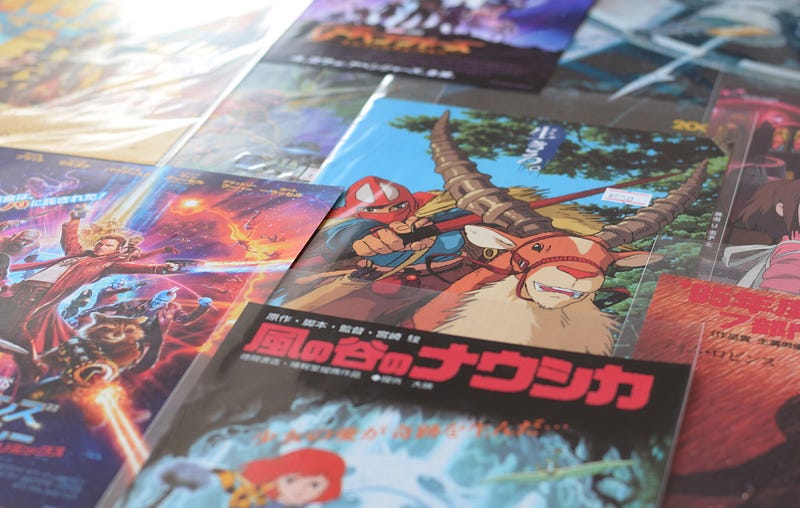
Hand-drawn pictures are still pretty much treasured, despite CGI movements that can enrich art when appropriately used. Hayao Miyazaki has shown us it’s possible to celebrate hand-drawn animation and enhance it with digital media in quite a few of his masterpieces.

Curating a journal can heal you.
There is nothing more cathartic than expressing your feelings with words. It makes you more aware of yourself, of your worries and your desires.
Capturing all that noise allows you to manage depression, anxiety and stress. You’ll shift your point of view and get a better perspective of your inner self.
Having a daily journal helps your mental health and to get a sense of reality. You’ll channel your energy more productively and benefit from a calming effect when expressing your thoughts. Check out the greatness and gratitude journals for inspiration.

Taking notes sharpens your focus.
Have you ever attended a design studio with lots of colourful handwritten post-its scattered on the board?
“Brain dumps!” — That’s how my colleague defines them.
You just got an idea, and you jot it down on a post-it. Everyone in the team does the same and whacks it on the wall. That’s the quickest way to converge ideas from different minds into one single place. We selected and elaborated those ideas further as a blueprint for our project.
Could you do this online without physically writing it down as a team? Maybe. One of the reasons we miss going to the office is the lack of white-boarding and the depth of interaction these sessions have.
Scribbling stuff in person is still so much more fun than dragging a mouse.
Did I tickle your curiosity? Here’s a little advice from a millennial that has seen the digital revolution.
Put down your phone, grab a pen, start writing, scribbling, doodling. Whatever inspires you! It does not cost you anything, and the benefits are tremendous.
If you got kids, get them interested in handwriting. They’ll become smarter adults one day.


