The Lure of the Crypto Succubus
Don’t buy any cryptocurrencies — they are all elaborate Ponzi schemes


Nearly every popular cryptocurrency, including Bitcoin and Ethereum, are elaborate pump and dump schemes, where new naive buyer victims pay off promoter sellers.
While 55% of crypto investors don’t have a college degree, several other victims are highly intelligent engineers who have been misled on how finance and governance work in the modern world.
First, Some Basics..
The underlying technology behind every cryptocurrency is called Blockchain.
A blockchain is a distributed database that is shared among the nodes of a computer network.
Bitcoin and other cryptocurrencies merely use blockchain as a means to transparently record a ledger of payments. These ledgers are distributed across the nodes of a computer network. In order to confirm a payment transaction, the network of nodes expends effort to solve an arbitrary mathematical puzzle. The transaction is then appended to the blockchain and updated across the network.
Blockchain can, in theory, be used to immutably record any number of data points, like votes in an election, product inventories, state identifications, deeds to homes, and much more, and is considered a breakthrough technology.
If Blockchain is a breakthrough technology, then why are cryptocurrencies worthless?
The value of an underlying datapoint like a contract, deed, or votes in an election doesn’t increase based on how the data point is recorded. (The value may decrease, though, if record-keeping is poor). Similarly, crypto tokens — Bitcoin, Ethereum, and such— whose transactions are recorded using these blockchains don’t derive any value from the utility of transparent and distributed blockchain ledgers.
Bitcoin supply is limited to 21M coins but the SHA256 technology behind the blockchain is open and is not patented or copyrighted. Anyone can implement a blockchain similar to bitcoin. There can be an infinite number of such blockchains with a limited or unlimited number of tokens per blockchain.
The price of a demand limited, but supply unlimited product or service should tend to zero, which is the inherent value of any cryptocurrency token.
Anyone can build anything but they don’t.
True, but the intellectual property behind products like cars, smartphones, and such are protected through trade secrets, patents, copyrights, supply chain deals, and such, which makes it hard for anyone to replicate these products—a high barrier for entry. Such barriers don’t exist to build a new cryptocurrency.
Blockchain technology is open source and anyone can build their private blockchain and create an infinite number of private tokens with ease, which makes these tokens worthless.
There is quite some R&D going on around various blockchain applications, and many of these applications use their own private blockchains and private tokens.
How then to explain the current crypto prices?
The value of cryptocurrencies is solely what its buyers ascribe to it and nothing inherent.
Transparency of blockchain ledgers offers good insights into crypto buyer and seller patterns. Crypto HODLers (“Hold On for Dear Life”) provide short-term support for cryptocurrency prices by creating an artificial shortage of sellers. FOMO (“Fear of Missing Out”) buyers induce price spikes and often cash out at loss when momentum stalls.

Promoters of many crypto schemes (a.k.a. “whales”) appear to be using several time-tested network marketing and religious indoctrination techniques to put together a band of fanatic believers to be HODLers to retain value until the whales can cash out. Truly ardent crypto believers hope that the longer they can maintain the congregation of believers HODL’d, someone will find a real utility for cryptos and the scheme will not unravel.

Sadly, this is how nearly all network marketing-driven Ponzi schemes also work. These schemes all retain their stored value well until HODLers give up and start a bank run on Ponzi assets.
How is this different from the valuation of Gamestop or AMC or such meme stocks?
Stocks like GameStop or AMC are priced well above their inherent value.
However, once stock is overpriced, smart CFOs issue shares that raise the low bar of the value of the stock or provide the company with enough capital to purchase another undervalued business that adds to the value of the company. Cryptos cannot raise their low bars by issuing new equity or through acquisitions.
Can Cryptocurrencies provide freedom from oligopolistic governmental control, overreach, takeovers, and sanctions?
No, they can’t.
Several libertarians who despise governmental authority are often victimized into believing that cryptocurrencies are free of oligopolistic control, while in reality, any cryptocurrency, once it reaches a certain size, will require organization and hierarchy that is less likely to be democratic and more likely to resemble the nobility and fiefdom of dark ages, where the rich (whales) call the shots.

Wealth inequality is higher in the crypto world than in the fiat world
Some of this administrative or power overreach is evident during the Russia-Ukraine conflict. Principled crypto advocates have been at odds with those who want to boot all Russian exchanges from the ecosystem, as a highly advertised purpose of why cryptocurrencies exist — freedom from arbitrary sanctions or financial lynching — is being challenged.
Even successful bottoms-up collaborative movements like Linux and Wikipedia have eventually evolved bureaucratic structures that resemble that of elected governments and crypto ecosystems will follow suit if they can sustain to grow big enough.
Read more of my articles by joining medium with a membership
Can’t cryptocurrencies evolve into a Linux or Wikipedia-like movement?
Yes, they can.
Certain digital currencies, like the digital version of fiat currencies, have the potential to unlock the value hoarded by established financial clearinghouses, if properly regulated. Cryptocurrencies can motivate their establishment in mainstream finance.
For instance, many of the financial systems are so arcane that clearing of transactions doesn’t happen on weekends or off business hours in the US — as if computers need their rest or weekend off. Being a clearinghouse in traditional finance requires an investment that only an established bank or financial institution can afford. Compare this to an ETH 2.0 validator node that needs to put up only 32 Ethereum tokens (now valued at less than $100K) to function as a clearinghouse.
However, the value of these potential blockchain-based disruptions in the future is unlikely to come to reside in worthless tokens called cryptocurrencies.
Understanding where value resides in the blockchain/crypto ecosystem is really important. As a related example, no one makes money purely by selling Linux or through Wikipedia. Linux distributors make money by offering clean, stable, and trusted distributions and for value-added services and technical support offered around these distributions.
Why do some crypto advocates claim cryptocurrencies can substitute the dollar-based fiat currency?
Most of the views around crypto tokens as “currency” evolved from a classical economic understanding of money merely as a medium of exchange and store of value. Modern economies don’t follow classical economics and follow various complex Keynesian and Monetarist economic strategies.
For instance, currency is a trusted medium of exchange to buy and sell goods and services. However, airline miles or hotel points and numerous other loyalty points are also great mediums of exchange.
Just being a trusted medium of exchange doesn’t grant any system the audacity to replace or fulfill the functions of fiat currency.
The dollar keeps losing value due to inflation and government intervention. Isn’t crypto a solution to this problem?
No.
Currency is a long-term store of value only in classical economics. Countries ended pegging currencies to gold after the Great Recession in the 1930s. With the fall of Brettonwood in 1971, the dollar is no more pegged to gold and is not advised as a long-term store of value. In fact, no modern currency is intended to be a store of value and hence savings should never be hoarded in any currency.
Remember — Whenever a crypto advocate talks about problems with fiat cash losing value due to inflation, they are talking about problems that never existed in the first place
Won’t governments continue to dilute the dollar?
Central banks are expected to continue to conduct market interventions to arrest shocks in the economy at a pace faster than how the economy would have naturally settled down to its equilibrium state without such interventions. This avoids prolonged cycles of economic depression that create undeserving victims.
A stable market with fewer uncertainties needs less private business insurance and costs less overhead to do business. This would offer a competitive advantage for businesses operating in that economy. Hence central banks will continue to make market interventions.
Currencies are not a good long-term store of value and no one should store their savings in any currency.
Does that imply I should put all my money in stocks?
This is not any form of financial advice and should not be construed as such. Please contact your financial advisor before making investment decisions.
Every smart government creates laws and incentives to facilitate the diversion of wealth and investments of its citizens to value-added economic activity in the society. In a country with a well-functioning economy, the country’s stock market can be a fair representation of the value of such investments, the value of which should increase as society progresses.
In order to defend against inflation over the long term, investing in stocks, real estate or other assets that mirror value-added activity in the society is likely to be the best bet. Between 1928 and 2015, S&P500 has given a compounded annual growth rate (CAGR) of 9.5% while Inflation was CAGR 3.0%. Investing in S&P500 during this period would have beaten inflation by 3x.
On the other hand, currencies are not long term stores of value and it is not advisable to hoard dollars (or any other currency) for the long term.
The emergence of index funds has provided an avenue for unsophisticated investors to participate in the growth of the economy. Based on the 87-year history outlined above, such funds could return inflation-adjusted returns of 7% annually over the long term.
Why can’t cryptocurrencies replace gold?
Gold has historically maintained a store of value status because of its use in jewelry. In honor-driven societies like India, families hoard Gold to sustain and grow their honor position in the society. Indians have hoarded around $1 trillion worth of Gold which has helped boost the store of value of Gold. Cryptos don’t have any such utility that appeals to the human senses.
Can’t cryptocurrencies be a store of value at all?
The best possible outcome of a Pyramid scheme is that the underlying good becomes a store of value upon late discovery of a utility for the good. Even then, the valuation of crypto tokens (called cryptocurrencies) will be subject to the laws of supply-demand and Porter’s five forces and hence challenged to sustain non-zero prices.
Art is an interesting asset that has historically maintained a store of value in the black market since the value of art is what a buyer ascribes to it and hence easy to smuggle across international borders (unlike gold that can be easily detected and valued by international customs enforcement).
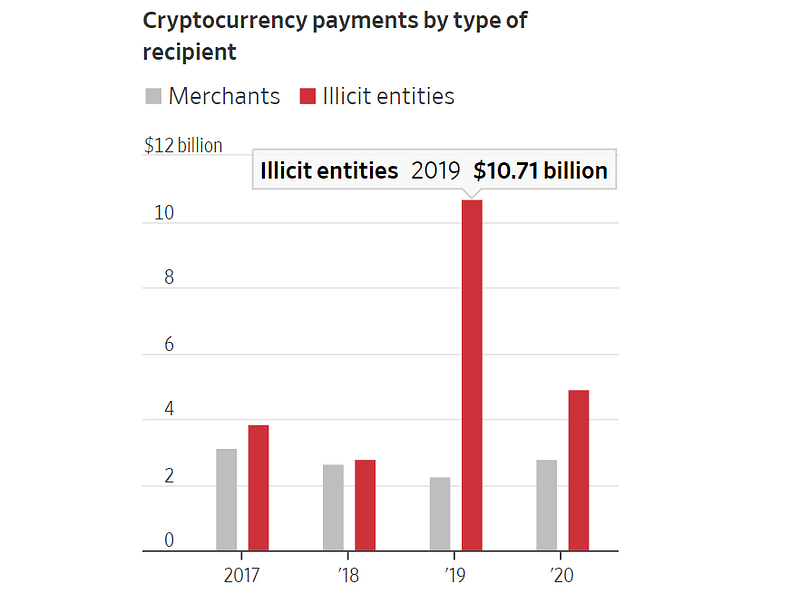
75% of crypto transactions are illegal. Cryptocurrency “washing” sites like Hydra that mask the transparency of blockchain ledgers form a key component of this supply chain. If such sites are not shut down by government regulators and continue to elicit trust (in the black market), then cryptocurrencies are likely to continue to be a popular tool to settle transactions underground. However, the evolution of cryptocurrency as a store of value appears challenging, even in the black market.
Can cryptocurrencies offer a decentralized fiat alternative for payments?
Cryptocurrencies can either be truly decentralized or have a high transaction rate, but NOT both
Popular cryptos like Bitcoin or Ethereum rely on a “Proof of Work” (PoW) based blockchain technology based on the SHA-256 hashing algorithm. PoW is a decentralized consensus mechanism that requires members of a network to expend effort solving an arbitrary mathematical puzzle to prevent anybody from gaming the system. This effort increases as more miners join the network, which inherently limits the rate of crypto transactions that can be executed using any PoW. Bitcoin and Ethereum can only confirm 5 to 10 transactions per second. Compare this to a VISA or Mastercard that can do millions of transactions per second.
Alternately, cryptocurrencies may employ a “Proof of Stake” (PoS) based transaction confirmation system that can handle thousands of transactions per second, but such a system would mirror an oligopolistic transaction clearance system like that run by banks today and will not be truly decentralized.
Can’t the lightning network handle 100K+ tps with PoW cryptos?
Lightning network takes transactions off-chain by opening channels that can support multiple transactions before those transactions are embedded in the blockchain. Such transactions need high volumes to keep fees low and call for the need for aggregators, and an oligopolistic structure, which essentially corrupts the truly decentralized design of cryptocurrencies.
Can’t cryptocurrencies co-exist with the dollar but are free of governmental control and fiat?
No, cryptocurrencies can’t co-exist as truly decentralized systems without government regulation once they grow to a certain size

There are different ways governments can exert centralized control. Taxing is one. KYC (Know Your Customer) regulations are another. As bitcoin nodes come to be hoarded by large public companies and mining becomes more centralized, it would also create more oligopolistic entities that governments can exert control over more easily.
Doesn’t regulation offer legitimacy?
No
Regulations are often merely intended to ensure that the product or service in question is being fairly advertised and sold and free of market manipulations.
In fact, certain regulations can hamper trust in cryptocurrencies. For instance, the Government of India has regulated cryptocurrencies like lotteries, where one cannot write off the cost of a lottery ticket (losses) and need to pay a high tax for the winnings (profits).
Read more of my articles by joining medium with a membership
References
- https://www.investopedia.com/terms/p/proof-work.asp
- https://www.investopedia.com/terms/b/blockchain.asp
For further reading
- Wall Street Journal — What Is Cryptocurrency, and How Does It Work?
- Wall Street Journal — Cryptocurrency Has Yet to Make the World a Better Place
- Bloomberg — Don’t Call Bitcoin a Bubble. It’s an Epidemic
- Benzinga — Dogecoin Co-Creator Says 99.9% Of Crypto Market Is Driven By ‘Greater Fool Theory’
- New York Times — Technobabble, Libertarian Derp and Bitcoin
- Wall Street Journal — Yes, Bitcoin Is Useless. Many Will Say: So What?
- Wall Street Journal — Bitcoin’s ‘One Percent’ Controls Lion’s Share of the Cryptocurrency’s Wealth
- Bloomberg — NYC, Miami Seen Facing ‘Ponzi Scheme’ Risks With Crypto Push
- Financial Times — Why bitcoin is worse than a Madoff-style Ponzi scheme
Disclaimer: This is not any form of financial advice and should not be construed as such. Please contact your financial advisor before making investment decisions.