
The "Low-Grade" Fitness Revelation That Transformed My Life at 37: From Desk-Bound To Dream Body
Discover how a seemingly minor change can unlock a 56-pound weight loss journey and achieve life-changing results.

I grew up in the '80s and '90s when phrases like "no pain, no gain" and "feel the burn" were popular in exercise culture.
Heck, even the most outstanding athlete of all time, Mohammed Ali, known for his famous line, said — "I hated every minute of training, but I said don't quit. Suffer now and live the rest of your life as a champion."
It's hardship and perseverance porn on steroids.
Ali trained at a world-class level, but you can see how I closely associated "pain" with health and wellness, and it all influenced my preconceived ideas about fitness.
Couple that with the fact that not a single person in my circle of influence was interested in fitness, and suddenly, my mind liquefied into the same negative self-talk.
- "I have a slow metabolism: losing weight is nearly impossible for me."
- "I've accepted my body the way it is: I'm comfortable with who I am."
- "I don't have the genetics for a lean physique like some people do."
- "I'm too tired after work to even think about going to the gym."
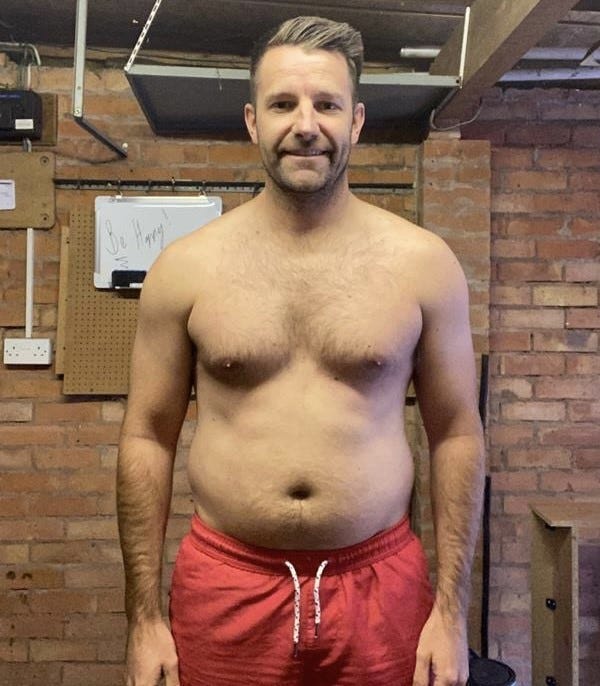
This limiting internal dialogue, as a desk-bound office worker with a dadbod, kept me trapped and unhappy for six years.
I didn't need to waste all that time.
If you're finding yourself stuck like I was, nor do you.
Kooky, woo hoo, philosophy language online, when people try to sound edgy, makes me cringe.
But famous (relatively) fitness expert Joe Delaney hit the nail on the head when speaking about achieving your best body.
“It’s the cumulative result of small, gradual, repetitive, and distinctly undramatic actions. It’s the expression of routine, the manifestation of unspectacular but unrelenting habits”.
The key term here is "undramatic" because he's not telling people they need to train as if they're gearing up for a boxing match with Ali.
They're small things that might seem trivial, but they have life-changing effects over a long enough time horizon.
They also don't have to be painful, despite what culture brainwashed us to believe.
Buckle up, and let's dive into it.
You're not thinking small enough.
I lost 33+ pounds and, more importantly, kept the weight off when I began to think a lot smaller regarding fitness.
Running was at the top of the totem pole of fitness boredom when trying to tackle my potbelly. I love it now, but the thought of running for 30 minutes terrified me back then.
I'd make excuses like, "It puts too much pressure on my knees" or "I just get bored too quickly."
What if I told you to worry a little less about all that high-intensity, back-breaking stuff because it's the even more granular things that significantly impact your weight loss?
Dr. James Levine coined the term NEAT or "Non-Exercise Activity Thermogenesis."
It's all the energy you use outside the gym and exercising, and when I was imprisoned by my woeful routine of mainly doing nothing, I never even considered it.
NEAT includes energy you use to lie down, stand, walk, climb stairs, fidget, clean, sing, and type like I am now.
Research shows when you include all non-strenuous activity, it makes up about 60% to 80% of all the calories we burn daily.
High levels of NEAT are directly associated with lower levels of obesity. As you can see, actual "exercise" only makes up around 15% of all the calories we burn daily.
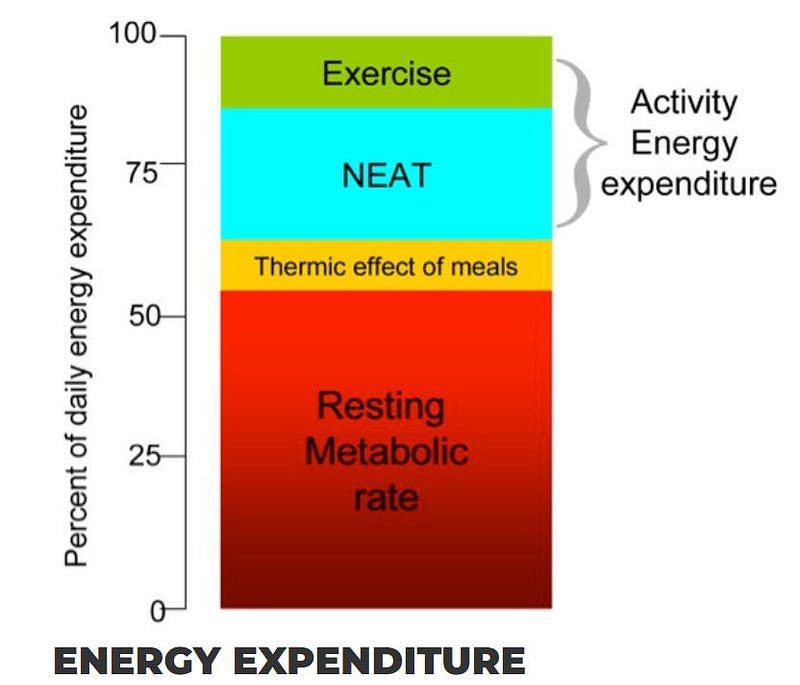
Dr Levine's study found that keeping weight off, in the long run, is easier when you prioritise NEAT over strenuous exercise.
He's right because I'm living proof.
It appears small, but it's a biggie because minor and seemingly insignificant changes can help you burn 350 calories a day from Low-grade activities, which is 40 extra pounds a year for the average person.
Another study examined Levine's research:
“We recruited 10 lean and 10 mildly obese sedentary volunteers and measured their postures, activities of daily living, and fidgeting for 10 days. Obese individuals were seated, on average, two hours a day longer than lean people.
Their conclusion:
“If obese individuals adopted the NEAT-enhanced behaviours of their lean counterparts, they could expend an additional 350 kcal/day from these numerous small low-grade activities and movements. Since this is equivalent to approximately 18 kg (40 pounds) in a year, this may be an essential factor in long-term weight control”.
I talked to a fitness expert when I got fed up with guessing and making my own rules.
It rewired my brain because it was the first time I had ever considered these unintimidating low-grade movements as a way to not only lose weight but live healthier.
My fitness pro, Chris, started with a checklist of strategies for moving more.
At first, I thought they were pointless, but I slowly realised they were a massive cog in the wheel and a cornerstone habit because they are things I'll most likely do for life.
And without making drastic changes.
Caution: These tactics aren't groundbreaking, but they get the job done.
- As a writer, I leave my phone upstairs in my room (more steps)
- I go outside and go for a walk every morning.
- I make a concerted effort to take the stairs.
- Every 30 minutes, I stand up at my desk.
- Go for a walk on my lunch break.
- I have a stress ball at my desk.
On average, I hit 8,000 steps daily, which is between 314 and 391 calories, without significant changes.
It slots into my routine like a glove.
Focus on burning "fun calories."
My typical week includes going to the gym three times for weightlifting and three 5km runs.
I learned to love running because lockdowns brought about anxiety. I felt like it was the best way to clear my head and relieve the pressure on my chest. Running three times a week is something I maintain.
But here's the thing.
Once I started to lean into activities that I enjoyed and were second nature, like playing 5-a-side football (soccer) with the lads or committing to playing cricket every weekend in the UK summer, my activity and step count increased.
Anything involving a ball doesn't feel like a strenuous activity. It's just how I'm wired. I get ludicrously competitive, and there's no off button. I'll race to tackle someone or chase after a ball during a cricket game without thinking of it as exercise.
During a game of cricket here in the UK, if it's not interrupted by weather and you play a significant part in the match, you can cover 23 km, about 900 calories burned.
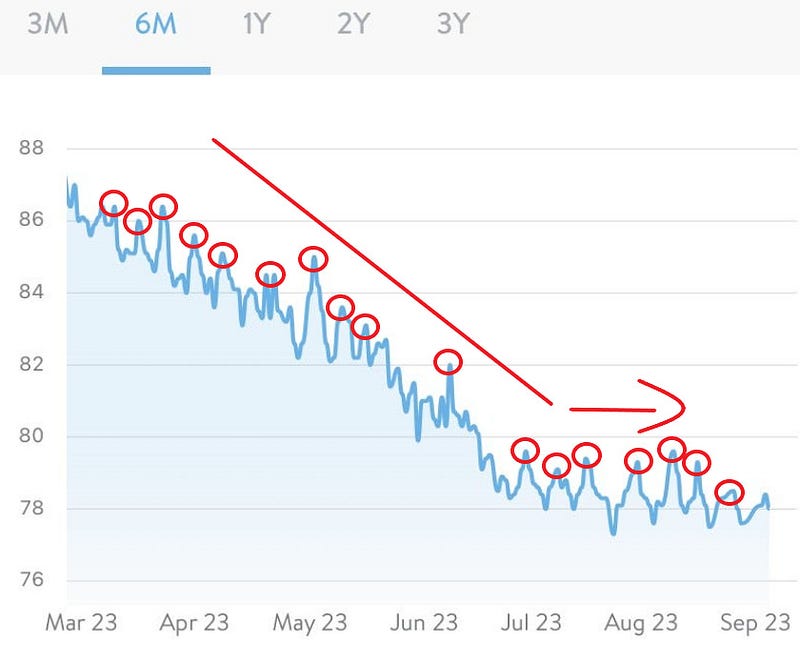
I weighed myself every Sunday morning the day after a cricket match — here's what it looks like on a chart.
Circled in red is each Saturday I played cricket. You can see it's like a top signal on a stock chart because the very next day, my weight came crashing down after a day's play.
I was usually down about 3.5 pounds.
I understand that factors like dehydration and nutrition can play a role in weight regulation, but the point is that this doesn't even feel like exercise to me.
It's pure enjoyment.
I incorporate these social activities to stay physically active, but the beauty of it is that if they didn't have health benefits, I would still do them.
It's why it's so effective.
The research on recreational sports is undeniable.
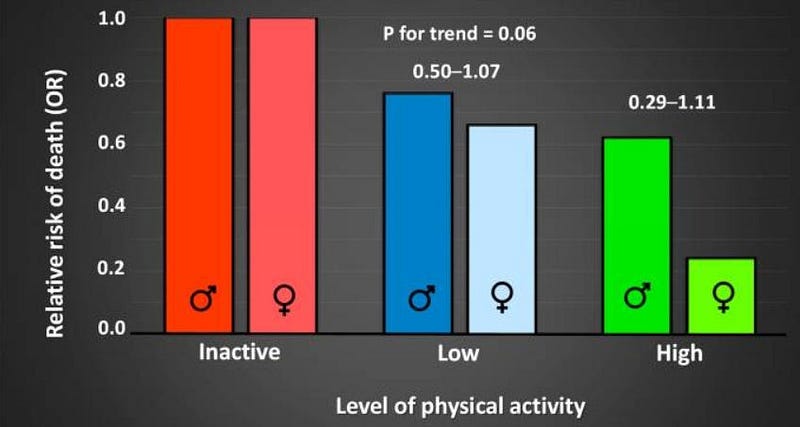
You have a 29% lower risk of death if you choose to play a sport, you enjoy
A longitudinal study of 7,925 healthy men and 7,977 healthy women aged 25 to 64 who reported exercising at least six times a month found that 1,253 people who died prematurely had lower physical activity levels.
Researchers concluded being physically active is linked to a lower risk of dying.
Stop sabotaging yourself.
I shot myself in the foot for nearly a decade by disregarding flexibility.
I was tapping into society's idea that discipline meant structure, and I had to stick to precisely what I said I'd do.
Before I took the bull by the horns with my weight loss journey, I made one unnoticed error, which I repeated like a stuck record.
Ready?
I treated my exercise habit like this immovable boulder in the sea.
I was either all-in training at a million miles an hour or not exercising and eating like a drunken sailor. There was no middle ground or comfortable sweet spot I could slip into and repeat for life.
For some reason, we think in these extremes.
We also don't use damage limitation or flexibility after a lousy week of eating and not exercising, so this extreme thinking leads to self-sabotage by turning the damage into destruction.
I've lived this life. The "I'll restart the healthy eating/exercise tomorrow or Monday."
I would give my brain a free rein between now and when I promised to start again, which involved overindulging. It's why you hear these nightmare stories of people putting on weight when they're dieting.
It's challenging to control every variable in your life, including weekends away, beers with friends, birthdays, weddings, and your neighbour's cocktail party.
When these things cropped up, I used to chuck the towel in. Or, as my online fitness trainer Chris calls it, "push the f**k it button."
He used to say to me:
“Jay, it’s okay for these things to crop up.
It’s life, it happens all the time, but for you to be brutally consistent, you almost have to think counter-intuitively mate. You’ve almost gotta be comfortable with inconsistency, but consistently keep getting back on the horse”.
It was an aha moment.
He's right — just because one thing has cropped up in your social life doesn't mean you have to eat like a child and smash your diet to smithereens like I did every time.
This will rewire your brain.
It's like an old buddy used to say to me: "Jay, there is no hiding place for data".
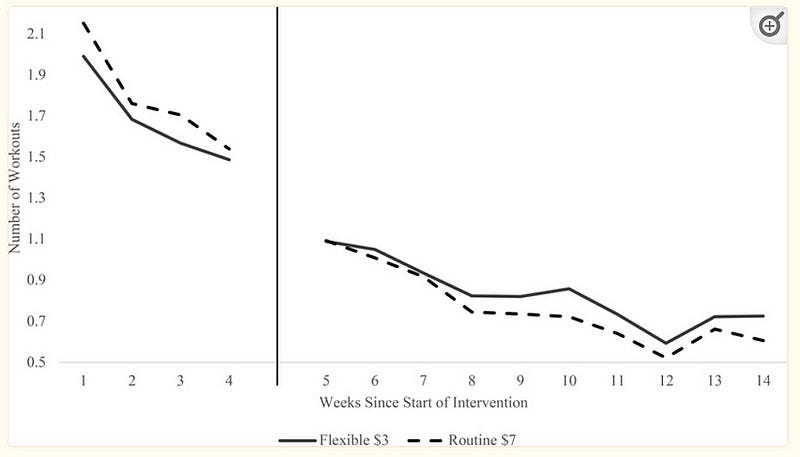
Researchers from Harvard Business School studied 2,508 Google employees to help them achieve their fitness goals.
They wanted to find the tradeoff between people with a flexible gym routine and people who fix their training to a particular day and time.
They even incentivised them to see if money made a difference, giving one group $7 and another $3 each time they attended the gym for 30 minutes.
The flexible gym routine group receiving $3 attended the gym 8% more often over a more extended period than the fixed group participants receiving $7, who had a steep drop-off.
So, the fixed routine group were paid more and went to the gym less. Lol.
8% doesn't seem like a lot, but let's compound that over 52 weeks, which, if you go to the gym four times a week, is 208 times a year, it works out to 17 more gym sessions or an entire extra month in the gym over a year.
The message here is to be flexible.
“In short, when people are induced to exercise at an equal frequency but in a more routinised way, we find evidence that they form weaker exercise habits, contrary to past theorising”.
The solid line is the flexible group paid $3 — The dashed line is the fixed group paid $7
Final Thoughts.
These low-grade activities were the foundation of my consistency and were a natural gateway to higher-intensity workouts like weight training and running.
I base my approach on prioritising small daily habits that are sustainable for a lifetime.
If I miss one or two gym sessions, I don't hit my self-destruct button; I say to myself, "No worries, I'll pick back up tomorrow."
All while maintaining my low-grade activities.
- When it comes to burning calories, think small — consider the daily things you do and what adjustments you can make to move more.
- Stop disregarding flexibility — it's a strength, not a weakness, to change course slightly when something crops up. Just get good at jumping back in the saddle.
- Put yourself in a position to burn fun calories around the things you love, or at least like, because you'll likely do more of it for longer.
It's not a conclusive list of changes to implement, but it was my ground zero when setting the wheels in motion for success.
I hope it gets you started on your journey.
Special Offer for My Readers
Chris, the online fitness pro who revolutionised my fitness journey, is offering a free discovery call exclusively to my readers.
If you're ready to transform your fitness and tailor a plan that suits your unique lifestyle, this is your chance.
Click here to book your FREE call with Chris and start your journey towards a healthier, fitter you. (affiliate link).


