avatarGauri Sirur

Summary

The website content discusses "The Loves of Jupiter," a science-based haiku that intertwines astronomical facts about Jupiter's moons with Roman mythology, and acknowledges contributions to this poetic form by Adam Nathan Wieland and fellow writer B.R. Shenoy.

Abstract

"The Loves of Jupiter" is presented as a scifaiku, a science-based haiku, which creatively blends the scientific knowledge of Jupiter's Galilean moons with the Roman mythological tales of Jupiter's amorous exploits. The article highlights Jupiter's status as the largest planet in the solar system, with 79 known moons, and particularly focuses on the four Galilean moons—Io, Europa, Callisto, and Ganymede—discovered by Galileo Galilei in 1610. These moons, along with others orbiting Jupiter, are named after the deity's mythological partners. The piece credits Adam Nathan Wieland for inspiring the author with his engaging scifaiku poems and extends an invitation to writer B.R. Shenoy to explore this poetic form. The author also expresses gratitude to Dennett and Tracy Aston for publishing the poem.

Opinions

  • The author appreciates the intersection of science and mythology as a source of poetic inspiration.
  • Adam Nathan Wieland's work is recognized as an influence and a source of enjoyment for the author.
  • There is an admiration for the mythological naming convention of Jupiter's moons, reflecting the planet's significance in ancient narratives.
  • The author values the creative challenge of writing scifaiku and encourages others, specifically B.R. Shenoy, to engage with this genre.
  • The author expresses thanks to Dennett and Tracy Aston, indicating a sense of community and support among writers and publishers in this field.

The Loves of Jupiter

A SciFaiku — Science-based Haiku
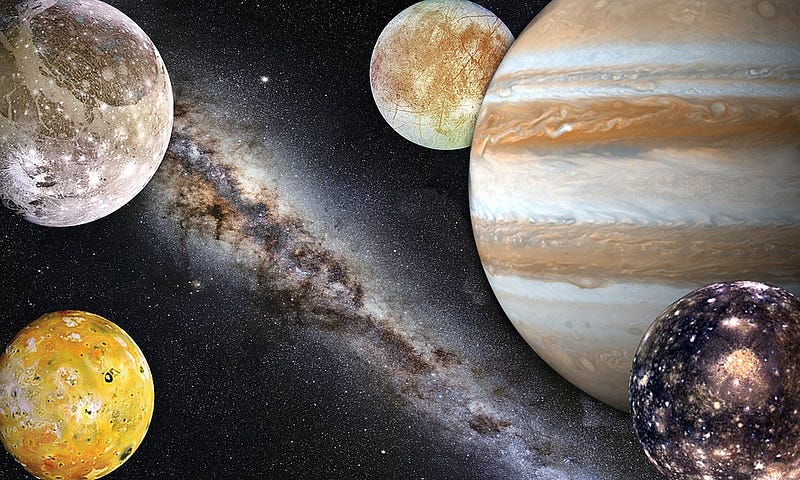
Picture from Pixabay by BrunoAlbino

Io, Ganymede

Science weds Mythology

Moons of Jupiter.

Jupiter is a gas giant and the largest planet in our solar system. It has more than the mass as the rest of the planets (in our solar system) put together.

It has 79 known moons.

The most massive of these are the so-called Galilean moons credited to Galileo Galilea, who discovered them in 1610. Their names are Io, Europa, Callista, and Ganymede.

In Roman (originally Greek) mythology, Jupiter (Zeus) was the king of the gods. He had one wife, Juno (Hera), and numerous extra-marital partners.

The four Galilean moons and several others that orbit the giant planet are named after Jupiter’s storied love interests.

The above poem is a Scifaiku or Sciku. I learned about this science-based form of Haiku, when I read the intriguing and enjoyable poems by Adam Nathan Wieland.

I invite my fellow-writer, B.R. Shenoy, to try her hand at this fun variation of haiku.

Many Thanks to Dennett and Tracy Aston for publishing my poem.

Haiku
Science
Nature
Solar System
Poetry
Recommended from ReadMedium
avatarPraise Frank
Self Study III

A poem

2 min read
avatarOiseau Distrait
Wake Up Now…

Don’t be late!

2 min read