
The Lost City of Petra
GiaB writing prompt #7 Man-made Wonders of the World
In case you may have been living under a rock in 1989 and missed Sean Connery and Harrison Ford in Indiana Jones and the Last Crusade, click the link for a breathtaking view of the two hottest men in the known universe hugging each other.
But even more interesting is their location, in Jordan, where they gallop on horseback through the Siq (pronounced seek) –– a torturous, more than half-mile long, nearly 300-foot-high tectonic crack in the sandstone that leads to the ancient Nabatean city of Petra, one of the Seven Wonders of the World.
Who were these Nabateans? How did they thrive in such an arid climate? Why hasn’t anyone ever heard of them?
I’ve always been fascinated with ancient peoples, their cultures, gods, temples, their way of life. But until I landed there a few years ago, I had never heard mention of this ancient tribe, these desert nomads who carved this monumental city out of the side of a cliff, and flourished here from about 312 BCE to AD 106.
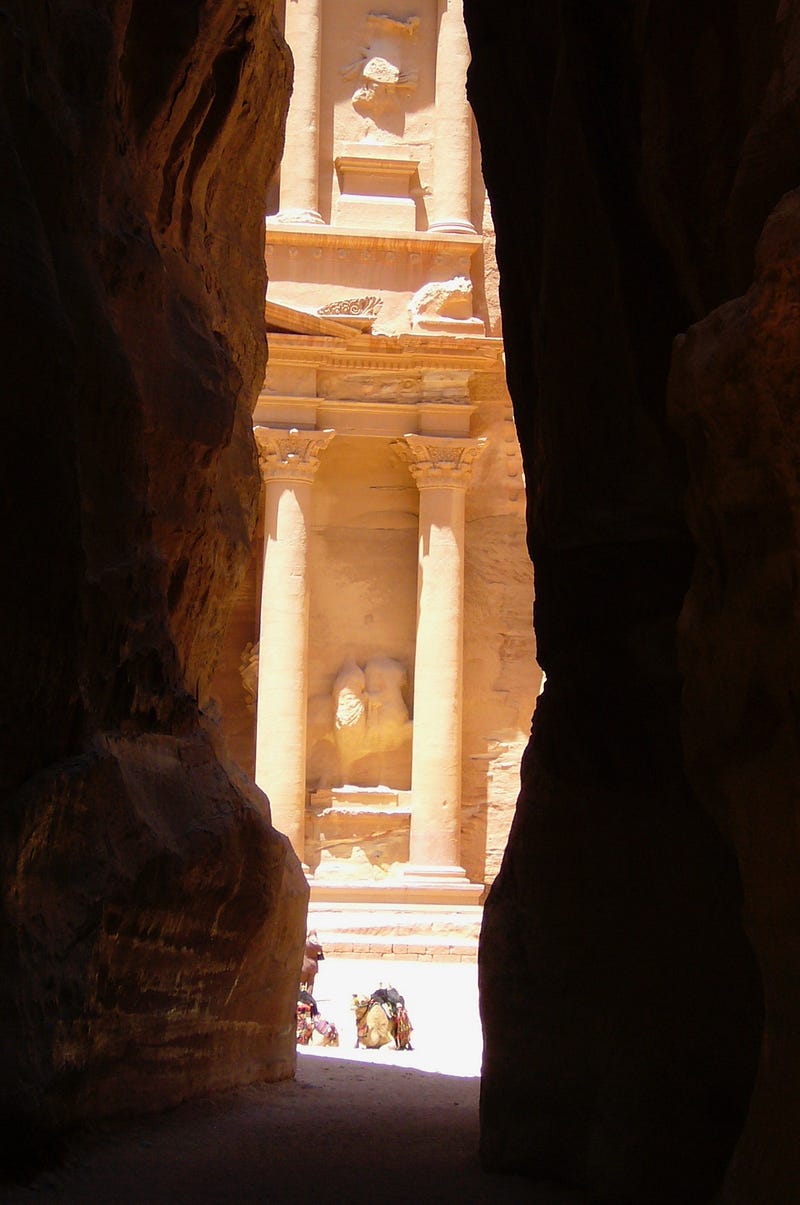
Siq, and ye shall find
The most notable natural feature at Petra, the Siq is a long, narrow, dim pathway that serves as the entrance to the city. Many ancient ruins, like Stonehenge or the Pyramids, can be seen from miles away. Not so for Petra.
The Siq was created by a tectonic shift that split the earth open, leaving a huge gash visible from space but barely discernible from the back of a camel.
From the moment I stepped into that vast crack in the sandstone until I exited nearly an hour later, nothing (emphasis: NOTHING) except the towering walls of the slot-like canyon, known as the Siq, was visible –– and in some places, not even the sky.
Still visible along the lower left side of the Siq are the remains of an expertly engineered channel, once lined with clay pipe, that brought water to the city from remote and closely guarded springs and cisterns.
Nabatean Nomads
The Nabateans arose from Bedouin tribes who used their deep understanding of desert water sources to become successful traders on the Arabian peninsula. The secrecy of the locations of their cisterns and other desert watering holes allowed them to maintain absolute control of desert trade routes.
In this otherwise uninhabitable region, the Nabateans’ greatest strength over their rivals was their hydraulic engineering expertise, developing intricate water networks that could sustain large populations in arid locations.
When threatened, the Nabateans would simply lead their enemies into the desert and wait for them to run out of water.
Control of the trade in frankincense and myrrh brought enormous wealth and exotic goods to the citizens of Petra, already flush with gardens, pools, and water fountains. Some scholars believe that the “wise men” who came from the east to present the baby Jesus with gifts of gold, frankincense, and myrrh were Nabateans. When they reached Jerusalem, the Nabateans traded their goods for gold, perhaps sharing a bit of their bounty with the lucky newborn.
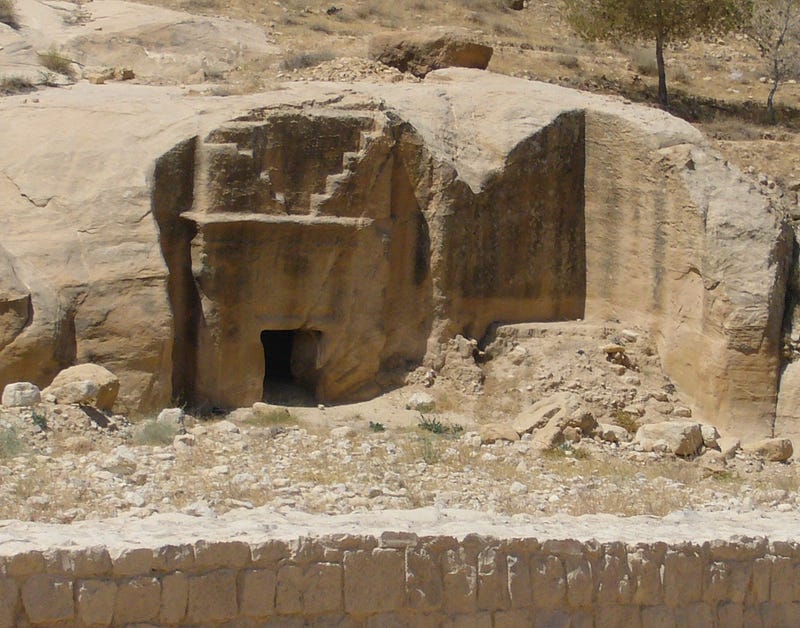
Crowsteps and Obelisks
Although much of Petra has yet to be excavated, rich and varied influences of other cultures on Nabatean architecture are visible.
Typical small tombs are decorated with crowsteps –– a design (possibly Assyrian), carved from the top down on the upper section –– thought to represent a connection with the gods, or perhaps an ascent to the heavens.
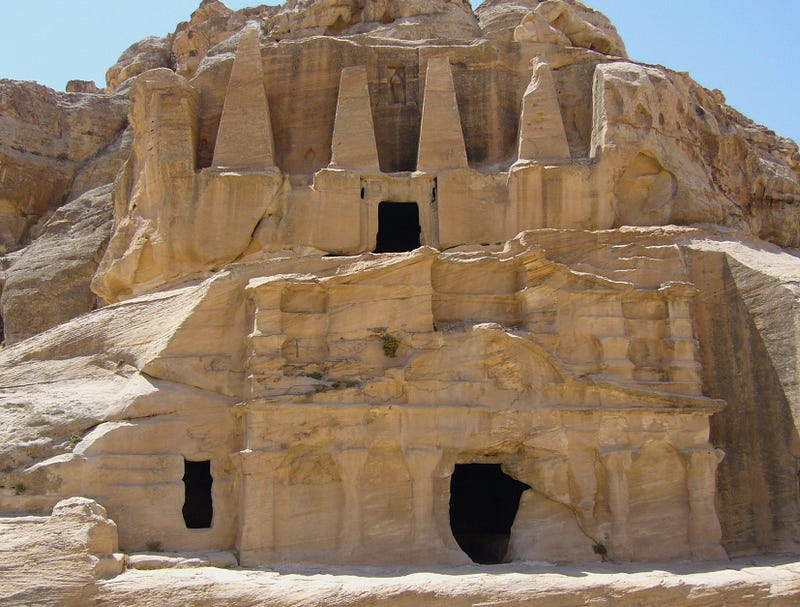
Nabatean architects were also influenced by the Egyptians, incorporating obelisks and carvings similar to hieroglyphs into their constructions.
No matter where your eye falls, you’ll find traces of many other cultures the Nabateans encountered on their trade routes –– Hellenistic, Roman, Mesopotamian, and a host of others.
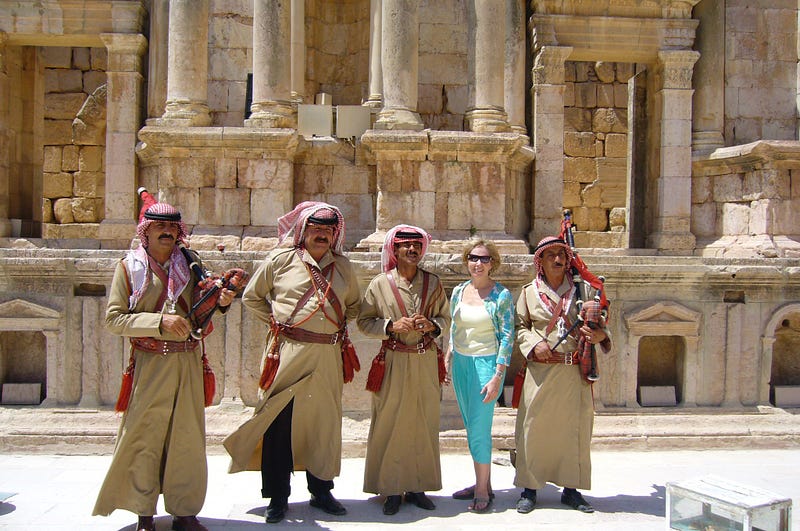
Explore the Treasury, marvel at the colorful swirls of natural stone walls inside, hike around the ruins while wondering how anything thirstier than a dung beetle could possibly survive here, and bliss out to the other-worldly dissonance of a wandering Jordanian bagpipe band (sorry, I can’t explain this).
Even though Sean and Harrison won’t be there to greet you, the Jordanians are warm and friendly and eager to flirt with you. Petra needs to be on top of your bucket list as soon as we can all travel safely again.
Appreciation
Thank you for this delightful prompt, Victor Sarkin and Chirag!
PS: You should have stopped reading before now, because I can’t resist:
You can Panasonic, you can Nakasone, but you can’t Nabatean.
:D
Adelia Ritchie, 2020