
The Long Way Round
Bolade Oliveira lit a cigarette and checked his watch. It was 7:42. The sunlight dimmed and the colorful favelas dulled in the dusk. He was behind schedule. He was going to have to drive fast; driving fast meant risking unwanted attention. “It’s not going to fit.”
“It’ll fit. You gonna stand there and bitch or you gonna help me get this into the trunk?”
“I am helping. You’re wasting your time.”
“Ain’t you the manual labor around here? Why don’t you help me out?”
Bolade sighed and stubbed out his cigarette on the tire, unbuttoned his right shirt cuff and rolled it up. His brown skin glistened against the white cotton fabric. “I’m not bitching, I’m telling you: your package isn’t going to fit. I was hired to move a package four feet by two feet by one-and-a-half feet — twelve cubic feet. It’s 16 inches from my elbow to my wrist — ”
“What? You measure your arm?”
“What I do is I prepare for my job.” Bolade walked over to the bulging duffel bag half-wedged into the trunk, grabbed it and yanked it out. “It’s 16 inches from my elbow to my wrist and 40 inches from my belt buckle to the ground in these shoes. Your bag’s four feet long, but whatever you’ve got in here — ”
“Look it don’t matter what I got in there.”
“ — Whatever you’ve got in here isn’t uniform in size. The specific contents are none of my concern, but your bag’s stretched in the middle. Looks like it’s about four feet by two-and-a-half feet by two-and-a-half feet. This trunk is only 17 cubic feet and you need 25 for this package.”
“You dumb porter, why didn’t you bring a bigger car?”
“Because your boss stipulated twelve cubic feet of storage and fast delivery to the airstrip. A bigger car means it’s harder to navigate through the favelas. Means a bigger target for the PRF officers.”
“If you can’t handle the PRF maybe the boss hired the wrong guy.”
“I agree, your boss did hire the wrong guy.” Bolade rolled his sleeve back down and buttoned the cuff. “But if that guy wants to keep his job, he better load a package of the correct dimensions into my trunk in the next 90 seconds before I drive off.”
A minute later, Bolade Oliveira started his car and sped off toward the airstrip with a black duffel bag measuring twelve cubic feet in the trunk.
He was 27 minutes behind schedule. The car was an old sedan, maneuverable enough down the tight city streets, small enough to fit down the alleys if he needed. And he needed.
Outside the city, Bolade had made up almost five minutes of his deficit. The plane would take off at 9:45 whether he was there or not. He would have to watch himself on the highways, too. The PRF — Brazil’s Federal Highway Police — were well-known for their ruthless tactics. Bureaucratic inefficiencies meant that the stolen car he was driving wouldn’t show up in the database for 24 hours, but the PRF routinely employed search dogs and their DOA units — the airborne division responsible for tracking drug or environmental smuggling. Whatever was in the package, Bolade knew there was too great a risk of detection if the PRF pulled him over. Whether delayed or detained — his employer didn’t offer second chances.
He also knew if he wanted to make up time, he’d need to risk the forest roads. Bolade hated the forest roads. They were easier to avoid detection but also unpaved, unlit, harder to drive on, and harder to navigate. The forest roads, like the forest, were unpredictable. And Bolade’s work demanded predictability. But that’s not why he hated the the forest roads; he hated them because they reminded him of Manoel.
When Bolade reached the nearest turn-off for the forest road, it was past 8:30. With the sun down, it would be more difficult to navigate by direction on the winding forest roads. He’d taken these roads before, but navigating by landmarks was equally unreliable since the landscape was prone to change — entire sections of rainforest could be stripped away by illegal clearcutters in a matter of days. He had learned to look for tributaries as guides; the roads seldom crossed water and would often follow the course of a stream through the forest, and the clearcutting didn’t affect the waterways. Manoel had taught him that.
In the favelas, everyone had expected the brilliant, passionate Manoel to become a great politician — a hero from the favelas who wouldn’t forget his home, who would help them rise up from their station. It was only Bolade who wasn’t surprised when his older brother dropped out of university to join an environmentalist group. Manoel had taken him on trips to the rainforest since grade school, had shown Bolade how to find edible plants, how to track animals and poachers through the underbrush, and later how to spike trees to jam the clearcutters’ saws and lay trip-wire traps on game-trails to deter poachers. Even as a child, Bolade understood the gravitational pull of the freedom to take action that drew his brother away from the city.
When Manoel and a group of environmentalists were found murdered at their camp, Bolade, too, felt the steady tug of gravity — one that pulled him away from people or a sense of home. With Manoel gone, Bolade was adrift, focusing on himself and his preservation. In the five years since his brother’s murder, Bolade drifted further and further. He knew the landscape of the favelas, and Manoel had taught him to cover his tracks and to seek out paths — all valuable traits to people with deep pockets who didn’t want questions asked. As long as he got his, what did Bolade care about his deliveries? If he didn’t do it, someone else would.
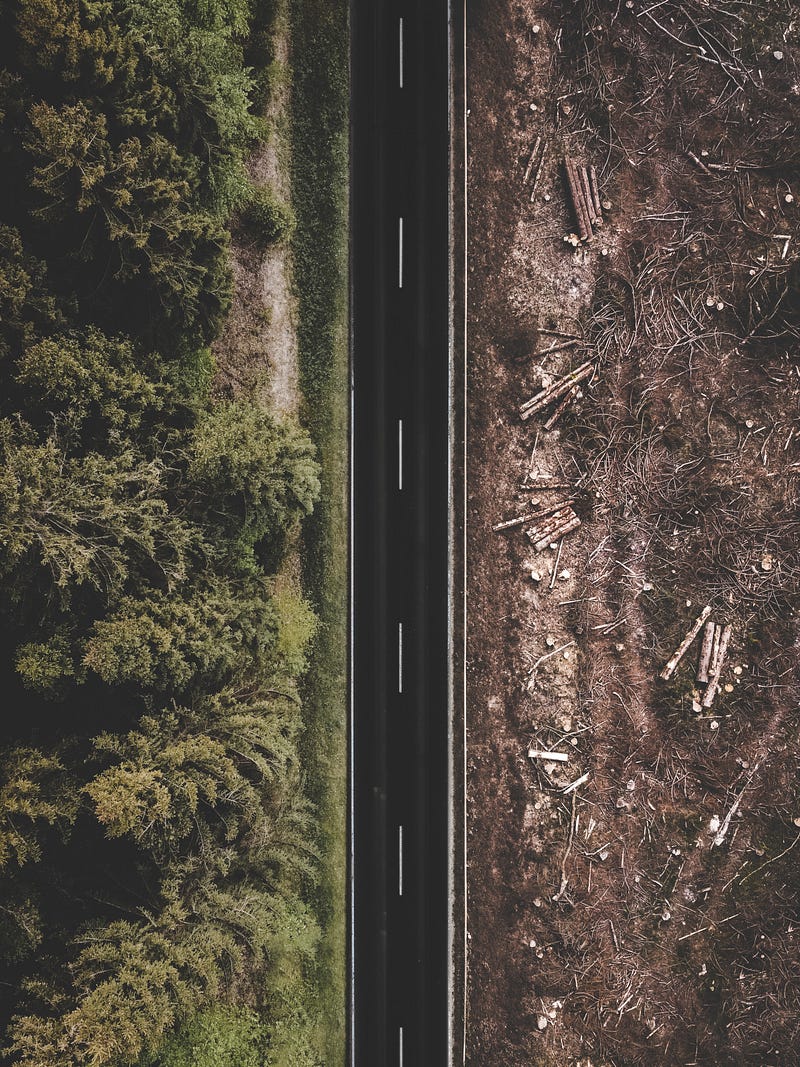
There was a fork in the road up ahead. The area had recently been cleared, but Bolade noticed a forest stream that continued along the right-hand road. Though the forest was gone here, the underlying topography had not changed. Bolade could make out a game-trail worn into the earth. The underbrush must have been dispersed during the clearing, but the impacted ground was faintly evident in the glow of his headlights. As much as outside appearances could change, the underneath kept a true account. Manoel had taught him that — how to look underneath for the truth. He recognized this split, it was 33 miles from the airstrip. He checked his watch. 9:18. He’d made the last leg of the route in 29 minutes before; he needed to do better.
The forest roads were more dangerous in the clearings. The embankments along the dirt roads became susceptible to erosion after the forest was cleared away and root systems deteriorated. Bolade drifted toward the center in the turns to avoid potentially-crumbling embankments in the large clearing. This, too, was something Manoel had taught him. The environment — the animals, the trees, the people — relied on balance to thrive. The trees depended on the animals for fertilizer and seed dispersion, the trees provided shelter and oxygen, the people cleared away fallen or dead trees and played their role in the food chain. If people only looked out for themselves, the balance would shatter, everything would suffer.
This was why Bolade hated the forest roads. Remembering all the lessons his brother had taught him and how he was squandering those teachings unsettled him. Alone in the car with nothing but his thoughts, Bolade would begin to doubt. He hated those doubts — they were distractions that came at the times when he couldn’t afford to lose focus. Between the possibility of eroding embankments and PRF officers and whatever consequences were in store for missing this delivery, Bolade needed all his nerve.
Headlights in the mirror. Had his driving drawn the attention of PRF officers? He was close to the airstrip — had PRF flyovers detected the location? Were they investigating? Bolade suddenly faced a decision — should he continue to the airstrip and possibly lead the PRF to the location or get caught up in a shoot-out? Should he abandon the delivery? Re-route? The lights didn’t seem to be growing closer.
He had reached the edge of the fresh clearing and the forest was swallowing up the road again. At the next crossroads, Bolade turned away from the forest stream, away from the airstrip. He turned his lights off and watched his mirror. The other vehicle continued on in the direction of the airstrip. He didn’t see much, but it appeared to be a large pick-up truck. The PRF drove armored SUVs and reinforced sedans. It didn’t appear to be a PRF vehicle, but it was difficult to tell. Bolade opened the console next to the driver’s seat and withdrew his pistol, resting it on his lap. He kept the lights off and backed onto the main road toward the airstrip.
He was now driving in the dark along the center of the road, far enough behind the vehicle to avoid detection. If the other vehicle was headed to the airstrip, Bolade wanted to be able to survey the situation before moving in. He could follow its lights well-enough in the darkness, and it wasn’t much further now.
Sure enough, the other vehicle pulled up to the cabins at the perimeter of the airstrip. It was 9:42. In the dim light of the cabins, Bolade could see that it was, in fact, a large pick-up. These weren’t PRF officers. Two men climbed out of the cab and headed around to the tailgate while the driver stayed inside and signaled to the plane. The plane must be taking multiple shipments this time, Bolade thought, pulling up next to the dispatch cabin. He got out and slipped his pistol into the holster at the small of his back.
Bolade carried the black duffel toward the plane as usual, but one of the men called out from the back of the pick-up.
“Hey, can you give us a hand with this?” A thin man stood on the back tire and fussed with some straps.
Bolade tensed. Was this some kind of ploy? He set the duffel down and wiped the sweat from his palms on his slacks. “I need to get this on the plane before it leaves.”
“Yeah, it’s not leaving without this cargo. Special order from the boss.”
Bolade strode over to the tailgate as the man who had called out unfastened a dirty blue tarp. The other man, older and heavier, hoisted a large duffel up on the tailgate and began to unzip it, pulling out large, wrapped bricks of cocaine. The last fasteners came off the tarp and the thin man whisked it off like a magician flourishing a cape. Bolade grimaced.
There were five bodies piled in the truck bed, bullet holes obscuring their features. The heavy man pulled out a knife and gestured.
“Alright,” the thin man instructed Bolade, “let’s lay this one out along the tailgate.”
“Wait, what are you — ”
“What does it matter to you? They aren’t any of our guys. The boss had us take out this environmentalist group who found out he was hiding his product in animal skins. Said it was poetic or something. Move more supply this way, too. More money for us, am I right?”
Bolade reached down behind his back.
The pilot couldn’t hear the gunshots over the sound of his engines firing up. Bolade emptied his black duffel — jaguar pelts lined with packages of cocaine — and switched out the contents with the heads of the killers and the dispatch operator. He loaded the bag into the plane’s cargo hold and waved the pilot off.
A minute later, the plane took off toward its destination with a black duffel bag measuring twelve cubic feet in the hold.
Bolade Oliveira lit a cigarette and checked his watch. He was behind schedule by over five years, but maybe he could make it up.
He began to douse the cabins in fuel.


