
The Living Cocoon Coffin
What does it mean for you and the environment? You can decide to be buried in a coffin made from fungi-like mycelium fibres
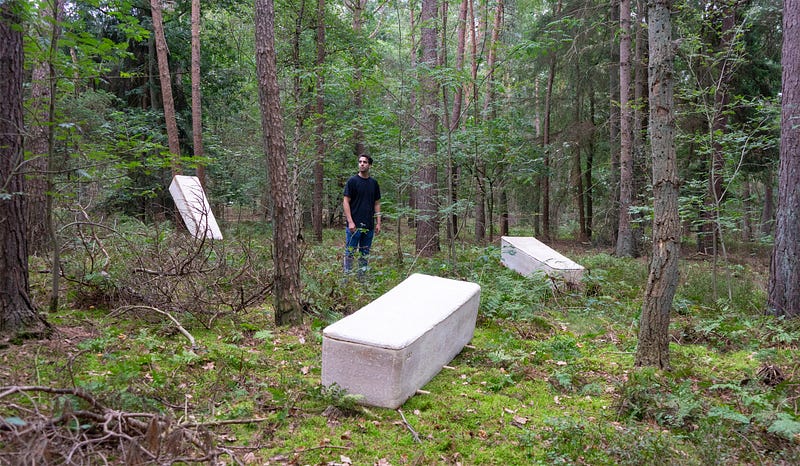
If you are one of those who are passionate about the environment, and you are keen to do your own bit, before and even after death, then there is a new way to do just that. There is now a fast compositing coffin, made from fungi-like mycelium fibres.
A 26 years old, Dutch Researcher and Bio-designer at the Delft University Of Technology, Bob Hendrikx, invented a biodegradable coffin, that makes the corpse decompose faster, into the soil, thus enriching the soil as well.
He created the living cocoon coffin from mycelium, which removes toxin from the corpse, and then break down the body into living micro-organisms. This accelerates the decomposition of both the body and the coffin itself within three years. Three years is all it takes in comparison to the conventional wood or bamboo coffin that breaks down by its 10th year.
You might wonder what Bob was thinking when he started to research into this biodegradable coffin. This is what he said, at the launch of the coffin,
“We are currently living in nature’s graveyard, our behaviour is not only parasitic, it’s also short-sighted. We are degrading organisms into dead, polluting materials, but what if we kept them alive? The Living Cocoon enables people to become one with nature again, and to enrich the soil instead of polluting it.”
The beauty of this is that it also cleans the surrounding soil of whatever pollutants there are, and turning them into biodegradable microorganisms.
What Is Fungi Mycelium?
Mycelium is fungi like in the world of the web that interacts and inter-tangle with each other. Mycelium is multi-cellular, and they are actively engaging in looking for waste to recycle. Hence, Bob Hendrikx called them ‘’Nature’s Recycler’’. They do this by constantly growing and extending their tentacles under the soil, thus providing essential nutrients that feed their growth. Hence they can grow to thousands of acres.
In Netherland, farmers use mycelium to regenerate their soil and to get rid of toxin. Bob Hendrikx continued,
“Mycelium is constantly looking for waste materials to convert into nutrients for the environment, It does the same with toxic substances, including oil, plastic and metal. For example, mycelium was used to leech radioactives waste in Chernobyl, it is utilised in Rotterdam to clean up soil, and some farmers also apply it to make the land healthy again.”
A Girl’s Question Brought The Idea To Him
At 2019 design week in Netherland, Bob said he was much concerned about living home pod, which he wanted to showcase. Then a girl came up to inspect the home pod and asked him if she could leave her grandma there if she dies.
Bob said, after that, he started thinking that mycelium can even be the perfect idea to build up a coffin, instead of a home, ‘’allowing us to go back to the soil, according to Genesis 3:19, and providing foods for plants.’’
In the Loop Of Life Foundation, Netherland
Bob Hendrikx founded the Loop-of-life Foundation, a biotech start-up, which he also directs. Here, the coffins are grown from the mycelium in just seven days. He creates a mould, with a mixture of mycelium and substrate (or compost), and the mycelium eats the compost and grows to fill up the shape of the mould. It grows in just seven days, requiring neither heat nor light.
The living cocoon coffin had been tested with funeral directors both in Hague and in Delft. Another biotech design company in the USA, ‘ecovative’, has also tested it in USA soil, but yet to come up with its report on the benefit to the eco-biodiversity of the soil.
He is also interested in developing light-emitting fungi, to serve as a bio-marker to identify each grave. This can also replace natural flowers that people place on the graveyard.
The Cost
The living cocoon coffin currently costs $1350, including taxes, which he believes will gradually become cheaper as more people get interested in it.
Commercialisation of Death
The commercialisation of the dead continues as people develop funeral rites and burial practices in honour of the dead. Families prefer a living memory.
Throughout the world, as in everything else, the greed of the funeral directors is geared towards making people forget the transition from death to decay.
The funeral industry is in the UK is worth about £1 billion annually, that uses about 4.2 million litres of embalming liquid each year, and 20 million feet of wood for coffins and vaults. The chemical used to treat the coffins and vaults leech into the groundwater/soil. Cremation, although, slightly cheaper, at about £1000, releases toxic fumes into the atmosphere.
According to the National Funeral Directors Association, more than half of Americans are interested in a green funeral because of the cost savings and environmental benefits.
Cocoon Coffin Has Already Been Used
Actor Luke Perry was buried in cocoon coffin in March 2019, according to the daughter, Sophie Perry.
The first woman, aged 82, was buried on September 12, 2020, in Hague on the coffin.
Other Green Burials
Some cultures have their supposedly green burials around the world. Notable are SKY burials practised by the Himalayans where the corpse is exposed to a very high altitude to be scavenged by wild birds.
There is also water cremation or alkaline hydrolysis, in which the corpse is chopped up, and treated in potassium hydroxide Most environmental issues are caused by the living but have you ever considered the environmental impact of death? Alkaline hydrolysis, a greener alternative to burial or flame-based cremation, uses a combination of water and potassium hydroxide to decomposing bodies. It doesn’t require burial space, uses 1/12 the energy of traditional cremation and doesn’t produce toxic gases or air pollutants.
The Take-Aways
Bob Hendrikx next mission is, ‘’to know exactly what contribution the cocoon coffin makes to the soil as this will help us to convince local municipalities in the future to transform polluted areas into healthy woodland, using our bodies as nutrients.”
We can gift our bodies back to the earth, that has sustained us over our life for the benefit of those coming behind.
Trees can be planted to regenerate the earth.