
The Literary Brat Pack Really Deserved a Much Better Name
They defined literature for a generation and beyond
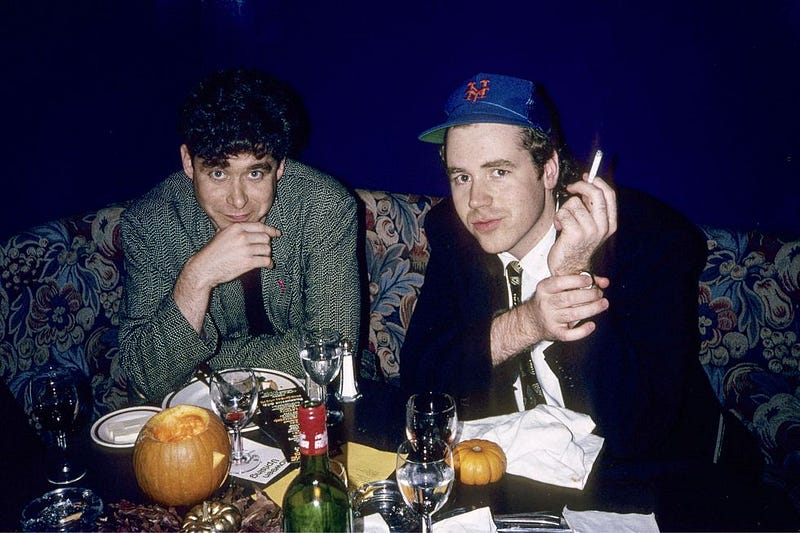
Chances are good that you’ve heard of the Rat Pack, the ultra-cool crew of Frank Sinatra, Dean Martin, Sammy Davis Jr, Joey Bishop, and a few others that ruled Las Vegas in the 1960s and gave us the original Ocean’s Eleven film from 1960 that was little more than two hours of them being cool onscreen. You have also likely heard of the derogatorily named Brat Pack that was made up of 1980s film stars like Rob Lowe, Emilio Estevez, Molly Ringwald, Judd Nelson, Ally Sheedy, and a few whose names escape me at the moment.
With both the Rat Pack and the Brat Pack, the member were famous, instantly recognizable film or music stars. There was another young crew from that 80s era you may not know, mainly because authors rarely gain the notoriety of other types of artists. That’s unfortunate, because these writers were some of the finest of the past half century, and certainly wrote books you’ll recognize.
Writers are by nature solitary creatures. Paradoxically, some of the best work is produced when authors interact with each other at least socially. A few times this happened come immediately to mind: the Bloomsbury Group in England in the early part of the 20th century (Virginia Woolf, E. M. Forster, John Maynard Keynes, Lytton Strachey); the Lost Generation writers in 1920s Paris (Ernest Hemingway, John Dos Passos, Gertrude Stein, Djuna Barnes, Ezra Pound, T. S. Eliot, F. Scott Fitzgerald); and Brooklyn in the 2000s (Paul Auster, Zadie Smith, Martin Amis, Jennifer Egan, Coleson Whitehead, Jonathan Safran Foer).
Another key time when great writers interacted professionally, socially, and even educationally occurred in the early 1980s at the most unlikely of places: Bennington College in Vermont. This was where, in 1982, Bret Easton Ellis, Donna Tartt, and Jonathan Lethem all arrived to start their freshman year of college. These three, along with fellow Bennington student Jill Eisenstadt and non-Bennington writers Tama Janowitz and Jay McInerney, would become what was known as the Literary Brat Pack. You may recognize a few of the names, especially Donna Tartt, and it’s worth getting to know all of them.
Let’s start with Bret Easton Ellis, who I have written about before and consider the literary voice of Generation X. Ellis completed his first novel, Less Than Zero, when he was 21 years old; it was published in 1985 while he was still a student at Bennington and propelled him to a level of notoriety few authors could reach today in our arguably post-literate world. It was immediately recognized as something we had just never seen before
With Less Than Zero, it was not just the short episodic scenes or the fact that it has only the hint of a conventional plot; both of these had been done before. What stood out as new was the totally detached, amoral narrator and cast of characters. This is no angsty coming-of-age novel; it’s a “we can’t even be bothered to give a shit” novel, yet not in the posing manner of so much written today. These characters literally give not one shit about anything. It was jarring, especially in the middle of the morning-in-America Reagan 1980s.
A quick note about the sadly better-known film adaptation of Less Than Zero that was released in 1987. In a word: don’t. Don’t watch it. You’ll thank me later.
Ellis followed up Less Than Zero with The Rules of Attraction in 1987. The novel expanded his Less Than Zero universe from L.A. to the fictional Camden College in New Hampshire (his version of Bennington). To this day it is the only novel I have ever read that both begins and ends in the middle of a sentence. Then came American Psycho, the book most people know him for. While he was vilified for its violence and misogyny and dropped by his first publisher as a result, the book and the film version of it have become both critical and cult favorites.
Ellis wrote several more novels, including The Informers, Lunar Park, and Imperial Bedrooms, a sequel of sorts to Less Than Zero 25 years later. Today he has essentially abandoned the novel as a creative form, which is unfortunate given how good he is at it. He now writes screenplays, directed a television series, podcasts, and last year released his first nonfiction essay collection, White.
The next author, who is around ten years older than the others in the group, is Jay McInerney. He became linked with the Bennington crowd mainly because his first novel, Bright Lights, Big City came out in 1984, one year before Ellis’s first book, and as the two rising stars of the era they started hitting all the New York clubs together. Bright Lights, Big City was unique not because of the drug culture of Manhattan it portrayed but because of something I have only ever seen work in this one novel: he wrote it in the second person. For whatever reason, his opening line of “You are not the kind of guy who would be at a place like this at this time of the morning,” is more powerful than writing “I am not the kind of guy.” It takes some getting used to at first, but once you do it flows and puts you directly in the story.
I enjoyed his 1988 novel Story of My Life even more than Bright Lights, Big City, but it got little attention for nearly two decades. Then it was revealed in 2008 that the main character, Alison Poole, was based on McInerney’s ex-girlfriend, Rielle Hunter. Hunter, and the novel, became news that year when then-presidential candidate John Edwards admitted to having an extramarital affair and a child with her while she was working for his campaign. And in yet another Literary Brat Pack crossover, the character of Alison Poole appears in Bret Easton Ellis’s novels American Psycho and Glamorama. McInerney’s most recent novel is Bright, Precious Days (2016), the final book in The Calloway Trilogy.
In the mid and late 1980s, Ellis and McInerney were the acknowledged stars of the group. That changed in 1992 when Donna Tartt published her novel The Secret History, which became a huge bestseller. Tartt was a classmate and friend of Ellis’s, and she dedicated The Secret History to him. Like The Rules of Attraction, it is set at a fictional Bennington College and uses thinly fictionalized versions of people they knew there as characters. Like The Sun Also Rises, it can be hard to tell where fact ends and fiction begins in both Ellis’s and Tartt’s early work.
In any case, The Secret History was a massive hit, and established her as the new star of the group. Being in no hurry to publish, her second novel, The Little Friend, came out in 2002. Eleven years after that she moved into a league of her own with the 2013 publication of The Goldfinch, for which she won the Pulitzer Prize.
Another member of this so-called Literary Brat Pack was Tama Janowitz. She was also older than most of the others, though a year younger than McInerney, and she exploded on the scene in 1986 with the short story collection The Slaves of New York. If the book were to come out today it might not even cause a stir, but it definitely did in 1986. It addressed sexual politics, also in a Manhattan setting, in a way that had never been done before, and even today the stories can be almost as troubling as Less Than Zero. In many ways it laid the groundwork for countless novels that came after it. She followed this up in 1988 with A Cannibal in Manhattan, which I will admit I have not read and thus cannot comment on. Her most recent book, Scream: A Memoir of Glamour and Dysfunction, came out in 2016.
Probably the least-known core member of the group is Jill Eisenstadt. She was a year ahead of Ellis and Tartt at Bennington (graduating in 1985), and released her debut novel, From Rockaway, in 1987. Like most of her contemporaries at Bennington, Eisenstadt wrote in a minimalist style heavily influenced by Joan Didion and Raymond Carver. It was an excellent novel and though most of the story takes place in her hometown of Rockaway, New York, it is partially set at Camden College, the fictional name given to Bennington by Ellis in The Rules of Attraction. She has written two other novels, Kiss Out in 1991 and Swell in 2017.
Jonathan Lethem is often linked with the Literary Brat Pack (I even included him in the list at the start of this piece), but in reality he was never really part of the group. His name gets included because he was in the same class as Ellis and Tartt freshman year and has become a successful writer. He never graduated from Bennington, though he spent what would have been his senior year living in his girlfriend’s dorm room there, and his focus early on was art, not literature. His first novel was not published until 1994 (well after the rest of the group) and he did not have a true hit until Motherless Brooklyn in 1999. Other novels of his include The Fortress of Solitude (2003) and Chronic City (2009).
Though Lethem was not part of the 1980s New York social scene the other writers were a part of (having moved back to California), he was influenced by it. All of these authors drew inspiration from each other, even from their often-heated rivalries with each other, and it impacted their work in a positive way. When you read groups of authors who lived at the same time and shared life experiences, you can often get a better feel for a time and place than you can from something like a history book.
Less Than Zero captures a specific piece of the early 1980s better than any documentary could, and Story of My Life has one of the best-written female protagonists ever penned by a male author. I recommend both of them if you’ve never read them. They (and all the others listed here) can be found on Amazon, but go find them at an indie or used bookstore instead. That’s the way we did it back when we, and the authors, were still young.