Book Review of “The Listening Society”
A Metamodern Guide to Politics

“To unite the many struggles of the exploited bodies of the poor with the struggles of the lost, suffering souls of the rich world. And to expand that struggle to sustainability across time and space. And to expand that solidarity to fathom the vast suffering and multiplicity of perspectives of the animal realm in its entirety. And to deepen the struggle until it is reborn as play.”
— The Listening Society
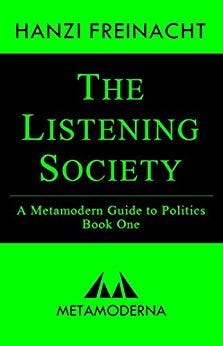
I read an advance copy of The Listening Society: A Guide to Metamodern Politics by Hanzi Freinacht back in May, which was released on September 1st by Metamoderna.org. This book is the first of its kind, generating a deep discussion about society’s psychological development from a metamodern perspective. While many people are still floundering to figure out what comes after postmodernism, some, like Hanzi Freinacht, are working vigorously to get ahead of the problem, and are now waiting to greet you. Metamodernists have listened to the sages through the ages, and carefully studied people and politics, so that we all can be elevated to the next paradigmatic plateau together. For a backgrounder to the core concept, see my introductory Beyond Metamodernism post.
In the early pages of the book, Freinacht describes metamodernism as a “philosophical engine” which can ‘drive’ us from point A to point B. It is a great metaphor. But perhaps we should think of this not like a car engine, but rather like a video game “engine” that processes complex information to provide a high level of resolution. We need to use more game-theory to understand conflict, and gamify the peaceful resolution. This will help us build the virtual metamodern ‘engine’ that gets things done efficiently.
The Listening Society attempts to revitalize the noble premise of politics — the representation of (all) people — by calling us up to a higher humanistic and philosophical plateau. Will you answer the call?
Listen Up
“The word ‘listen’ contains the same letters as the word ‘silent’.” — Alfred Brendel
Let’s start with the title. It is called The Listening Society because it implies that no one is left outside the conversation, that everyone is heard and has their needs are met. This does not mean direct democracy (which is not always functional: ie. Brexit). It means that society itself is the product of more sincere communication and deeper understanding. It would mean that policy is generated from the perspective of wisdom, not a perch of partisanship. Listening is contrary to the usual political status-quo, which is a lot of talking past one another. We are constantly encouraged to ‘speak up’ but how often are we reminded to shut up and listen?
The Listening Society, as defined below, is one of three parts of political metamodernism. The book is dedicated to the first part only. Politics aside, it refers largely to the socialist infrastructure needed for a healthy fair society.
“There are three different parts of political metamodernism:
• The Listening Society — which is the welfare of the future, a welfare that includes the emotional needs and supports the psychological growth of all citizens. A society in which everyone is seen and heard (rather than manipulated and subjected to surveillance, which are the degenerate siblings of being seen and heard).
• Co-Development — which is a kind of political thinking that works across parties, works to keep ego-issues and emotional investments and biased opinions in check, and seeks to improve the general climate of political discourse: “I develop if you develop. Even if we don’t agree, we come closer to the truth if we create better dialogues and raise the standards for how we treat one another.”
• The Nordic Ideology — this is my name for the political structure that would support the long-term creation of the listening society and make room for co-development. It is called the Nordic ideology because its early sprouts are cropping up in and around Scandinavia. It includes a vision of six new forms of politics, all of which work together to profoundly recreate society. A large part of this has to do with how to defend citizens from new sources of oppression that can emerge as a side-effect of a “deeper” society. These new forms of oppression are generally of a more subtle and more psychological kind than what we have seen in the 20th century.”
The concept behind the The Listening Society reminds me of Axel Honneth’s impactful study The Struggle for Recognition. If we could only recognized each other, we would struggle less. Instead, we ‘Otherize’ each other, and they become alien enemies to us. And as Freinacht’s Listening Society suggests, it is ironic that in a era of mass surveillance, the state is so blind and deaf to its citizens needs. The NSA may be listening to your phone calls, but do they hear you?
People say that Hillary Clinton is a great listener, according to Ezra Klein’s interviews and analysis. And in all fairness, she probably genuinely is, and has learned a lot from listening. But it begs the question of who she listen to. She listened to the wrong people when the US waged war on Iraq. She listened to the wrong people when she took free money from bankers, and consequently she spoke wrongly to them, pandering. She listened to the wrong people when she ran for President in 2016 and lost to Donald Trump. More importantly, she didn’t listen to the right people; to Bernie Sanders and his voters. She’s still not listening to the right people, but she is a good listener.
We must also listen to animals, listen to nature, and listen to the activists and scientists who communicate their secrets. Fundamentally, I suppose we need to listen to ourselves, to the little voice inside us: Our conscience. It says to question, to distrust demagogues, to rebuke quick fixes and snake-oil salesmen, and perhaps most importantly to doubt ourselves. Ultimately, we need to develop more of an appetite for listening, for seeking knowledge. We must listen to the collective action of groups as well.
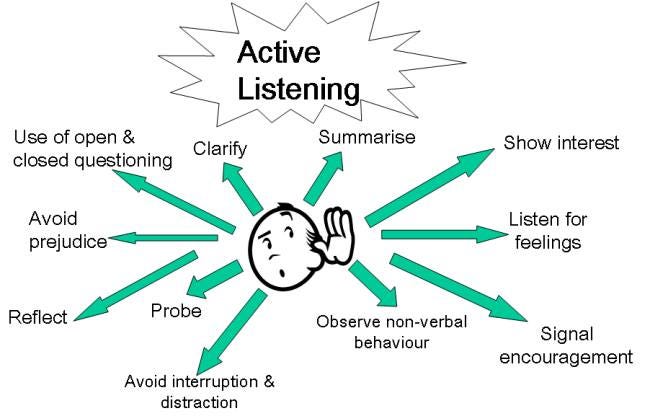
Listening is more than the concept of hearing. It means expanding our awareness, and ultimately constructing a welfare state that hears, supports, and validates everyone. It occurs to me that so much time spent on the internet (over two decades now) is in a way ‘listening’ to the world, processing it, knowing and meeting the struggles of distant invisible peoples. Not everyone uses the internet this way though. There are, of course, some negative consequences of this type of listening, sales funnels, echo chambers, and cyber-polarization.
I suppose an insight I am grasping for here is about how we can ‘listen’ in very efficient and condensed ways, such as watching a documentary or reading a book. This type of simple 2–6 hour intervention could change the world, you would think. For example, if only Jeff Sessions read a book or watched one of dozens of documentaries on the war-on-drugs, he might have a clue about how to do his job correctly: by ending prohibition, not increasing it. Such is the deafness of power. They are decades behind the discourse.
A good friend of mine once remarked “if a tree falls in the forest, does anyone care?” The remixed proverb is meant to suggest that the philosophical question is not whether it makes a sound, or whether anyone hears it, but rather what are the ethical and ecological implications of mass deforestation? To really listen is to understand. And until we understand, we will never solve the world’s problems faster than we are creating them.
“We have two ears and one mouth, so we should listen more than we say.” ― Zeno of Citium
Meditation

The book takes listening to its logical conclusion. Perhaps the ultimate lesson is not just about listening to others, but truly being silent. Freinacht dedicates a section to an empirical example of Vipassana meditation taught in schools, improving students moods, self-control, attentiveness, sociability, and performance. Later, the book provides a list of 67 citations that scientifically validate the social, psychological, and medical benefits of meditation.
I can speak to this from experience as well. I attented a Vipassana 10-day silent meditation retreat. I was speechless, (pause). We watched an hour video of founder lecturing each day, as part of the course, but otherwise there is nothing to listen to but your own thoughts and biorhythms. The entire group participates in the vow of silence, not communicating with each other at all, even by gesture. So it is not merely an instructive analogy, but perhaps a prime example of truly listening.
Vipassana is a discipline that takes a lot of hard work and patience. The word translates as “insight into the true nature of reality.” This sounds like a tall order, but it is based on simplicity. The technique, of simply observing the breath, works by teaching you to ignore everything else and focus on your natural respiratory rhythms, letting go of the impermanence of reality. It teaches you to be still and not react to everything, which prompts insight. The breath focus is designed to draw you in to psychosomatic awareness, letting go of all thought. In this way, it is the opposite of mental abstraction.
“If its not working, you’re not doing it right.” — Adam Kadmon, The Abs•Tract: Core Philosophy
It is worldwide, even most people still haven’t even ‘heard’ of it. And it’s power has been dramatically proven. The founder of Vipassana meditation, S.N. Goeka, led an experiment in an Indian prison and demonstrated the power of meditation to reform convicts. It essentially ‘cured’ the prison population of its criminal tendencies. It was the subject of an hour long documentary Doing Time, Doing Vipassana, which you can watch. You’d think the idea would spread like wildfire, not just throughout prisons globally, but in general.
Why hasn’t it? Because we don’t live in a listening society, yet, but the Scandanavian countries are a model, although still not perfect. We are sociologically deaf and dumb. That is to say, making moral progress in the world has been absolute hell, and retrospectively there’s no good reason for it to be so difficult? Have to ask why people resisted things like abolition or suffrage or civil rights? What mental gymnastics, then and now, did people perform to get out of listening and paying attention to atrocity?
The status-quo is bungled like a log jam and the good ideas aren’t getting through. No one is really listening, not only to each other, but to themselves. There is a very valuable abstract connection between meditation and metamodernism; between Vipassana and The Listening Society; between welfare and wisdom!
Vipassana took hardened criminals and made them into compassionate beings, so what have we got to lose? I am also advocating a novel form of abstract meditation, where I propose a more detailed description and technique based on abstraction.
Abstraction in The Listening Society

“there needs to be a lot of big talk when you deal with bigger and more abstract issues and matters” — The Listening Society
The Listening Society wouldn’t be as strong as it is if it didn’t appreciate abstraction. Big talk and abstraction go hand in hand, but big talk requires big listening. And as these excerpts suggest, abstract thinking is not very popular.
So let’s jump right into the big idea behind big ideas. Abstraction plays in the book in a number of ways. It is featured explicitly as one of the main stages in Michael Lamport Commons’ Model of Hierarchical Complexity (MHC), which is a major part of the book. The MHC is a science of information organization and stages of cognitive development, a mathematical basis for psychology (I wonder if Jordan Peterson knows of it?).
“Commons first formulated the theory after having taken a year off from work to study mathematics, where the language of abstract algebra helped him to describe the formal relationships between the different stages.” — The Listening Society
In The Listening Society, it is the first of the four “Important Stages” that get their own subsection: Abstract ->>> Metasystematic. Each level corresponds of computational complexity in life forms, and it can be applied to our own thinking as well.
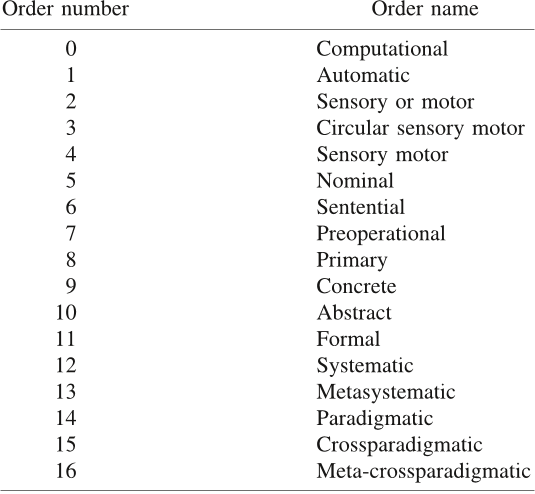
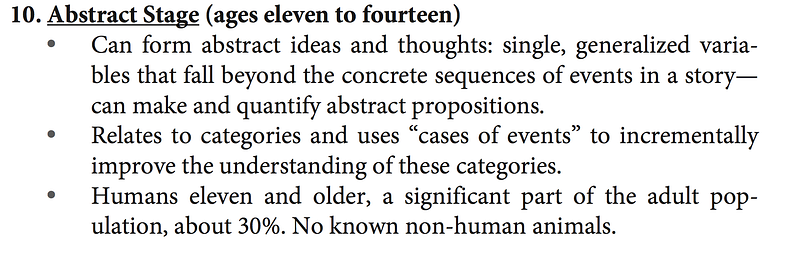
In the context of MHC, abstraction has much to do with levels of complexity, as well as with depicting the hierarchy itself. It is a necessary stage that bridges the Concrete and the Formal. A corrective note: I think they may have mixed up the population percentage with the next stage, as it goes from 30% to 40% in the Formal stage, and then back down to 20% in the Systematic stage. At any rate, abstraction is also foundational in the process of ideation and concept formation.
“At stage 10 Abstract, we can invent our own abstractions: not just chairs and tables, but furniture; not just furniture and domestic appliances, but “all movable objects you put in a home”; not just home and office but all indoors environment — and so forth.
This is not just mimicking words like “furniture” used by others, but actually creating novel abstract concepts or variables themselves.
The stage 10 Abstract thinker can then use quantification of these var- iables: some of the furniture, some of the time. This can refine the varia- bles, make new distinctions and let the abstract concepts acquire new meanings.
The abstractions are taken from stories about concrete things, people and events. These abstractions — furniture, love, justice, animosity, weight, volume — take on meanings that go beyond the particular story they are a part of.”
This is merely the beginning of abstraction, as we can abstract up and down the hierarchy from this stage.
“The MHC stages measure orders of vertical complexity. This means that each stage coordinates the actions at the preceding stage. You go from constructing stories to finding abstract variables in those stories, to finding relationships between abstract variables, to finding systems of relationships, to finding common properties in systems, and so on.” — The Listening Society
Indeed, one thing I am attempting to do through The Abs-Tract Organization is abstract metamodernism itself. We’ve got a ways to go for that. For more info on the Model of Hierarchical Complexity read their article on it, or the book. I would prefer to focus on their more general usage of abstraction throughout the book.
“In the postindustrial, digitalized and globalized economy, where the most revenue is cycled through rather abstract services, we no longer have the same class division.” — The Listening Society
Here we find an allusion to the ubiquity of abstract services, which I read as a double reference to both service jobs and the services themselves. Service jobs now constitute about 90% of jobs in advanced economies, whereas they were only about 30% at the turn of the 20th century. I touched on this in How to Humanize AI with Abstraction, where there is also a graph showing that data. Freinacht raises this point to comment the diffusion of class stratification. The relationship between elites and masses has become much more abstract than traditional hierachies and class structures. It is not the proleriat now, although they still exist, but the precariat.
With respect to abstraction in the postindustrial global economy, Srnicek and Williams’ book Inventing the Future: Postcapitalism and a World Without Work uses abstraction much the same way (similar to The Abstract Society). The question is what can we do about it?
“We need directions, but these directions must necessarily be of an abstract, open-ended nature. We don’t need cookbooks; we need general ideas on how to create good cookbooks, so to speak. We need stories about stories. Meta-narratives.” — The Listening Society
The description of general ideas and meta-cookbooks resonates a lot with The Abs-Tract Organization’s mission.This quote is in the context of solving the “multidimensional crisis-revolution” of our time. There is both a great threat and opportunity to address the meta-problems we collectively face. Freinacht prescribes anticipation and foresight to be ready to create the next and final phase of global development — peace.
In particular, the need for blueprints that are also open-source and dynamic aligns with my description of H.G. Wells’ “Open Conspiracy,” which I defended in detail against George Soros’ Open Society in The Abstract Empire of Global Capital. So, how do we develop this meta-cookbook and whip up recipes to solve the meta-crisis?
“The more correct, abstract and complex your map of reality, the greater non-linearity you can afford in your thinking and agency, since you hook up with deeper and more universal structures of how society is evolving. That is how it works: the Heracles, Prometheus or Achilles of our age is whoever can think the most abstractly and act the most non-linearly.” — The Listening Society
Again, another great quote where we find concordance with how I have been describing abstraction as mapping, based off the work of both Jordan Peterson and Benjamin Bratton, who each got a respective review of their abstraction. We do not mean having a static map that you assume is a true representation of the territory; we are talking about non-linear thinking, and perhaps holographic mapping.

But do not confuse our meaning with simple territorial maps. At least in this beautiful abstract map we can see borders for what they are: perforated political lines that people drew on the earth; not real. The more abstracted your figurative ideas about social reality, the clearer your worldview, for the better. And may the greatest abstraction win: a metamodern society that has (re-)solved the problems of (post-)modern society. It is the most authentic holistic inclusive representation of the earth and the world society on it. It’s almost like we need a new global meta-religion to bring people together.
“…traditions abstract from the stories and narratives of their time, certain universal understandings (you go from MHC stage 9 Con- crete stories to stage 10 Abstract concepts). There is not just “the gods”, but a “God above all gods” — the ultimate abstraction.”
Abstraction can describe the progression ideas and evolution of religious beliefs. It takes one out of the lower stages of superstitious and archaic conceptions about the world, to more abstract metaphysical descriptions of nature and God. Jordan Peterson lucidly describes God as the ultimate abstraction in this clip from The Rubin Report.
This multi-perspectival view is vital for a true conception of “God” and the development of abstract religion. For more on Peterson’s thinking see The Abstraction of Jordan Peterson and the sequel The Detraction of Jordan Peterson.
But what about the limits to listening? How can hear anything when the public discourse has so much white noise? Metamodernism and abstraction helps improve the signal-to-noise ratio, but more on that later.
The Listening Society contains many more insights than I’ve given space to here. I have only focused on listening, meditation, and abstraction. There is more to it. Freinacht closes out the book with an appendix, listing the key points of the metamodern view of life, science, reality, the human being, society, and spirituality, existence and aesthetics. Most of the chapters are of the book are available to read at metamoderna.org. I highly recommend you listen to our metamodern guidance.
The Abs-Tract Organization (TATO) is a boutique research and media think tank, centered around the broad concept of “abstraction” and five other vital research streams.
If you appreciate the work we do, please support us on Patreon for $1.
Please like and share this article. Join and support our growing metamodern project at http://www.abs-tract.org and on twitter @TATO_tweets.