
Sustainability, Lifestyle
The Line-Dried Laundry Smell: Origin and Ingredients
Researchers at the University of Copenhagen have studied the phenomena that take place on a wet fabric and they discovered how line-dried laundry gets that unique scent.

aeder on PexelIn our daily life we encounter several fragrances and a sense of smell plays an important role in the physiological effects of mood, stress, and working capacity. The smell of coffee inebriates our mornings, the scent of jasmine marks the arrival of summer and the fresh sea breeze makes us reminisce vacation time. In Marcel Proust’s novel Remembrance of Things Past, the nostalgic flavor and fragrance of a madeleine recalled childhood.
The perception of smell consists not only of the sensation of the odors themselves but also of the associated experiences and emotions.
“Every word has its scent” said Nietzsche.
The fresh, pleasant scent of laundry dried outside in sunlight is one of those smells imprinted in our olfactory memory. It evokes warm memories and a unique sensation of cleanliness.
Thus, many detergent companies have tried to optimize their soaps to reproduce the well-known smell of “clean laundry”. However, despite the importance of detergent fragrances and washing methods, the drying process plays a key role in determining the laundry smell. — You can use the most pleasant, fragrant soap but if you forget your clothes in the washer they will not smell good! —
Silvia Pugliese, a talented Ph.D. student in Chemical Sciences, and her research group at the University of Copenhagen, in their last publication on Environmental Chemistry have investigated the chemical and physical phenomena that take place on a wet fabric surface during the drying process and they discovered the origin of the smell of line-dried laundry.
If you are wondering why chemists are interested in laundry smells the first point to consider is that if it smells — it’s chemistry. Scent is the most chemical of all the senses; odors are generated by small molecules with a molecular weight < 300 Da that humans perceive via the olfactory system. To be smelt, the molecules must vaporize either as a result of evaporation, if a liquid, or sublimation if a solid (eg menthol or camphor). The odorous molecules typically belong to the Volatile Organic Compounds (VOCs) class.
I contacted Ms. Pugliese and we have talked about her interesting study, from chemist to chemist!
Ms. Pugliese explained that the study started out as a side project: “Dr. Matthew Johnson, my supervisor at that time, was scientifically fascinated by the line-dried laundry scent, thus, in parallel with our official research projects, we have optimized an experimental design to determine the molecules responsible for that fragrance”.
To achieve the goal a set of 100% cotton towels from Ikea got washed three times in ultra-purified water — no soap — and was left to dry in three different conditions:
1. outside in the sun — on a balcony of the Department of Chemistry; 2. outside in the shade — on a balcony of the Department of Chemistry, using a plastic cover to screen sunlight; 3. inside a dark office.
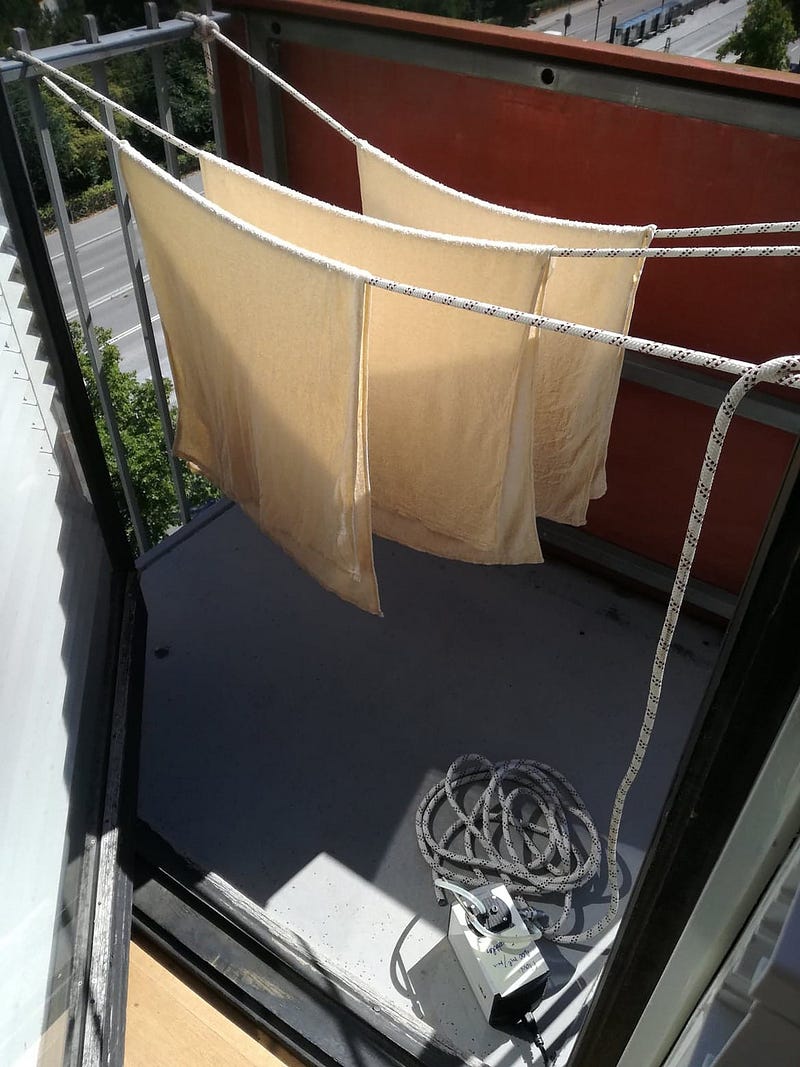
After the drying time, the towels were sealed into specific sampling bags for 15 hours and the inside air was sampled and analyzed to investigate the presence of odorous molecules. To perform a comprehensive study the following were also analyzed: - fresh non-washed towels — to determine the role of water in the generation of the smell; - an unused sampling bag — to monitor interference from the set-up; - the air of the drying environment (balcony and office) as background.
Then, all air samples were analyzed by using Gas Chromatography coupled with Mass Spectrometry (GC/MS). GC/MS is the method of choice for small and volatile molecules — VOCs — due to its ability to separate complex mixtures and determine and quantify analytes even at trace levels.
Are you curious to know the results?
The GC/MS analysis has revealed that only when towels were dried outside in the sun, oxidised VOCs such as carboxylic acids, aldehydes and ketones were detected.

These molecules are relevant because many of these compounds have a low odour threshold (are therefore easily perceived) and are used in the perfume industry owing to their pleasant scents! In particular, line-drying produced methacrolein, which has a typical floral scent, pentanal whose smell is fruity, 2-hexenal which smells like almonds, nonanal and decanal which both produce fresh, citrusy aromas.
The line-dried smell is a bouquet made of these molecules!
“Once revealed the ingredients of the clean laundry smell the next step was to figure out in which way the oxidised VOCs — responsible for the fresh, pleasant fragrance — were formed” said Ms. Pugliese.
Because these oxidised volatile compounds were not detected in the other drying conditions, various sources could be ruled out. They were not observed in fresh non-washed towels, — so they do not originate from the fabric, nor were they detected in the sampling bag, so they were not contaminations in the experimental set-up. In addition, air samples from the outdoor background showed the presence of un-oxidised VOCs at very low abundance while oxidised VOCs were not obsverved.
Thus, how are the oxidised VOCs formed?
The explanation is fascinating: both sunlight and the presence of liquid water are necessary to generate the odorous molecules.
The surface water layer on a wet towel plays a particularly important role. During drying process, the un-oxidised VOCs present in the outdoor air background— which are the precursors of the final odorous molecules — dissolve in the aqueous phase and enter into the water layer of the towel. Here, VOCs encounter radicals, unstable species generated by UV light from towel dyes and brighteners, and thus undergo oxidation reactions that generate their oxygenated counterparts — oxidised VOCs, finally!
Since now we know both the ingredients and their origin, the mission seems to have been accomplished, however, Ms. Pugliese and coauthors revealed to us another “secret” about the persistence of the clean laundry smell. Oxidised VOCs, indeed, bind with the cotton, which is a linear cellulose polymer, by hydrogen bonds and thus can be retained — together with their fresh, clean smell — by the fabric for few days. One can imagine that the system comprised of water on the cellulose fabric creates a “sink” for the oxidized form of the VOCs.
Despite Ms. Pugliese is now working as early stage researcher in the eSCALED projects to encapsulate synthetic metal complexes in nanostructured electrodes for catalytic CO2 reduction, she is still curious about the line-dried laundry scent. She said: “it would be interesting to repeat the experiments in different places given that air quality varies with location and time the compounds that can be adsorbed by fabrics can vary considerably” and then added “I would be curious to know if UV light lamps can “replace” the role of sunlight”.
Maybe one day we will read another paper authored by Ms. Pugliese with the answers to these questions.


