
The Life, Work, and Happiness Theory
Designing a lifestyle where work isn’t invasive.

Your lifestyle is something you naturally fall into from your wants, needs, and obligations. The wants and needs are how you desire to spend your time, but the obligations are how you have to spend your time.
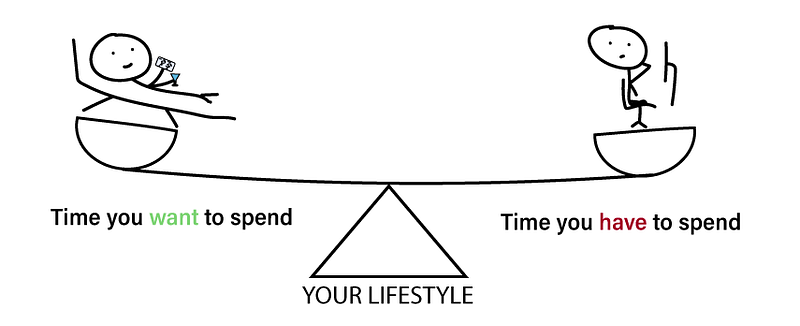
This becomes the balancing act of happiness—our hobbies, relationships, and pleasure on one side; work and responsibilities on the other.
But when our work (obligations) stop being a part of our lifestyle and instead start dictating our lifestyle, we lose a crucial aspect of happiness — perceived control.
People don’t hate work or their lifestyles; they hate not feeling in control. Emerging studies suggest lifelong happiness is directly linked to feeling in control of one’s life.
And that feeling of not having sway over your destiny seems to transcend country, culture, and socio-economic status. People’s perceived sense of “enough money” (perceived income adequacy) had a more significant effect on happiness than what they actually earned.
It’s simple. You, me, and the regular person would instead do what we want to do than be coerced into anything else — even if we like the activity.
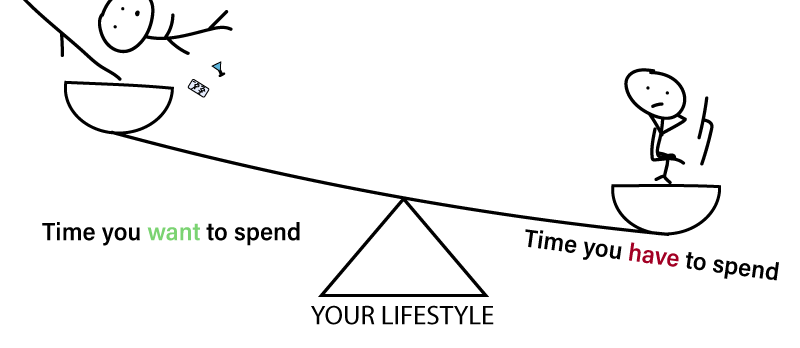
When you’re being dictated, told what to do, or given a schedule you have to abide by, it doesn’t matter whether you like the work/action; the lack of control makes you hate it.
So, if we take this knowledge at face value, we can logically assume that one way to be a little happier is by regaining control over our time and responsibilities.
There are a few tried and true ways of doing this, but the one we’re going to focus on relates to money.
Money, Time, and Control
How do we organize our work to fit our lifestyle, rather than the work dictating our lifestyle? That’s the question.
We can’t exactly get rid of work and trust me; we don’t want that — work is one of the few things that give us purpose.
What we want is to work in such a way that we can control the amount and type of work we do. Working while being less obligated to continue working if it doesn’t fulfill us anymore is the dream.
The simple answer to this problem would be to win the lottery and have unlimited money and therefore 100% use of our time.
The non-fantasy-land answer involves thinking about money as a freedom tool rather than a goal in and of itself.
More Money Means More Runway
Increasing income is two things.
- Difficult.
- An enabler for lifestyle inflation.
But even though it’s hard, our income does tend to increase over time. So then it’s up to us to not let our lifestyles get unnecessarily luxurious.
Remember what we discovered earlier?
Happiness is more linked to control than anything else. So, that new car or $300 pair of trousers isn’t going to actually make you significantly happier.
But freedom will, and it’s not free, but it’s the next best thing — it involves not spending money.
Your Savings Rate Builds The Runway
Saving that extra money you earn, hell, even saving right now without an income increase, is the easiest way to build a runway — and a long runway equals happiness.
A long runway means that at any point, you have the freedom to drop activities that aren’t enjoyable and pursue activities that are fulfilling.
Morgan Housel, the author of the Psychology of Money, describes this as “Doing what you want, when you want, with who you want, for as long as you want.”
And I’m inclined to agree.
You can’t head on a 3-month Solo Backpacking Trip at the drop of a hat when your money’s tied up in a BMW you can’t afford.
You can’t quit your gut-wrenching job if your regular $200 nights out keep denting your savings.
But you can do both those things and more if you have a runway, a war chest — a freedom pile.
So more money isn’t necessarily a bigger paycheck — it’s a higher saving rate.
And a higher savings rate gives us more options for work, therefore, allowing us to be pickier with the type of work we do — or even giving us the leeway to try our hand at converting a hobby into a business.
This is how we slowly do what we said before.
This is how we organize our work to fit our lifestyle, rather than the work dictating our lifestyle.
And On That Note
With our higher savings rate, as we build our runway and slowly increase our options for what we want to do and gain control over what we have to do — we see changes in our behavior.
- We’re less stressed about the future.
- We’re more relaxed about speaking our minds at work.
- We have more options and start to consider them more frequently.
- Lifestyles we truly want suddenly become in reach.
We slowly gain these new waves of freedom until we’re suddenly living the way we want to, making money the way we want to, and can genuinely have moments of peace in life.
That’s happiness to me, and I hope you can find it too.
Talk soon.
✌🏼 Sah
I hope you enjoyed that one. Keep up with my shenanigans here; I post maybe 1–2 times a week. And hey, if you want something deeper, I’ve written a small book on sorting the mess of life-decision pressure— enjoy!
Liking Medium? Sign up through your favorite creator’s link (me) at no extra cost to support them and get unlimited access to member articles.


