
The Life of an Artist
We are not footloose and fancy free!
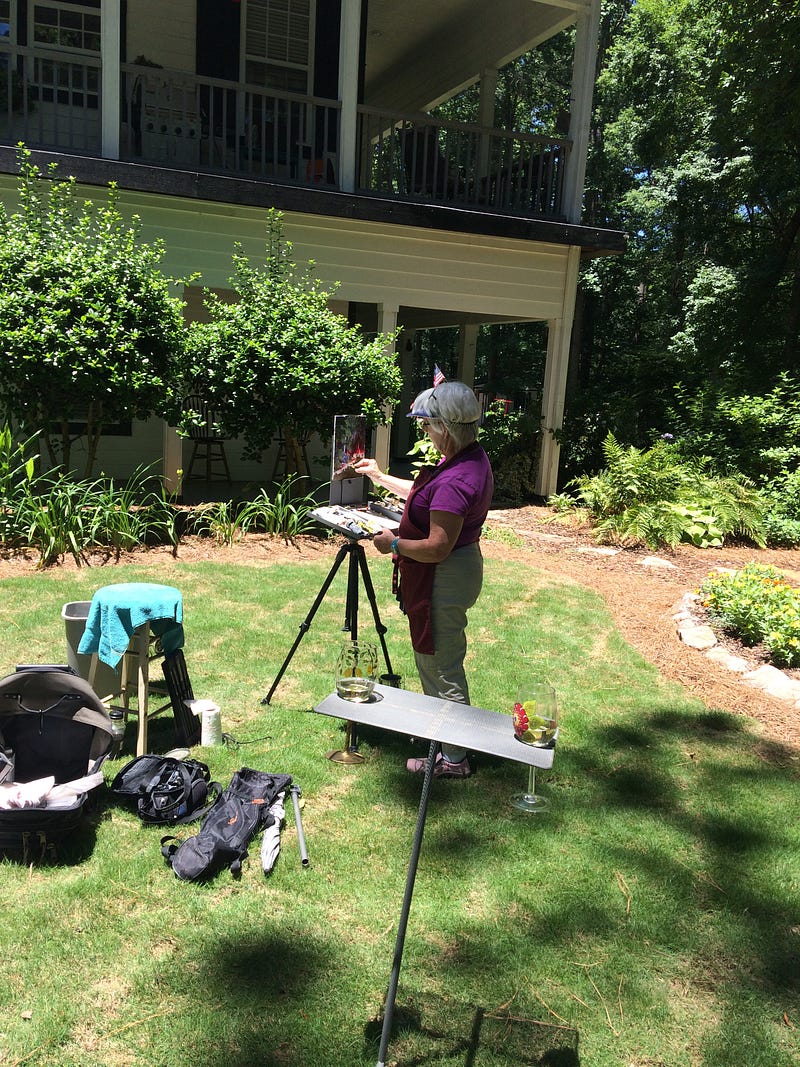
This is a fun photograph … me painting with stuff around, not normally carried with me when trekking in nature with a backpack to paint plein air. And … notice the little stand my friend’s husband made for us to have our “stemmed wine glasses” with us! What fun we always have when we get together!
So the title about being footloose and fancy free … well there are times we just have fun. Many of those times there is no pressure to create what I would call a “frame worthy painting!”
Most of the time when painting plein air, we are creating studies. Studies teach us about seeing the true colors of nature, light, downtown, trains, you name it!
Soooo …. maybe I need to get back to the subject of this article!
I have not been on Medium to write much in the past few months.
It seems I have found other things to do besides write. I have even found other things to do rather than paint. Organization of painting inventory, and the massive number of files, photos, etc. on my computer have called me to get them in order. I’m running out of room to store them. Both the paintings, and the digital files!
And, add into the mix, photographing artwork so I can submit paintings to juried art shows, participate in invitational shows, and carry work to my galleries. Oh My!!!
But also, Spring in Georgia is the time of many art events, some of which are painting plein air which I mentioned in the first paragraph. That term is French for “in the open air.”
Plein air painting is about leaving the four walls of your studio behind and experiencing painting and drawing in the landscape. ArtistNetwork.com
There is no better way than going to the source and painting what you see! Many artists paint in the studio from their photographs which is fine if you can keep yourself from “copying” the photo exactly. It should only be a reference for remembering everything you saw.
Remembering is essential. You need to remember how the air felt! Was it heavy, light, windy, still, etc. What was the sun doing, were birds singing, or bugs biting you? I tell my students when in the studio, to turn away from their “work-in-progress” and close their eyes to remember details of the day and how it felt.
This. Really. Works!
Other events are scheduled during this time as well… shows being a big one which I mentioned above. That requires travel to deliver artwork, then schedule the date of the reception to attend. So keeping a calendar of all essential dates is a big deal.
So, back to the life of an artist, right?
Sure, we work in our chosen medium: oil paint, pastel paint, sculpture, carving … many different kinds of ways to create something artistic.
But, creating is only maybe 40% of our time when we have become a professional artist. I’ll clarify that by saying, “if you don’t have help.”
I have recently hired another artist to help me with inventory and possibly other office type work. Keeping up with cataloging all the art is a time consuming piece of our week. Taking photographs and loading to the computer, editing the images for use in entering shows or for the galleries to load to their sites, takes a huge amount of my time.
Entering shows and competitions requires looking through the work we do, choosing appropriate ones to enter, and then making sure we have the size required to upload for their juror and judges. That requires we understand how to edit images as mentioned above. Then setting those pieces of art aside with a label so we don’t make a mistake of entering it into another show that overlaps.
Why enter shows?
Building a reputation is one key element to sales. Artwork must speak to the viewer and they purchase because they like it. But I have heard from clients about seeing my work and then deciding to get in touch to purchase something or commission a piece to their specifications.
It also can make a difference in teaching workshops and classes. It is hard to pinpoint sometimes if it helps, but when I have people tell me they saw my work at “such and such” show, I know it did help! A student who saw my work realizes what they might need and contacts me to find out about taking a class or workshop from me.
This type of “life as an artist” may not be what you as an artist want. That is okay as well.
Why do I tell you all this?
Because everyone seems to have the wrong idea about the life of an artist.
I probably work more hours being an artist than most people that have a 9 to 5 job.
I’ll say it again … we are not foot loose and fancy free!


