
The Lesson of Bus 22
Things are not always what they seem
Summer, 1970. The warm air drifting in through the windows of Bus 22 as it rolled lazily along Route 3 brought with it the distinctive smell of carbon monoxide, along with a host of other odors of more questionable origins. As impure as it was, the outside air provided a bit of relief from the sweet, oily smell of the creosote-treated wood floor of the bus.
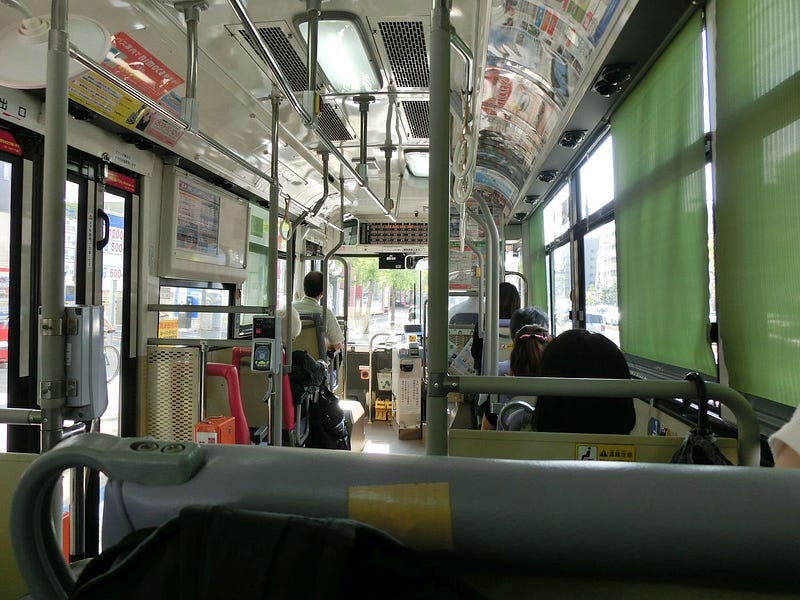
Even though few foreigners lived in Fukuoka, Japan back then, all of the passengers remaining on Bus 22 that day were Americans.
“The best way to get back to base from Fukuoka is to go to Gate 1 of the Tenjin Bus Center and catch Bus 22. It will take you right to the bus stop in front of the Main Gate.”
This advice was one of the first things you learned after arriving at Brady Air Base.
Brady was a small installation that hardly deserved to be called an airbase. Facing the continent, Brady was in a perfect location to intercept radio signals of our Asian adversaries. The closest it came to supporting any air operations was a tiny no-longer-used helipad overgrown with long weeds that poked out of the cracks in its asphalt.
The base was located on a long, narrow tombolo that separates Hakata Bay from the Pacific Ocean. Aptly named Umi-no-nakamichi (Road In The Middle of the Sea), the tombolo was so narrow in places that you could drive along while simultaneously enjoying the view of the tranquil Hakata Bay on one side and the rolling Pacific Ocean on the other. The tip of Umi-No-Nakamichi was linked to a small, sparsely-populated island named Shika-no-shima (Deer Island). Bus 22 normally went all the way to the end of the peninsula, did a loop around Shika-no-shima, and then came back along Umi-no-nakamichi to Route 3 and then back on to the Tenjin Bus Center.
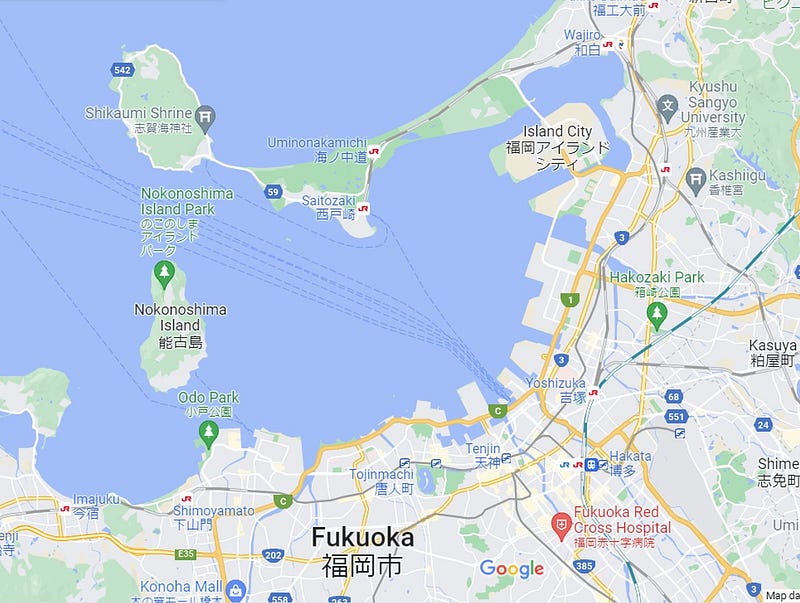
We were more than an hour into our ride when the familiar small office building with the big red HITACHI sign on top finally came into view. The sight of the scarlet logo always brought a feeling of relief when returning to Brady, for it marked the three-way intersection we called “The T.” A turn up the stem of The T meant you were on the final Umi-no-nakamichi leg of your journey.
After another 10 minutes or so, Bus 22 rolled up to Gan-no-su (Goose Nest), making what we thought was the final stop before the base, which was still a couple of kilometers up the road. Expecting to be on our way after a brief stop, we were taken aback when the driver started talking in Japanese while gesturing with his arms. None of us could understand what he was trying to say, but the meaning of his gestures was unmistakable. He wanted us all off of his bus.
Eventually, we started to file off, shooting the driver sidelong dirty looks as we did. Once we were off, the driver restarted the engine and pulled off into the nearby Gan-no-su turnaround.
I asked one of my fellow travelers if they knew what had just happened. She replied, “They do that sometimes. If there aren’t any Japanese passengers on the bus when they get to Gan-no-su, they kick all the Americans off and cut the route short. They’re just too lazy to go all the way out to the island.”
Not knowing any better, I took her word for it and filed this new tidbit away in that mental drawer labeled, “Reasons Not to Trust the Japanese,” where it sat for quite a long time.
After about 15 or 20 minutes of sweating on the side of the road, another Bus 22 rolled up. This time, the driver let us all on and took us the rest of the way to Brady Air Base. I don’t recall if there were any Japanese passengers on board.
Over time, my knowledge and familiarity with Japan slowly grew, as did my Japanese speaking and reading proficiency. I started to learn kanji, starting with the names of the places I encountered in my daily life. It was quite a thrill whenever I was able to make sense out of some previously-indecipherable poster or sign.
Then, one day I was back at Gate 1 of the Tenjin Bus Center, waiting to catch the bus out to Brady. As Bus 22 pulled up, I looked at the large characters showing the final destination above the windshield.
22 雁ノ巣… 22 Gan-no-su
Surprised, I asked the driver about going out to Brady. He explained that Bus 22 runs two different routes. Some go the full route that loops around Shika-no-shima and back, while some go only up to Gan-no-su. He explained that I needed to wait and take the next Bus 22 if I wanted to go out to Brady.
It was then I realized that every conclusion we had jumped to about Japanese people earlier when we were kicked off the bus at the Gan-no-su stop was wrong.
Our displeasure and suspicions were due to our own ignorance and Japanese illiteracy.
It is my hope that all of the Brady Air Base residents who have ever been kicked off of Bus 22 in Gan-no-su will have a chance to read this story.


