
The Legal System is Making My Son Take Anti-Psychotic Medication
And that’s a good thing
Our healthcare system is broken. A walk around San Francisco makes that clear. People in psychosis are everywhere — on the bus, on the street corners, huddled up under filthy blankets sleeping in doorways, their dirty, scab-covered feet poking out at passersby.
I don’t usually interact with these people. I fear them. They’re unpredictable, and I don’t want to draw their attention. But if a gentle one who doesn’t smell bad sits near me on the bus, I’ll talk to him. And when I’m driving by a certain street corner, where one or another often stands with a sign, I’ll stick my arm out the window and hand them two dollars as I whoosh by.
That’s all I can do. There’s nothing I can do.
I feel for these people. My son was one of them and could be again. After developing schizoaffective disorder (schizophrenia and bipolar) at age 18, he spent time in our home, various cheap hotel rooms, and a trailer on the Peninsula before going rogue, sleeping outside in San Francisco and around the Bay Area. For awhile, he favored a tiny, protected spot beneath a pedestrian walkway on Telegraph Hill, a spot he kept secret until one day he asked me to help him move his stuff — a big dirty blanket, a pair of sandals, a handful of damp clothes.
Things are different now. He lives in a subsidized apartment by himself. He gets food stamps (now called EBT). He gets Social Security and Supplemental Security income, about $1,100 a month (when they aren’t deducting unpredictable amounts for this or that), one third of which goes towards his rent. He’ll turn 37 in September. It’s been a rough 17 years.
“Why aren’t you medicating him?” I cried to an officer. “I don’t know, ma’am. That’s not our job. We just transport the prisoners.”
But last year, when he was decompensating in jail, chained hand and foot like a feral animal in an orange jumpsuit, shouting angry nonsense at me through thick glass in the visitor’s booth while the three young officers it took to get him there looked helplessly on, I experienced one of the worst days of my life.
“Why aren’t you medicating him?” I cried to an officer.
“I don’t know, ma’am. That’s not our job. We just transport the prisoners. You need to ask someone in mental health.”
Usually, I keep my grief and upset locked away in a small container lodged somewhere in my belly. But it burst out that day — in the visiting booth, in the lobby of the jail, on the patio outside the jail, and in the driver’s seat of my car as I made plea after plea after plea, call after call after call, crying and begging and snotting and hiccupping into the phone. Please help my son. Please help me. Dear god, why isn’t anybody helping my son?
People care about this issue, and not just because we have to walk by scary and repulsive people on the street every day — but partly because of that. We care because these people are our sons and brothers and parents and cousins and friends. We care because allowing people to live in pain and sickness and poverty on the street is obviously wrong, and we are not inhumane. But what can we do? There’s nothing we can do.
The perils of jail time
After being arrested for a minor misdemeanor (vandalism under $400), my son spent nine months in jail. For much of that time, he was unreachable. After I had that first horrible visit, I went back and back again, but was told he wouldn’t come out of his cell to see me. (Later, he said he didn’t know I was there.)
In the past, when he’s been arrested for being mentally ill, he’s called me collect from the jail to get some kind of help, but this time, no call came. When I tried to interact with the people in charge — in correctional mental health, or correctional health, or county behavioral health, or any other government division — I was told that because he’s an adult with privacy rights, they couldn’t give me any information. They couldn’t even talk to me on the phone.
But I’d learned from experience that they could listen, if they accepted my call. So I called and told them, over and over, that my son should be on the mental health unit of the jail — where one-third of the prisoners at Maguire Correctional Facility in Redwood City are held, a rate that’s comparable to jails and prisons across the U.S. — that he needed anti-psychotic medication. That he was in crisis. That he should be in the hospital. That he should not be in jail.
“In the past, when he’s been arrested for being mentally ill, he’s called me collect from the jail to get some kind of help, but this time, no call came.”
I also wrote him letters and mailed them to the jail. They came back unopened. As it turned out, I was supposed to be mailing them to a mail processing center in Florida where they would check for secret messages and concealed drugs. I should have read the fine print on the website.
The one thing I could accomplish was to look at the “inmate locator” online and see what he was charged with and when his next hearing was scheduled. But after showing up at the courthouse on the first appointed date only to hear that he was unfit to stand trial and had declined to leave his cell, I stopped trusting those dates. Also, his charges kept changing, which was deeply alarming. At first, he had only a misdemeanor vandalism charge. But then a felony appeared for damaging the jail, and later, another felony for obstructing an officer. It felt to me like he was sinking deeper and deeper into quicksand and I was running around on the surface, unable to find a rope to throw him. Was my son ever going to get out of jail?
I suppose I should mention here that in the week before he was arrested I had called the local police three times asking them to take him to the hospital — something they’d done before. But after visiting his apartment the first time, police determined that while he was obviously unwell, he was not a danger to himself or others, so therefore couldn’t be taken to the hospital against his will. He declined their offer to take him. None of that mattered once he was arrested and jailed.
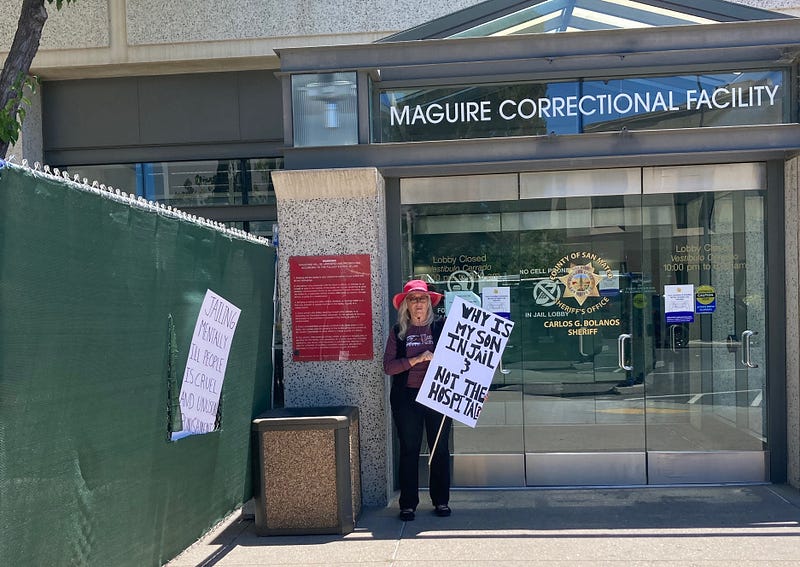
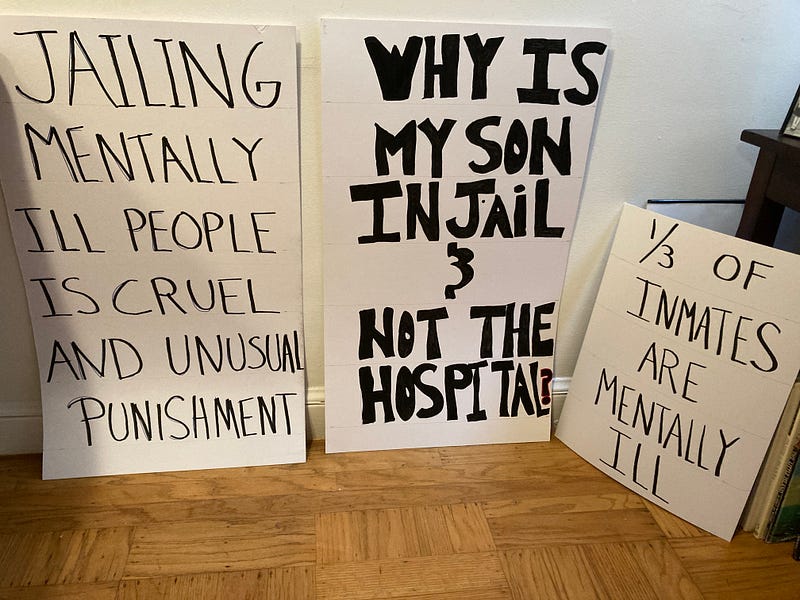
Finally, in frustration and desperation, I made some signs and stood with them outside the jail. It was the only thing I could think to do. I talked it over with a spiritually-minded friend beforehand. She said as long as I had no expectations of any result, I should go ahead and do it. Do it for my own peace of mind. Do it for the positive energy it would send to my son inside the jail. Do it to feel that I was doing something. So I did. I also called a local newspaper and told them what I was doing.
Not much happened on the day I stood outside the jail. But people going in and out of the jail or walking by noticed me. Some of them gave me a smile or a thumbs up. A reporter came out and interviewed me and took pictures. And the very next day, I got an email saying my son was trying to contact me — that in order to receive his email, I needed to put some money into an account. I have to believe the two things were connected. Someone at the jail noticed me and decided to help my son figure some things out.
As I soon learned, systems had changed since the last time he was in jail. He couldn’t call me collect. He needed money on his books first in order to use the phone. He couldn’t email me directly. He needed money in the jail’s “smart communications” account in order to send and receive email. Once I understood that, I put money in both accounts, we began a correspondence, and things started looking up.
Hughette to the rescue
Besides the trauma of being in jail for so long, the fact of being in jail created other huge problems for my son. For one, it caused him to almost lose his subsidized apartment. HUD (the federal department of Housing and Urban Development) didn’t want to pay for an apartment that wasn’t being occupied. That makes sense. Yet if my son lost his apartment, what would happen to him when he was eventually released from jail? The fact that he had an apartment subsidy in the first place was a bona fide miracle. He would never be able to get a subsidy again.
Meanwhile, a jail psychiatrist who didn’t know my son had evaluated him via a 15-minute Zoom call and determined that he should be sent to Napa state mental hospital — that he was incapable of living on his own, despite the fact that he’d been doing just that for the past two years. And even though I felt strongly that he should have been sent to the hospital instead of jail in the first place, the prospect of Napa frightened me. Unlike the local community hospital, where they commonly kick my son out before he’s fully stabilized, the state hospital felt like a life sentence. If my son was sent to Napa, they could do pretty much anything they wanted to him, including keeping him there indefinitely. If my son went to Napa, he might never be released.
Meanwhile, a jail psychiatrist who didn’t know my son had evaluated him via a 15-minute Zoom call and determined that he should be sent to Napa state mental hospital — that he was incapable of living on his own, despite the fact that he’d been doing just that for the past two years.
A temporary conservator who had worked with my son before teamed up with me to tackle these two problems, and I thanked god that she knew my son already and had once again been assigned to his case. Because to anyone who looked at him on paper — like the prosecutor and the jail psychiatrist — these determinations made sense. Sure, take away his subsidized apartment and pack him off to the state hospital. He’s not normal. He’s a troublemaker. He’s certifiably insane.
But Hughette and I knew other things about him. We knew he’s also super smart, and charming, and fun to talk to, and lovable, and fully capable and competent to run his own life, with a little help from me and the service providers assigned by the county, who were already lined up and doing their job. So we went to two scary hearings with HUD and presented the case that my son should keep his subsidized apartment. It made all the difference that Hughette was there. Her grasp of legal systems is amazing. My mother’s tears and fears could only take us so far… And HUD decided he could keep his apartment if he was released from jail by a certain date (very soon!) and wasn’t sent to Napa.
Everything we did seemed to happen on the edge of a cliff. Given the amount of procrastinating and rescheduling that goes on in the courthouse, a release by the required date was by no means guaranteed.
We also lobbied the prosecutor to ignore the jail psychiatrist’s determination and listen to our recommendation instead. We came up with a treatment plan that might please the prosecutor and the judge. We pushed and prodded the service provider — who had started the process to cut off my son as a client since he was in jail and beyond their control — to provide a plan in writing to the court and commit to providing regular updates in the future, i.e. take on extra work. And we explained it all to the defense attorney, who hadn’t had much experience with this type of case before.
How is this any different from what he’s doing already? the defense attorney wanted to know, since my son already has a service provider and a subsidized apartment and he’s still not making it — still winding up in jail.
The difference is, this time, he has to take his medication, because if he doesn’t, he will go back to jail.
The paradox of our (in)justice system
So that’s the paradox. As much as I regret my son going to jail, and see it as a brutal option and a basic injustice, it somehow, in the long run, is helping my son. Because now, for the first time in the 17 years since the onset of his mental illness, he is being required to take anti-psychotic medication.
Always in the past, it has been a choice. And always, at some point, he’s chosen not (or possibly forgot) to take his meds. But this time, he’s been released from jail on a “mental health diversion” program, which is a particular kind of probation. He has a treatment plan which he must follow which includes proving that he’s taking meds. His service provider provides regular reports on his progress to the judge. He comes back to court periodically to check in. His charges, meanwhile, are held in abeyance. And eventually, in two years, if he successfully completes the program, they will disappear.
When he was first released from jail, it was close to Christmas time, and my extended family wasn’t ready to receive him. Neither was I ready to organize his re-entry. It had been years (five? eight? ten?) since he attended a family event. I told him he should probably stay home and he accepted that with equanimity, saying simply “I didn’t know people were mad at me.”
But now, seven months later, we’re coming up on a big two-week family reunion, and he’s let me know that he wants to come. It’s crowded. It’s intense. And I’ve been fretting about possible negative outcomes, so I sent him the following text.
I’m a little worried about you staying the whole two weeks. Hopefully, it will be all smooth and low key, but if it isn’t, you might have to take a break and go home for a few days. Just be aware. People aren’t used to you. It’s been like 8 or 10 years!
His response was super reassuring.
Anybody can k8ck me out. Just pleas3 tell everyone addr3ss their issues with me directlt. Ni gossip. No gossip or table talk or whatever please. Soim not in the dark. I think key is finish my outline so I have a purpose while I’m thete. If I’m working on book I don’t need anything but a chair. So leaving actually I cn do asap be4 problems heat up.
I told him I loved him and that his attitude made me happy and that I’d be passing his thoughts along to my sisters. When I did, their responses were heartwarming.
“Sounds like you both have the bases covered. I hope it works out the way you envision. It would feel good to be able to fold him into our scene,” said one sister. “It’s fine with me if he comes. I am looking forward to seeing him,” said another. And “That sounds great to me too! It will be nice to have everyone there,” said a third.
So now, thanks to the brutal and unjust criminal justice system, but also to the merciful and solution-oriented mental health diversion program, my son is coming to a big family event for the first time in a decade. As for me, I’m feeling happy and hopeful and grateful and relieved, and thinking good times are ahead— for at least the next two years. And who knows? Maybe my son will find, during his two years of legally-enforced sanity, that he likes being sane and wants to keep taking medication.
It’s possible. I’ll report back.
Wish us luck.
Epilogue: As I was finishing writing this story, we got a call from a friend about another friend’s death. It’s unclear whether or not this person committed suicide. He was found dead in his bath. What is known is that he had schizophrenia, and had been served an eviction notice. And what is known about my son’s recent history is that if Hughette and I hadn’t been there to go to bat for him, he would have lost his housing and his treatment team as a result of being jailed for being mentally ill. I support California’s new bill (passed in October of 2023) that makes it easier to compel people with mental health issues to get treatment.
Besides writing about women and mental illness and voodoo and politics and books and movies on Medium, I’ve published two novels here: Thirsty Work and Count All This. Check them out! If you need a membership for access, use my referral link and make me happy. And if you’re a writer with a passion for equality, submit to Fourth Wave.