
The Legacy We Leave: What We Hear When the Cellos Play in “Strawberry Fields Forever”
Replaying our lives through music
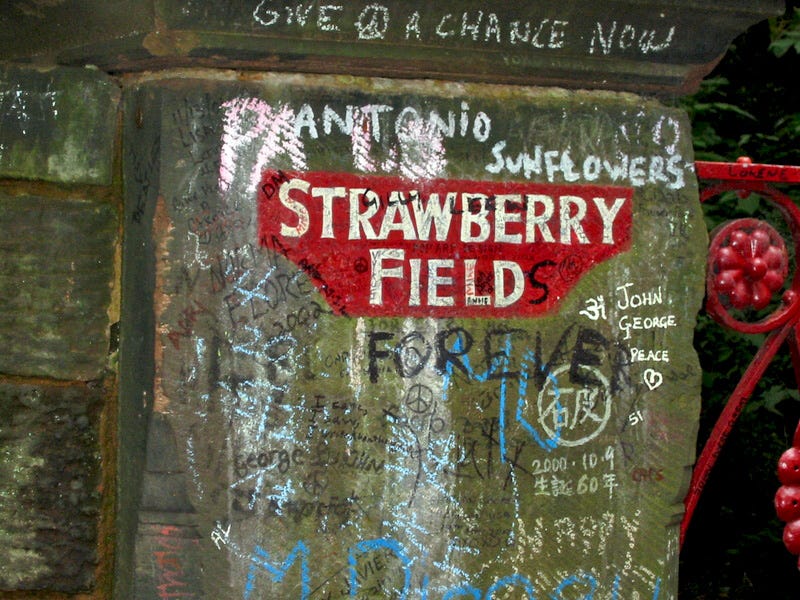
My rusty 2005 Toyota Corolla has an old CD deck. Every time I drive my beat-up car, I dig up my CD collection like a time capsule.
Yesterday’s selection was The Beatles 1967–1970 collection, or the “Blue Album.” It’s the one I used to play in my friend Katie’s bedroom on lazy summer afternoons in middle school.
We discovered the Beatles together that summer, decorating our walls with posters of the Fabulous Four like girls from our mothers’ generation.
Katie was always one of those cool kids who preferred George over Paul or John.
I rarely listen to this Beatles album now, and yet I’ve listened to these songs in this order so many times that I hear the next track in my head immediately when one ends.
In my mind, “Penny Lane” must always be played directly after “Strawberry Fields Forever.”
I haven’t asked her, but I’m pretty sure Katie would agree with me on this.
We agree on a lot of things, Katie and I. I’ve called her my friend for over thirty years.
In high school, I’d call Katie sobbing when I couldn’t solve our AP Calculus homework. She was the only person I knew who could win a physics competition and get wasted out of her mind at a Dave Matthews Band concert on the same day.
Katie’s work looks different than mine now. She owns her own structural engineering company in California that specializes in earthquake resistance. A lot of her clients are school districts.
It’s fitting that Katie now builds the sturdy foundations and walls of school buildings, and I’ve spent my own career safely working inside of them.
Back when Katie and I would lie on her bedroom floor listening to Beatles CDs, I focused far more on the lyrics than on the music. We would purposefully memorize the lyrics to Beatles songs so that we could sing them together on the bus to school.
And yet yesterday, as I was listening to “Strawberry Fields Forever” in my old car, I wasn’t focused on the lyrics.
I just kept hearing the cellos.
In all of my time listening to this song over the years, I don’t think I’ve ever even noticed the cellos in “Strawberry Fields Forever.”
The song, like many Beatles songs of this time period, is full of instrumental experimentation. It doesn’t just have cellos — it also has a Mellotron, trumpets, and an Indian harp called a swarmandal.
But yesterday, I heard those cellos. As I listened to those familiar lines of music, the part where the cellos sounds like regal horses cantering out of a gate, I pictured the musicians moving their bows together in a recording studio in the 1960’s.
I imagined what it must have felt like to play the cello in a Beatles song that generations of young girls would listen to on their bedroom floors.
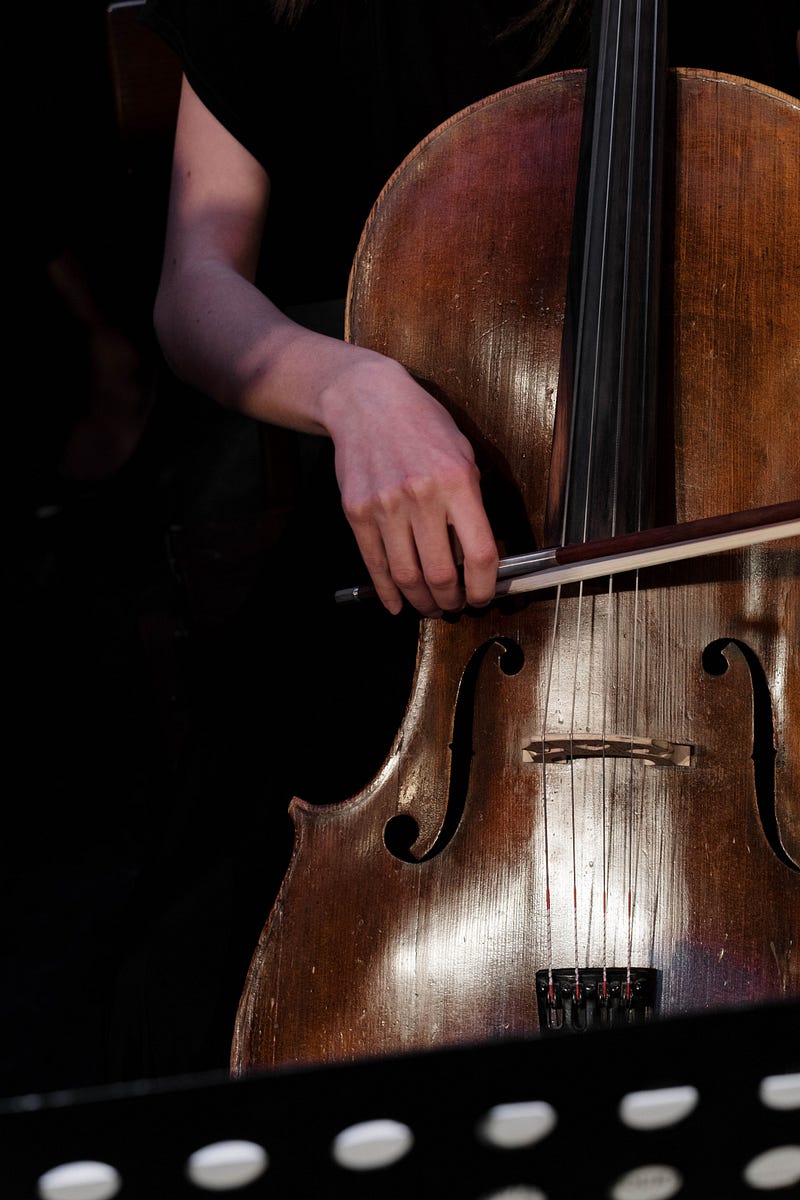
Who were these cellists whose work was frozen in time in this song, whom millions of people have heard and yet almost no one could recognize by name?
I learned that the cellists who played these lines were named Derek Simpson, Norman Jones, and Joy Hall. Their music was also featured on other Beatles’ albums.
Joy Hall may be dead now, or she is 102 years old. In 2020, she celebrated her 100th birthday. In addition to playing for The Beatles, she regularly played for the Queen Mother, was one of the first females to be employed by the London Symphony Orchestra, and played in orchestra shows while bombs fell in London during the Blitz.
Derek Simpson died in 2007. He started playing the cello at age 10, and later played in the Brighton Philharmonic and the London Chamber Orchestra. In addition to playing for The Beatles, he taught for many years at the Royal Academy of Music. After he died, his students performed tribute concerts in his honor.
Norman Jones is more difficult to find online. I don’t know whether he is alive or dead.
When Katie and I listened to this song in middle school, these cellists were already into middle age. In fact, Derek Simpson was exactly the age I am now.
They’d moved on from their Beatles days by then, but they were still playing their cellos. Music was their life’s work.
Except I wondered what Derek, Norman, and Joy would say if I asked them directly about their greatest life’s work. Perhaps they wouldn’t say music at all. Perhaps they’d focus on the children they raised, or the students they taught.
Maybe Joy would remember a specific performance in a music hall in London, one she performed to the backdrop of air raid sirens while hundreds of bombs fell on her city.
I remember a very special musical performance of my own, during my freshman year of college. It was the day after the September 11th attacks. I had just been accepted to play viola in my university orchestra, and it was our second week of rehearsals.
Our conductor stood before us that Wednesday evening and admitted he’d struggled with whether to cancel our rehearsal altogether.
Everyone on campus was still in shock over the images they’d seen on TV screens the day before. Some students had parents who worked in the Twin Towers. One had lost a friend in one of the planes.
But our conductor said it felt more fitting than ever to play music together that night. The world needed more beauty, so we put some beauty out there that evening.
Some of us cried quietly as we played our instruments.
Katie was only a few miles away from those attacks on the Twin Towers, as a freshman at Colombia University. She seemed less affected by the tragedy than anyone else I knew. Maybe because it was more real to her, or maybe because that’s just how she is.

But that January, I visited Katie in New York for my first visit to a city I would quickly fall in love with. We walked almost the entire length of Manhattan one afternoon, from 116th street to Battery Park.
On the way we stopped and got me a fake ID in the Village, and we also stopped at Ground Zero.
There were still hundreds of photos and posters of missing family members on the fences surrounding the hole in the ground.
It’s been nearly 21 years since I visited Ground Zero with Katie, and 28 since we lay on her bedroom floor discovering the Beatles together.
Listening to that same music yesterday, I couldn’t help but think about the passage of time, and how 1967, 1995, and even 2002 were so long ago and yet accessible in one second through a button on my car stereo.
Maybe if the three cellists who played in “Strawberry Fields Forever” were sitting here with me today, they really would recall their time with the Beatles as their greatest accomplishment, or at least the coolest memory of their lives.
I couldn’t name the coolest memory of my life. There are just too many. Though it’s likely that some of them involve Katie.
My greatest life’s work is also still fuzzy.
My old viola still sits in its case in my closet. It’s unlikely I will ever be heard on a musical recording. I probably won’t write something so beautiful that decades of students will pore over my lines in their literature classes.
And yet I’m here, doing my best, trying to live a life that feels meaningful. I’ve created two beautiful boys. Katie just had a daughter of her own this year.
We live on different coasts, but we see each other as often as we can.
So few of us will ever do anything that will be recognized by name after our deaths, even these three cello players who were talented enough to play with The Beatles.
But yesterday, in my beat-up car, I pressed a button and listened to these three cellists captured in time in 1967.
These musicians will never know who I am, and yet they made me think about my friend Katie’s bedroom floor, an eerie winter in New York City, an evening orchestra rehearsal, and my own life’s legacy.
All on my way to meet a friend for dinner, on a November day, at this midpoint of my own short life.
Thanks to Christopher Robin, for finally convincing me to write about music.
If you’re not yet a Medium member and want to read unlimited stories like mine, click on my referral link here.
If you enjoyed my story, sign up here to join my newsletter and learn when I publish next. Here are a few more of my stories you might enjoy…