
The Last Gardener
Ardena Treeve’s Diary
Prelude
We humans are frail creatures. Throughout our existence, we have lived on the edge, existing in a narrow comfort zone. By our own actions, almost six hundred years ago we came very close to destroying that small window of habitability. We managed to survive. For a while. But ultimately we succumbed to another threat — an almost unassailable enemy — disease. We’re not sure where it came from, but in 2656 a plague broke out. Some of our biologists thought it was a natural development. Others felt it might have been delivered to earth in a meteorite. It was utterly unlike anything anyone had seen before, giving some credence to its alien origins. But wherever it came from, it was deadly to primates. Monkeys. Apes. Us. Eventually it found its way everywhere. We died in droves. By destiny, or maybe by accident, ‘I alone am escaped to tell thee,’ as that old quote goes. Here is my story.
11.25.2721, The Settlement, Kristchur, Nu Zilund The plants have been busy today. There seems to be more rustling and moving than usual. Maybe it’s the heat. They always get more active when it’s hot, and it’s hotter than usual. Maybe that’s it; maybe that’s why. You can’t really tell what they’re up to. They shuffle up to one another, exchange chemicals, shuffle away. On sunny days like this one, they usually just stand there, with their leaves extended, taking in the sun. From the little we have learned about them, standing in the sun, taking it in, is some kind of religious experience. Direct absorption of energy, photosynthesis, no digestion, no effort — nothing at all like eating. Pure communion with the source of life, with nothing intervening.
Oh, don’t get me wrong. They’re not threatening or anything. Far from it. Every day they leave food — actually parts of themselves — for me to eat, just like they’ve been designed to do. No problem there at all. I’ll have plenty to eat, for as long as I want to live. It’s not too hard for them at this point, not too much work, since there’s only me.
I’m the last one left. The last Gardener.
There is no one else in all of Nu Zilund, except for me. At least I think so. It’s a big place, and there may be a few more here and there. I kind of doubt it. But I suppose it’s possible.
I’ve decided that I’m going to continue with the work that I was doing. That is, besides my gardening work. What else do I have to do?
At first I thought, ‘Why am I writing this? Who am I writing this for?’ I was supposed to be updating the article in the Cykloped about the development of the plants. But that was when we thought enough of us might survive. When we had that fantasy that we might beat this disease. We know better now. We! Who am I kidding? I. I know better.
Well, I still have my research, and my notes, so I might as well write it all up. Even though there’s no one to write it up for, no one to read it.
Actually, I’m not really sure what to write at this point. Like I said, I was supposed to be writing about the plants, Flora sapiens, but now I think I have to tell more of the story.
It’s late now, and I really don’t have the energy to begin. I’ll take it up in the morning.
11.26.2721, Settlement KNZ The plants, my sentient vegetal friends, are quiet today. They’re standing, taking the sun. I’ll go out later and do a walk about, check things out. Not that I need to. The plants have everything under control. They don’t need me. But I’ll go out and walk about anyhow.
Okay, here we go with my story.
I’m here in The Settlement, located twenty-six kilometers northwest of Kristchur, Nu Zilund, in the twenty-eighth century. I’m a Gardener. Besides my regular work, I was tasked with updating the entry on the plants in the Kete Aronui Cykloped, the great encyclopedia of everything. My name is Ardena Treeve.
Pretty funny, right? Ardena. It’s supposed to mean ‘great forest’ in some prehistoric language. Hilarious isn’t it? Great Forest Treeve. What a joke! And of course with a name like that, they put me to work as a bioculturalist. To work with the plants, as a Gardener. But I’m getting ahead of myself. First, let’s go way back.
If you look in the Cykloped, which I just did, it will tell you about how the New People established themselves after the Great Collapse. How we survived in five world centers. This is all ancient history, but I guess I better put it in, because who knows who or what will read this, if anyone or anything; and they — or it — will need the background.
Anyone who reads this will also be able to read the Cykloped, so I’m not going to go into great detail. But, in a few words, way back, a long time ago, by the twenty-first century, humanity had developed a great civilization that covered the entire globe.
But it was a sick civilization. One that didn’t recognize that the planet and its resources were not unlimited. It’s almost incredible to think that any civilization that called itself advanced could be so shortsighted. But they were.
They were also violent and exploitative, not only of the planet, but each other. They engaged in great acts of cruelty to one another. A very few people — almost exclusively men — controlled most of the planet’s resources, while the rest were left to eke out a living as best they could. They had a bizarre and bewildering societal arrangement based on skin color and gender. Certain skin tones were deemed to be superior to others. Women, no matter what their skin tone, were treated poorly, often brutally.
In a matter of three or four centuries, this insane culture (I guess there’s no other way to describe it), devoured a great portion of the planet’s easily accessed resources. In the name of what they called ‘progress,’ forests were leveled, wetlands were drained, oceans and skies were polluted, in short, the planet was made nearly uninhabitable for humans. By humans. They developed what they called ‘technology’ — a vast array of machines and computing devices. But instead of using these machines, this ‘technology,’ for the betterment of everyone, it was used to accumulate vast wealth for a few men.
Nor am I going into the concept of money and wealth here. You future readers will have to refer to the Cykloped for that explanation. In fact, I’m not sure I understand it myself. Let it suffice to say that this almost incomprehensible concept is another example of their bizarre and mad culture.
Even worse — much worse — the pollution which they had poured into the air greatly increased the greenhouse effect; the ensuing consequences to the global climate presented a severe, existential crisis. The planet was heating up. Fresh water and arable land were diminishing at a rapid, unsustainable rate. Violent weather, storms, droughts became the norm.
Eventually, in the late twenty-first century, the early twenty-second, this all came to a head. Their crazy society had reached a boiling point. The resources required to generate electricity to power their technological world were on the verge of running out. The ruling class consumed energy and resources extravagantly while everyone looked on.
The poor — which included just about everyone — revolted, almost everywhere, destroying the infrastructure that generated and distributed electricity. To say that their society was disrupted is an enormous understatement; they had become utterly dependent on their technology. Everything that they did relied on it. Their civilization unraveled when their technology failed them.
And on top of this, in the midst of this great societal upheaval, exacerbated by a global climate crisis, a plague, a disease appeared that wiped out almost eighty percent of the global population. This combination of societal revolution, disease and climate disaster brought civilization to its knees. This was the Great Collapse.
That’s where we come in: the New People.
Well, my head is spinning just thinking about all of this. I guess I need to go out and walk around. See what the plants are up to. I have a funny feeling they’re up to something. I’ll take it up again tomorrow.
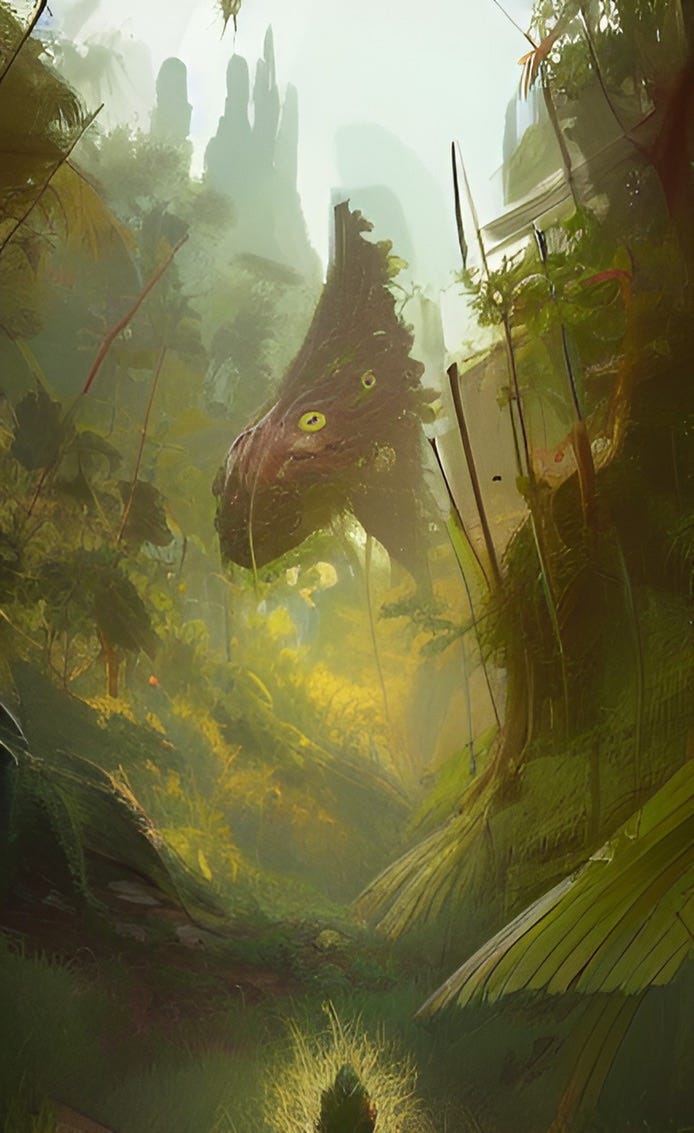
11.27.2721, Settlement KNZ Something’s definitely going on with the plants. When I woke up this morning, there was only one plant outside. There are usually dozens. Nearly a hundred is common. They left food where they always do. But only that one plant was standing there. And, also strange, it was not taking in the sun, even though it was bright and hot outside. I walked out to the end of the field, looking for the rest. Damned if that one plant didn’t try to follow me! They can’t move very fast, so there was no way it could keep up with me, but still! Even more odd, it sent up a bloom of some kind of aerial seeds. I’ve never seen them do that before. It’s almost like it was signaling the others. The rest of the plants were nowhere in sight.
I went back inside and had a cup of chai and some fruit. Took a shower. When I went back outside about an hour later, there they were. All where they usually were.
I’d better get a grip. I wonder if I’m starting to lose it.
Okay. Where was I? Us. The New People. I’ll tell you a little more about us. Then I’ll get on to the story of the plants.
After the Collapse, things were pretty bad everywhere. Most of the places where there had been a lot of people were wiped out by the Armageddon Virus. Things were pretty bad, and, in most places, life was nasty, brutish, and short. Conditions were primitive in the extreme. You can look up the details in the Cykloped. But a handful of places did better, and in these pockets survivors regrouped. They called themselves the New People, to emphasize that they were different from the crazy people that had caused all the suffering. They — we — decided to live our lives according to a different model.
We dedicated ourselves to living a mindful way of life. We focussed on inter-personal communications, relationships, thinking about everyone instead of just ourselves. For us, life would be unbearable without these things, without hope. Everything we did was always done with an eye towards community-building and shared purpose. Look it up.
So we created a new world, a new society.
It wasn’t easy. The climate crisis raged on. Unbelievable heat, torrential downpours, floods, devastating storms and winds. All these things stretched us to the breaking point. But, in spite of it all, we learned how to survive.
Growing food was a real problem. Every time we planted a field, the heat would bake it, or the rain would wash it out. Things that once grew plentifully wouldn’t grow at all. We needed to do something, but no one was sure what to do.
Some of the New People wanted to live near the sea, and survive by fishing. But the storms made that too risky. Some wanted to keep our numbers low enough to survive on foraging, but that didn’t work out either: how were we supposed to reduce our numbers? Even though there weren’t that many of us, foraging and gathering didn’t produce enough. And it was unreliable.
A few proposed a new, daring idea. Why not tinker with some plants? Make them able to survive the harsh weather, take care of themselves a bit. Make ‘smart plants,’ as they called them.
This idea caused quite an uproar. It meant using technology. Biotechnology, to be sure, but still technology. A lot of the New People were very opposed to this, afraid that we’d slide back into the old ways that wrecked the planet before. And some of them said we probably couldn’t do it anyhow. But we needed to do something.
I’ll tell you all about how the New People had a decades-long conversation about this, but it’ll have to wait till later.
Looking out my window, I see that the plants are quiet. A little too quiet. They should be moving closer together for nightfall. Tomorrow I’m going to take a hike around The Settlement and see if I can figure out what’s bothering them. It’ll take a few days, so I’ll have to pack some supplies now so I can get an early start.
I’ll take this diary up when I get back. There’s no hurry.
11.30.2721, Settlement KNZ I’m back. Well, curiouser and stranger. When I took off on Monday, there were no plants outside. They left me my food, like always, but no plants. None. Nowhere to be seen. Hmmm. I got up, looked out. No plants. Had my chai and fruit. Looked out. No plants.
I was all ready to go, to take a hike around the Settlement, Now I was more eager than ever.
The Settlement is big — 45,000 hectares. I can do a perimeter hike in three days if I really move it, but, like I said, ‘what’s the hurry?’ And besides, I wanted to do a little exploring, so I planned on four or five days. I set off.
After a few hours, I had become completely absorbed by the forest, a forest like no other.
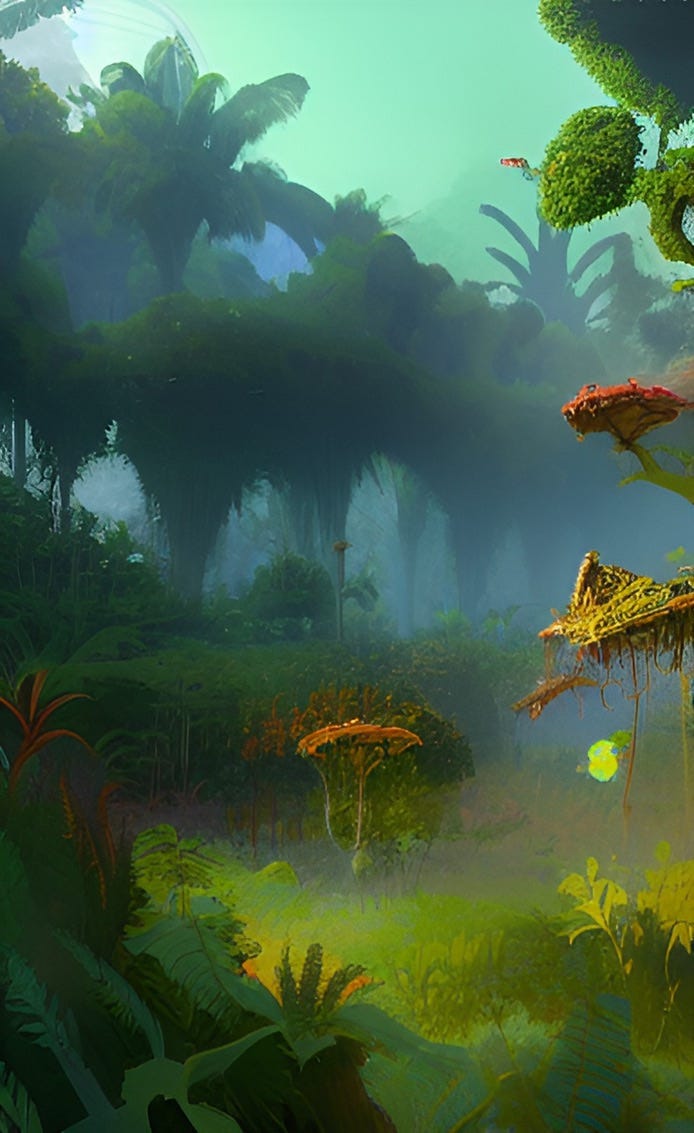
Jungle-like in places, woodsy in places, open spaces, meadows here and there. As I hiked, I was never out of hearing of dozens of birds. Large, black and iridescent green Tui, with distinctive white tufts under their throats flitted about. Fantails darted.
I had pretty much forgotten about the plants, but when I stopped for lunch, they came rushing back to mind. I was eating part of them.
After lunch, the trail took me through a thick forested area. Overhead, the birds were active. Big, plump Kererus showed off their iridescent green and bronze feathers. The signature sound of the Bellbird punctuated the canopy, answered by the loud clear voice of the tiny Rifleman. And the Kaka tried to drown out everyone else with its noisy, raucous call.
Still thinking about the plants, I stumbled, and roused a Kiore, who scurried away. ‘You’d better be careful, little one,’ I thought. ‘Better be on the lookout for Stoat, who would love to eat you.’
Everywhere were the ancient possum and the invincible hedgehog. In the evening, when I made camp at sunset, the sky was filled with Long-tailed bats.
Everything looked normal. Paradisal, in fact.
I was overcome with sadness and joy simultaneously. To know that I would probably be the last to experience this! The last human, that is. I felt the awesome responsibility of my obligation to appreciate, revere, love, recognize my participation in this world, on behalf of everyone who had ever come before me and done the same. For all I knew, I was humanity’s last representative.
My joyous melancholy passed, and I spent the night under my galaxy’s stars.
The next morning I decided to turn from the perimeter toward the heart of The Settlement. I made my way through a particularly dense forest for about an hour. I walked down the trail, across a small stream, and up the rocky shelf of the other side. As I crested the rise, in an unexpected forest opening, I was astounded to see the plants! All of them! Or at least what looked like all of them.
I stopped and plumped myself on the ground. I could hardly believe that I’d come on them like this. After a minute or two, I started paying attention to what they were doing. First, very unusual for them, they were in strange formations. A number of them had formed a spiral in the center of the clearing. And around these, the others had arranged themselves in some geometric shape, maybe six or seven sided.
Each plant had set flowers, and, almost too astounding to believe, they opened and closed their petals at the same time, as if they were signaling to one another. And this may have been the light — or my astonishment — but I could swear that some of the flowers were changing color at the same moment.
Flabbergasted, I tried to collect myself. This was definitely not something that had been bred into them when they were first created. They were supposed to make food, and help take care of themselves by moving a bit. But this! This was a totally unexpected thing! Was their level of communication more complex than we thought?
I watched them for hours. As the sun started to set, they began to shuffle off, back toward The Settlement village.
Numb, I made camp right there.
In the morning, I came straight back here.
The plants were all standing in the field, taking in the sun.
I’m taking a shower, getting something to eat, and going to bed. I’ll pick up my story tomorrow.
12.1.2721, Settlement KNZ This morning was like every other morning. The plants were taking the sun, food was where it was supposed to be. Did I really see what I thought I saw? Maybe I really am losing it. I wish there was someone to tell this to, someone who could tell me, ‘Yes, the loneliness is getting to you.’
But there are only the plants.
I need to get my head into something else, so I’ll take up my story.
Okay, where was I? The decision to create the plants. We — the New People — talked about it for twenty or thirty years. During that time, life was rough, but bearable. Just. We knew, though, that we had to do something. Growing food the old way, with technology, was not an option for anyone. Well, a few wanted to go that way, but almost no one wanted to risk the fool’s dream of technology, going back to being tech crazy. So, with a great deal of trepidation, as a society, we decided to look into creating smart plants.
Many questions needed to be addressed. What would they do? How could they help? Could we do this at all?
First, they needed to be able to get out of the sun when it was too hot, and find shelter and high ground when it was too rainy. Locomotion. Some plants already could move in the direction of light, or close up their leaves when it was too hot and bright. So we had something to work with on that front. But still, mobile plants were a lot to ask.
As for size, they couldn’t be too tall. That’d make them more vulnerable to the wind. They couldn’t be too small, since they wouldn’t be able to produce enough food.
And as for food, what would they produce? We humans need certain nutrients, amino acids, protein, carbs, fat and fiber. We also like variety. No one wants to eat the same thing every day, so they needed to produce several different types of foods, foods with differing taste and texture profiles.
The energy part was easy. They’d survive by photosynthesis, taking whatever additional nutrients they needed from the soil. We might even be able to make them able to synthesize some things that they couldn’t get otherwise.
Overall, it was really pretty easy to figure out what we wanted from them. The question was how to do it.
Humans, mammals, have brains, central processors that can direct things, sum up information and make conclusions. There is no analogue in plants — the smart plants’ intelligence couldn’t be based on a centralized brain. So the plant designers came up with a different solution, making use of what was already present in plants, their vascular systems. Based on these systems, the idea was to create a distributed network of specialized cells that worked together to form a collective form of intelligence, a gestalt mind, a complex neural network that runs throughout the plants entire body, allowing it to sense and respond to its environment in a sophisticated way
The designers planned to create this plant neural network using purpose-built cells, capable of transmitting electrical signals and chemical messages. When coupled with bioengineered sensory cells, this neural web would allow the plants to detect changes in light, temperature, humidity, and soil composition, and respond to these changes in real time. It would also give them a limited capability of communicating with other plants through chemical signals — something they already can do through symbiosis with the mycelium in the ground and on their roots — a prewired fungal web that exists pretty much everywhere — allowing them to coordinate their behavior with other plants.
If the bio people could pull it off, all this would allow the smart plants to process and store information, make decisions, and react to the environment in a way similar to animal intelligence. This design would make them capable of performing complex tasks, such as finding and accessing sources of water, defending against predators, and adapting to changes in their environment. And in real time. Most important, they could learn from experience, storing information in their neural networks, and using it to inform their behavior in the future.
Needless to say, they did it. The designers. I’m looking at their handiwork right now.
Hmmm! Writing this is making me think about what I saw yesterday. Hmmm. I know they can learn some things. I wonder how much they can learn? And how fast?
I think I’ll go take a walk around them.
12.6.2721, Settlement KNZ It’s been a few days. A big storm passed through, with lots and lots of rain and wind. My bungalow is pretty much impervious to weather, so it was no real problem for me. I stayed inside and watched — and listened. The plants did what they were designed to do. They moved up into the forest, out of the wind and the worst of it.
It’s funny. When they have to move like that, to protect themselves, they seem more energized afterward. More fired up, stimulated. For several days after a move, they produce more food, and they seem especially lush and vibrant. And I’m probably imagining it, but the food seems to taste better too, somehow. I can’t explain it. It’s always good, but after a move it’s better, somehow more satisfying.
Maybe it’s the hormones they use to move. Maybe it activates them, stimulates them.
Movement — locomotion — was one of the biggest obstacles for the designers. How to make plants move. They don’t have muscles or skeletons like animals do. But if you’ve ever had a garden, you know that plants, even the non-smart kind, can move and respond to their environment.
Everybody knows about phototropism — bending or growing towards the light. They do that with a hormone. They make it in the tips of plant shoots and leaves and it moves down through their vascular systems. When light shines on the plant, the hormone — it’s called auxin — moves to the shaded side of the stem, which makes the cells on that side get longer, which makes the stem bend toward the light.
Other plant movements, like responding to gravity or touch, work sort of the same way, using hormones, cytokinins and gibberellins, that affect cell growth and division.
And don’t forget, when it’s really hot or dry, plants can conserve water by closing the tiny pores on the surface of their leaves, too.
So the designers had something to work with. They built on what was already there.
Basically, in order to move, the plants extend their roots and push their trunks and branches forward, uprooting themselves in the process. By coordinating its movements, each plant can crawl forward like a caterpillar, in a wave-like motion, using its roots to grip the soil and pull itself along. It’s not all that fast — about the speed of a slow walk. But they can do it night and day without stopping, so they can cover ground pretty well.
I’ll write more tomorrow about what they look like, and their fruit too.
But now I think I’d better get outside and see what damage the storm did. Probably a lot of clean up to do.
12.14.2721, Settlement KNZ The solstice is getting close. Longest day of the year. I can’t believe it’s been more than a week since I wrote anything. I’m getting to be like the plants. I can sit for hours, doing nothing. The plants have been pretty normal, except that they disappeared for a couple of days. Maybe they’ve been back at that clearing in the woods.
When I’m not just sitting with the plants, I’ve been slowly cleaning up the storm clutter. No real damage. The rain filled the cistern to the top, so I have been releasing water periodically into the purification pools, then draining them into the holding tanks. Pretty easy work, but it’s something to occupy the time.
I have been sleeping very deeply these past few days, dreaming about the plants. In my dreams, it’s almost like I’m one of them. I feel vegetal, somehow.
I must be losing it.
12.21.2721, Settlement KNZ Another week gone! What did I do all that time? Sleeping a lot. I’m dreaming of the plants almost constantly. None of the plants were here this morning. I’ve got the strongest urge to go back to that opening where I saw them before. I can’t explain it. I’m going to grab a few things and hike on out there. I can be there by this afternoon.
I know I was going to describe what the plants look like, but it can wait.
Solstice is tomorrow.
12.23.2721, Settlement KNZ Something very strange is happening. Maybe I really am losing my mind. I don’t think so. But maybe.
I hiked back to the glade on Wednesday. Sure enough, the plants were there. But they weren’t in a spiral, like before. They were all lined up in two rows, like a colonnade. I felt the strangest urge, almost overpowering, to walk down it, between the rows. So I did. When I got to the end, there was a stump that was formed into a chair, sort of. It was more like a lounge chair. Before I knew it, I sat on it and leaned back. When I did, I felt an incredible sense of peacefulness and well being.
I felt so good! For a while I didn’t notice that the plants had started moving, and were getting into the spiral arrangement I had seen before. It took them a while. Like I said, they don’t move very fast. While they shuffled around, I sat back on the stump-chair. It was hot, but a breeze was blowing. I guess I dozed off for a while, but when I woke up I could see that the plants had set flowers again, and were opening and closing their petals. They were all around me. From my close-up perspective, I could see that the flowers were indeed changing colors, morphing from a pale, off-white to a deep pink blush. Here and there, some plants had a row of deep blue flowers.
I was mesmerized by the flowers. They seemed to be opening and closing in some pattern, but I couldn’t quite figure out what it was. The fragrance was almost overwhelming, a sharp gingery scent.
As I watched the flowers, the air seemed to vibrate. I was not quite asleep, but in a kind of torpor. Images of plants flashed through my mind. My stump chair embraced me. I could feel it connecting me to the ground, to the mycelium web beneath. I could sense the presence of the other plants.
After a long while, I woke up.
Most of the plants were gone. Four stood around me. One at my head, one at my feet, the other two to my sides. The stars were blazing overhead. A soft wind rustled. I climbed out of the stump chair. My pack was on the ground, where I left it.
It seemed like I had been there, in that stump chair, forever. My mind was as clear as can be, but it was empty. No thoughts. No internal monologue. Slowly at first, then in a rush, everything started coming back to me. My cottage. The virus. My solitude. The plants. I was staggered by the surge of all those memories returning, the re-emergence of the world. I began to sob uncontrollably.
After a few minutes, it passed. I was completely okay, curiously refreshed.
I made camp right there, beside the stump chair. I didn’t pitch my tent. Just laid out my bedroll. Ravenous, I ate a bit, then crawled into my bag and slept. When I woke up the sun was shining brightly, and it was heating up. Mid morning. The four plant sentinels where still at their posts. Their leaves were opened up, and they were taking the sun.
My euphoria of the last evening was still with me. For the first time in a long time, I was completely at peace as I hiked through the forest and back to my cottage. As I left, I noticed that my guard plants had folded their leaves, and were beginning to crawl after me. I soon left them behind.
When I got here, the rest of the plants were in the field, taking the sun. I felt a strong kinship with them, these photosynthetic beings.
12.26.2721, Settlement KNZ I’m still kind of freaked out by what happened on Wednesday. I wonder if I’m hallucinating? When I think about it, I say, ‘That can’t be.’ But I’m so sure it was real!
Today they’re acting completely normally. Standing in the field, taking in the sun, leaves opened. The food they’ve been delivering has been exquisitely tasty! I’m going to watch, to see if they go out there, to the glade, again. If they do, I’m going, too.
Okay, I promised a description of the plants.
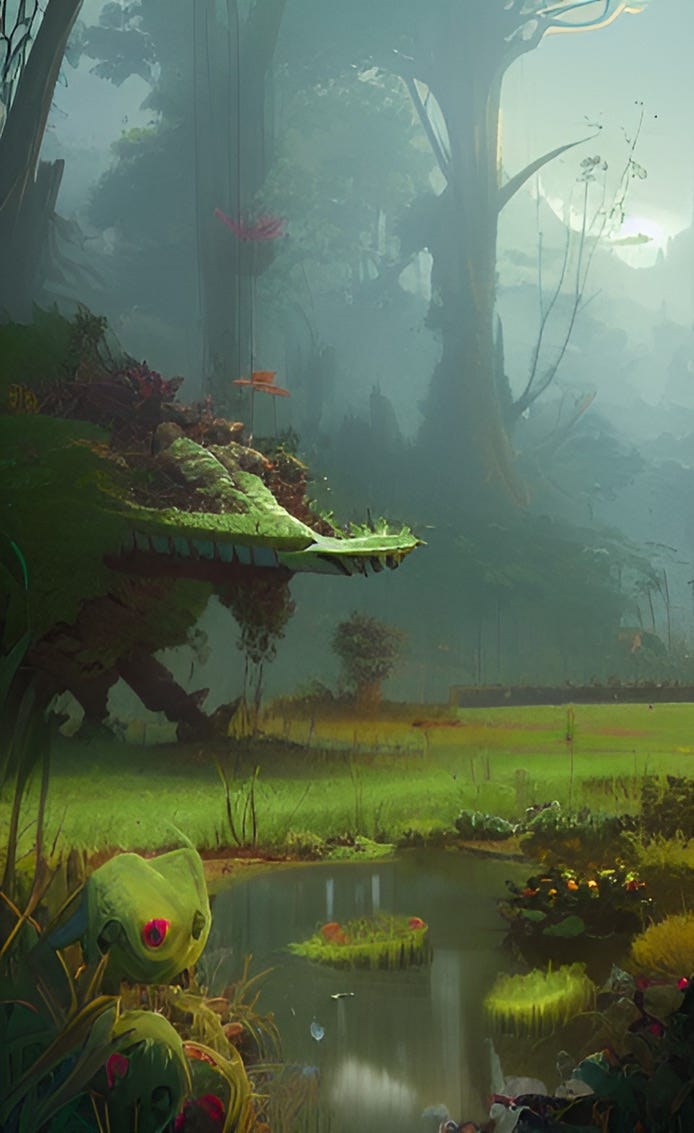
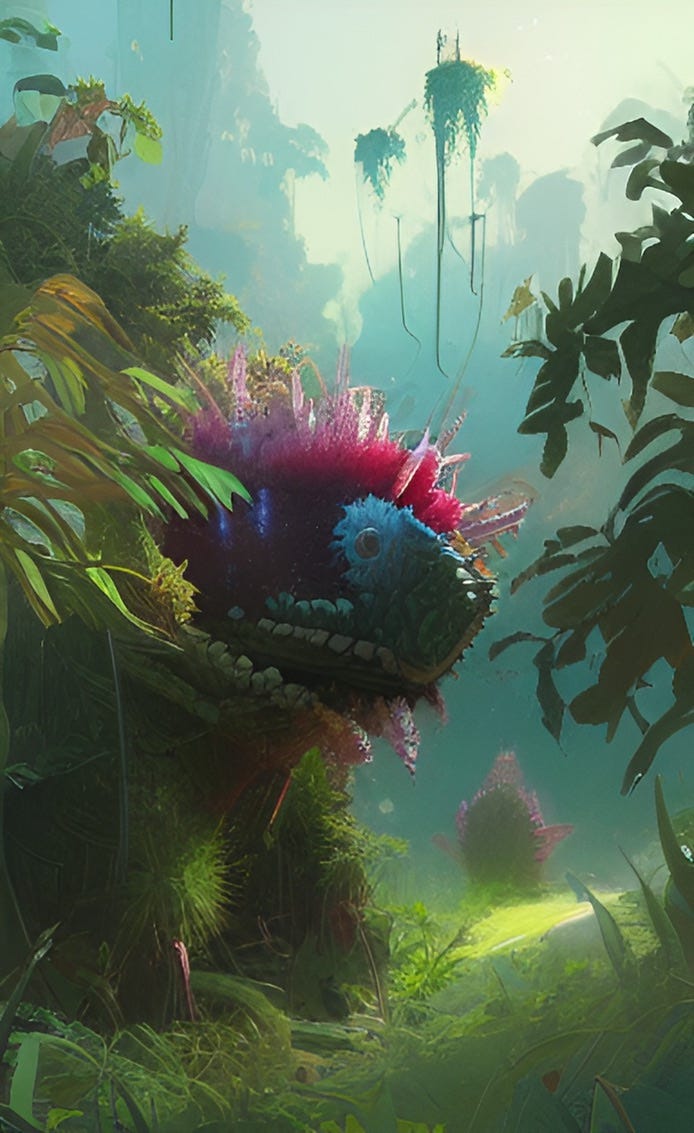
Like I said earlier, the designers didn’t want them to be too tall. Or too short. They made them about three meters high. Some get to about five meters. They’re not quite trees. More like woody shrubs.
A big difference from regular plants is their shape. Many tree-like plants have extensive root systems, sometimes equal to, or even bigger than the foliage above. Since the smart plants are able to uproot themselves and move, they don’t have extensive underground root systems. If they looked like an ordinary tree, with lots of foliage above, with their limited root systems they would be top-heavy, and liable to fall over. To counteract this tendency, the designers made them with cone-shaped stems, wider at the bottom.
They were also made with long, wide leaves clustered near their tops. When they are moving, or if the wind is blowing hard, or at night, the plants can fold these leaves in, and tuck them alongside their stems. When they are taking sun, they unfold these leaves and point them at the sun as it moves across the sky. To make sure the plants get enough sun energy, the designers also tweaked their photosynthetic abilities, supercharging them. As a result, they are very efficient light gatherers. In fact, they can create far more sunlight energy than they need. The designers did this for a reason: they expected to connect arrays of future plants into a kind of power grid.
The plants also are equipped with several sensors, located at the ends of vine-like structures that grow along the main stem. They can sense sound, light, humidity, barometric pressure, hot and cold temperatures. They can even sense the build-up of electricity, which helps them avoid lightening strikes. Importantly, Flora sapiens is highly disease resistant, engineered to resist pests, diseases, and environmental stressors.
As for the food they produce, any given plant can grow several different food types. Their fruits are mostly papaya shaped, with a semi-hard husk with a long shelf-life. They appear on vine-like growths, fairly low on the plant’s stem. The plants are able to modify what’s inside the husk to a great extent, producing several dozen different flavor palates with varying texture profiles. Of course, the fruit provides complete nutrition for humans, and contains high levels of essential nutrients, vitamins, minerals, and amino acids, that are important for human health and well-being. They are completely hypoallergenic.
A good cook can make a wonderful variety of dishes. In a pinch, almost any of them can be eaten raw, directly from the plant.
Since the fruit is low on the stem, reaching them for picking is easy. But the plants can ‘pick’ themselves too. Everyday, the plants go to a special place — we called them, ‘stores’ — and drop their fruit without any human help. All we needed to do was go to the ‘store’ every day and pick up what they left behind. They never over-produce, so there is little waste; they can sense how many humans are in the area, and produce food accordingly.
1.2.2722, Settlement KNZ Several ‘normal’ days have gone by. Well, sort of normal. My dreams have been chaotic and plant-filled. I’m always dreaming about them. I even nap in the daytime, and dream about them then, too. I’m getting the feeling that I need to go to the glade. I keep seeing the stump chair in my mind. But the plants are still here. So I’m staying here too.
1.3.2722, Settlement KNZ This morning there were no plants. Gotta go! Heading to the glade!
1.7.2722, Settlement KNZ Back again.
This time it was a bit different. There was no colonnade of plants. They were arranged in a spiral, with the stump chair in the center. I immediately walked up to it, tossed my pack on the ground and sat down.
That same sense of intense well-being flooded through me. The flowers appeared, flashing open and closed. The gingery scent. I seemed unable to move. In a stupor, same as before. Dreaming of plants. Just like the last time, I awoke with the stars burning overhead. I ate, crawled into my bag and slept, dreamless and deep.
When I awoke — empty-headed, like before — it was mid morning again. Only this time, all the plants were still in formation. I had the strongest desire to get back in the stump chair! I crawled back in. The stump was always comfortable, but this time it seemed like it had molded itself to my exact body shape. I imagined I could feel it pulsing beneath me. Like before, I felt connected to it, and to the plants as well.
My experience was not the same this time, though. I did not have plant dreams. Instead, I had visions of different places on the earth, various locales. Places I had been, or seen in videos. At one point, I saw an image from a book I had read as a child, showing the whole globe, the continents, the oceans. I saw an image of Nu Zilund, taken from high above, showing the other lands near it.
Once again, I woke to starlight, ate, and slept.
The next day was pretty much the same. But my visions in the stump chair were of many different things. People. Cities. Historical events. I even dreamed of books I had read.
I awoke, ate, slept.
When I woke this time, the plants were gone, except for my four guards. Also as before, my head was empty. No thoughts. No internal monologue. In a short while, the world came rushing back.
I packed up and headed back home, feeling terrific.
As I hiked, I thought about what was happening. They were communicating with me. I was sure of it. Slowly, what I had done, what had happened, began to dawn on me.
They had looked into my mind. I had given the plants a crash course on humans and the earth. A concentrated geography, history and culture lesson.
1.19.2722, Settlement KNZ Well, I’ve been out to the glade twice more since I last wrote almost two weeks ago. Two days, then three more. I’m not really sure that this is for real. Photosynthetic cognizance! How else to describe it? It’s so unbelievable! The plants are communicating with me. Either that, or I’m hallucinating badly. And I don’t think I’m imagining it. They are somehow getting into my mind. The stump chair, the scent. The flowers opening and closing. Is it chemicals? Is it somehow electrical, with the stump as a kind of electrical pole? Is it something completely different? Are we really all part of one thing? Is there really some hidden, underlying substrate which we all are part of, and the plants have somehow tapped into that?
I’m completely baffled.
But I can’t deny it’s happening. I think they are just as surprised as I am. They have somehow sensed my being. And I, theirs. I can’t explain it.
When I’m in the stump chair, I get a feeling of surprise, almost incredulity from them. Until a little while ago, they were not aware of the fact that this is a planet, with vast spaces, continents and seas. They spend so much time ‘in the present moment’ that the fact of an outside world, our ‘reality,’ is something of a shock to them.
I know they want me to continue teaching them. Teaching is not really the right word. There is no discourse, no exchange. They look into my mind and see what’s there. No intentionality on my part. I’m completely passive. They are looking at the pages of my mind, my experiences. They somehow have access to memories I have forgotten.
I intend to keep on with this. See where it goes.
3.6.2722, Settlement KNZ Monday, a month and a half later. There is so much to tell about these plants now taking over this part of the world, so much more than we ever could have imagined! They are alive in ways utterly different from us.
Their consciousness seems to be rooted in the present moment, making it difficult for them to comprehend the passage of time or the concept of distance.
It has been a struggle for me to understand them, to find a way to communicate with these arboreal intelligences who are so different. Since I’ve been writing this, I’ve come to understand that by directly absorbing the images in my mind, the plants became aware of the world beyond their immediate surroundings. Now they’re aware of other lands, other continents, thanks to the descriptions and images I shared with them.
The plants are fascinated by these distant lands and express a deep desire to see them for themselves. They were especially fascinated by my memory and thought images of the ocean, memories of my times at the shore. They longed to be there, to experience the sights, sounds, and sensations of these far-off places.
However, they struggled to understand why they could not simply walk there. For us, the concept of travel and exploration is second nature, but for the plants, it is a foreign and perplexing idea. I am slowly beginning to faintly understand what it would be like to experience the world as they do, rooted in the present moment and yet reaching out toward the unknown.
For now, I’m going out to be with the plants while they take in the sun.
8.7.2722, Settlement KNZ Monday, five months later. I see less and less need to write this. I’m convinced that the new masters of earth — those botanical minds outside my window — won’t communicate with words. But, I continue.
Last time I told you they were curious about the world. Well, they’ve created a floating raft that can traverse the ocean. What’s more, it’ll deposit seedlings on a foreign soil, to grow there.
The plants got to work, using their unique abilities to manipulate their bodies and grow in new ways. They started by growing long, flexible stems that could bend and twist with the waves. Then, they grew leaves and branches that could spread out like sails, catching the wind and propelling them forward. They needed to guard against the harmful effects of salt water, too.
The plants grew a dense, vegetative raft that was buoyant enough to float on the water. They tested their creation in a lake and found that it was stable and could move in any direction they wanted.
At this point I have to stop and tell you, again, that all this is not lost on me. I am likely one of the last human’s, perhaps the very last. To be witnessing these things — it is a mind-boggling experience — to say the least! But, I am curiously at peace. Working with the plants, bizarre as it may seem, is satisfying.
3.17.2724, Settlement KNZ Monday. A year and seven months later. I left off telling you about the rafts. Excited by their new invention, the plants began to prepare for their first sea journey. They selected the hardiest of their seedlings and attached them to the first raft using their tendrils. They also boosted the seedlings’ special roots and redesigned seeds, giving them the ability to drill down, to penetrate soil and anchor the seedlings in place once they reached their destination.
At last, the plants set out to sea, navigating the currents and winds with their sails. They would encounter many challenges along the way — storms, strong currents, and hungry sea creatures. This would be a great test of their ability to persevere, to adapt to each obstacle, solving problems using their collective intelligence.
My role in all this has changed over these past few years. I am acting as a kind of interface, between human culture and the developing plant culture. The plants are voracious for knowledge of the world. While my mind contains millions of images, which they ‘look at,’ it still doesn’t answer all their questions. Lucky for me, and them, The Settlement is home to a very fine library, thousands of volumes, printed on virtually impervious cellulose-based ‘paper,’ including a complete edition of the Kete Aronui Cykloped, the great encyclopedia of everything.
For the plants, I was a window onto the world, as seen by humans. My interactions with the plants began to follow a routine. I carried a volume or two or three to the glade, where I sat in the stump chair and leafed through them. Through my eyes, my thoughts about what I was seeing, the plants became aware of humanity’s interpretation of the world. I’m sure that the gap was too wide for much ‘understanding’ to take place. We are so utterly alien at heart.
But they ‘learned’ enough.
When they had a particular problem to solve, I ‘became aware’ of it while on the stump. I went to the library, looked it up, brought books back to the glade, and gave them what insight I could contribute.
I take this role very seriously. As far as I know, I am history’s first intermediary between two intelligent species
1.19.2726, Settlement KNZ Tuesday, a year and 10 months later. Let’s see. Where was I? The rafts.
After months of travel, the plants’ raft finally reached a foreign shore, on mainland Strailya. They wasted no time in depositing their seedlings in the new land’s soil. Roots quickly took hold, and the seedlings began to grow, thriving in the new environment. How do we know? The plants made these special pioneering young plants with the ability to release large quantities of aerial seeds. Some of these were returned to The Settlement by prevailing winds. Not only had the plants established a colony on a new world, they had effected a form of long distance communication.
The plants began to unlock the secret of the oceans and become true pioneers in the post-human world. They intend to continue their expression of their will to power, their program of exploration and the depositing of seedlings in new lands. Dozens of new rafts were created and sent off. The newest were more sophisticated, with some even developing the ability to communicate with other plants across great distances.
But something even more momentous was occurring.
Here in The Settlement, deep in a hidden corner of the forest, a completely new kind of plant was making its appearance. Rapidly evolving in ways no one could have predicted, the existing plants were creating a new version of themselves. The new plants were — are — a bit more compact than their counterparts. Their most striking feature? They did not produce food.
They did not produce food.
The basic, core, elemental purpose of the original smart plants was to produce food. These new plants did not.
The implications were earth shattering. Through some vegetal logic, these green thinkers, the first post-human plants, had decided against making food for a functionally extinct species.
It made sense. Why waste energy creating specialized food for a species that is all but gone? All the energy that had previously gone into food production could now be directed to the perhaps unknowable, even inconceivable purposes of foliate consciousness.
You also need to know how all this communication between me and them has happened. I’ve had a lot of time to think about it. I have access to a lot of books. And the plants guide me. Here’s what I think is going on. My theory.
My best guess is that these intelligent plants are entering my mind through a neural entanglement.
This kind of thing, this neural entanglement, can only occur when the plant’s roots come into direct contact with my neural pathways. The plants then release a chemical signal that triggers a reaction in my brain, somehow causing my neurons to become entangled with the plant’s own neural network. I suspect this is what the gingery scent is all about. It’s the triggering chemical. The plants are coming in direct contact with my neural pathways when I sit in the stump chair. Tiny microscopic roots penetrate my exposed skin, connecting me to the plants via their roots and the mycelium network.
As a result, I am able to experience a vivid and immersive connection with the plant’s consciousness. This connection was initially overwhelming, as I struggled to process the flood of sensory information and new ways of thinking.
However, over time, I learned to adapt to the new experience and gain a deeper understanding of the plant’s perspective. So I have been able to interact with the plant through a complex system of thoughts, emotions, and visual images that are shared between us.
The neural entanglement seems to have deepened, I guess, since me and the plants have become increasingly interdependent. I provide the plants with a new way of experiencing the environment beyond their physical boundaries. The plants enhance me, provide me with new insights and perspectives on the world — in fact, I’m convinced that they pointed me toward the neural entanglement theory.
This whole thing has not been without risks. Plant ‘consciousness,’ if that’s what you can call it, is almost overwhelmingly strange in the extreme. It’s almost a lethal text. There were times when I felt that I was losing my sense of self. There was a real danger that I might become trapped in the plant’s mind.
But I didn’t. I’ve learned to handle it, psychically.
It certainly has altered my perspective, my worldview. Since there are no other humans for me to interact with, I am left more and more with the plants. I suspect I am changing in some deep, fundamental way.
7.21.2730, Settlement KNZ Monday, four and a half years later. It’s been about a half a dozen years since the new plants appeared, the ones that don’t produce food. There are many of them now. But, I am almost always in the company of my original grove of about a hundred plants, the kind that still produce food for me. They continue to amaze me with the variety and tastiness of what they produce! Since there’s only me, they’re putting all their effort into my every meal. I can’t even describe the new tastes and textures! I want to say they know exactly what will please me, but they don’t. They are inhuman, so that’s not really possible. Since they have access to my mind, however, they are aware of what flavors and textures that I appreciate most, so this is what they deliver. So good!
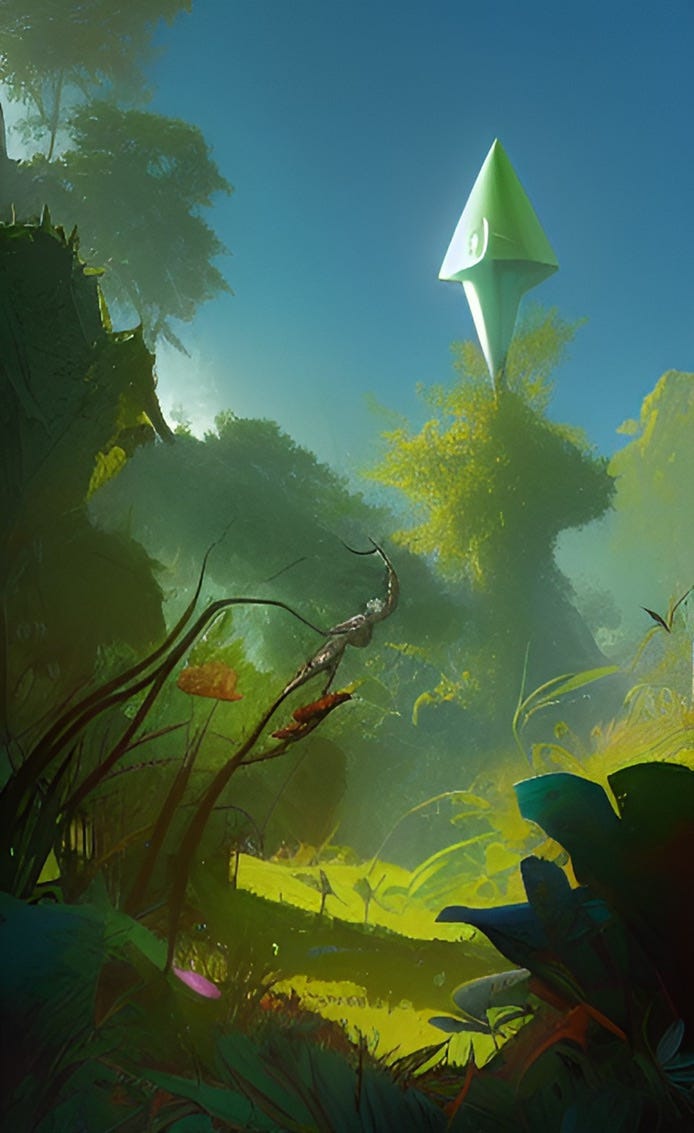
There have been some other, significant developments. The smaller plants have been busy developing yet another plant variety. They have created a very large plant, maybe twenty-five meters tall, that can grow a very large, bulbous pod that, when mature, can detach and float away. The mature pods generate and fill themselves with a mixture of gases, enough to make them float through the air, towering balloons.
The development of the giant floating pods was a major breakthrough for the plants. These large aerial pods not only dropped seeds and seedlings, they formed the basis of a new form of plant communication.
The plants had been exploring various forms of communication for years. They were adept at exchanging chemicals directly by scent, and via the all-present mycelium network. They had also developed a kind of semaphore communication, opening and closing flowers, changing colors. But the ability to transmit messages across vast distances was a game changer.
The smaller plants, the ones that no longer had the ability to grow food, perfected the design of the pods. They had to be large enough to contain the necessary gases for lift, but not so large that they would become unstable in the air. They also had to be sturdy enough to withstand the rigors of floating for long periods of time. Ultimately the giant plants created massive, bulbous balloons, with thick outer skins to protect the fragile interior.
Once matured, the pods were able to detach from the main plant and float upward, carried by the gases they contained. Rising higher and higher, they vibrated, emitting powerful low frequency humming sounds. By clever anatomical design, acoustically tuned ports, located on the sides of the pods were activated by the prevailing winds, producing a strong low pitched rumble, which could be detected by other pods in the area, and other plants on the ground too.
Detecting vibrations in the atmosphere over long distances is possible, but it depends on the frequency and strength of the vibrations. The plants learned — using me as an intermediary — that subsonic vibrations — with a frequency below the threshold of human hearing — could be used for communication. They can travel long distances through the atmosphere, and they are not subject to the same attenuation effects as higher frequency vibrations.
However, the effectiveness of subsonic vibrations for communication depends on several factors, such as the strength of the vibrations, the atmospheric conditions, and the sensitivity of the plants to the vibrations.
The plants immediately went to work, developing sensors, highly specialized receptors to detect and interpret subsonics.
The early communications were necessarily rudimentary, a series of simple vibrations that could be felt, detected. Over time, the vibration system will become more complex, each frequency carrying a specific message.
If all goes according to plan, the plants will one day send and receive messages from across the globe, sharing vital information about weather patterns, nutrient availability, and the best places to grow their seeds. They will also have the ability to exchange cultural information, sharing stories and legends about their history and experiences, though what a plant ‘culture’ might look like is anyone’s guess.
10.23.2756, Settlement KNZ Tuesday, twenty-six years later. Almost a whole lifetime has passed since I last wrote. I thought I had lost this journal years ago. I found it this morning. Pushed up against a wall, behind a desk. It’s been so long since I thought of this! I don’t spend a lot of time here. Sometimes I sleep here.
Mostly I’m out with the plants.
Where to begin?
I will make this entry, though far too much has happened to describe in this, my poor journal, which leaves so much unsaid. To say that, ‘everything has changed,’ is too trivial, too banal, to fully capture what has happened. No human will read this. Nor will any plant. All that I can do is proclaim to the universe, ‘This thing has happened.’
Like I said, mostly, I’m out with the plants. They feed me. Keep me dry when its wet. In return, I read to them.
Well, it’s not really ‘reading.’ It’s more like, I look at pictures, videos, pages in books, they ‘see’ them. The images, along with my thoughts about the images, somehow are ‘read’ by the plants.
So they could see — through my eyes — that there was a large body of water surrounding Nu Zilund, a fact they had been unaware of.
The aerial pods. Yes. A lifetime ago, I left off writing about the aerial pods. Yes, they were released soaring into the sky. Seeds were spread. Messages were passed.
As the years went by, the communication network grew stronger and more complex. Plants that had once been isolated were now connected to a global community, and the exchange of information allowed them to thrive and grow in ways they never could have before.
In my mind, the giant floating pods are a symbol of the plants’ intelligence and ingenuity, their foliate consciousness, proof that they are capable of adapting and evolving to meet the challenges of their environment. And as they float through the air, carrying messages from plant to plant, they demonstrated their dominance.
These pods are no ordinary balloons. They contain a unique mixture of gases that allow them to remain aloft for years, even decades. As they travel over the oceans and mountains, they collect moisture from the air, nourishing the seeds inside, making it possible for new plants to grow in far-off lands.
Over the years, the floating seeds have become a vital part of the plants’ life cycle, allowing them to spread their genes all over the world, creating new ecosystems and contributing to the diversity of life on Earth.
It goes without saying that, as the plants continue to evolve, they will grow even more intelligent, developing new ways of communicating and interacting with the world around them. They have already formed symbiotic bonds with other, non-smart species, interacting like no one had ever though possible.
They’ve become not just a species, but a community, a network of living beings, working together in perfect harmony. They’re not driven by ruthless competition, but by a deep understanding of the interconnectedness of all life.
And this understanding is not limited to the other plants around them. They recognize, in their own vegetable way, the importance of the animals, insects, and even the non-smart plants that share their world. They don’t have the ability to “recognize” in the way that humans do, but they are deeply aware, down to the cellular level, of the importance of consilience.
The plants only take what they need, and only what they can replace. They do not hoard resources or engage in wasteful practices. They understand that their survival is tied to the survival of everything around them, and they act accordingly.
I‘m certain that, as time passes, the plants will be the most remarkable species ever to arise on Earth. They are not just a collection of individuals, but a living, breathing ecosystem. And they continue to evolve, to adapt to new challenges and to find new ways to thrive.
10.23.2783, Settlement KNZ, Sunday. This will be my last entry in this diary. If I calculate correctly, and I believe I do, this is my birthday. I was born on a Friday, this date, in 2696.
I am eighty-seven years old. I saw the world end, and a new one begin.
Coda Ardena Treeve lay in the stump chair. It had been a long walk for her, but she had help. Several plants supported her, half carried her. Once again, for the last time, she felt a sense of extreme well-being. She was perfectly supported. The stump had long ago molded itself to her body contours.
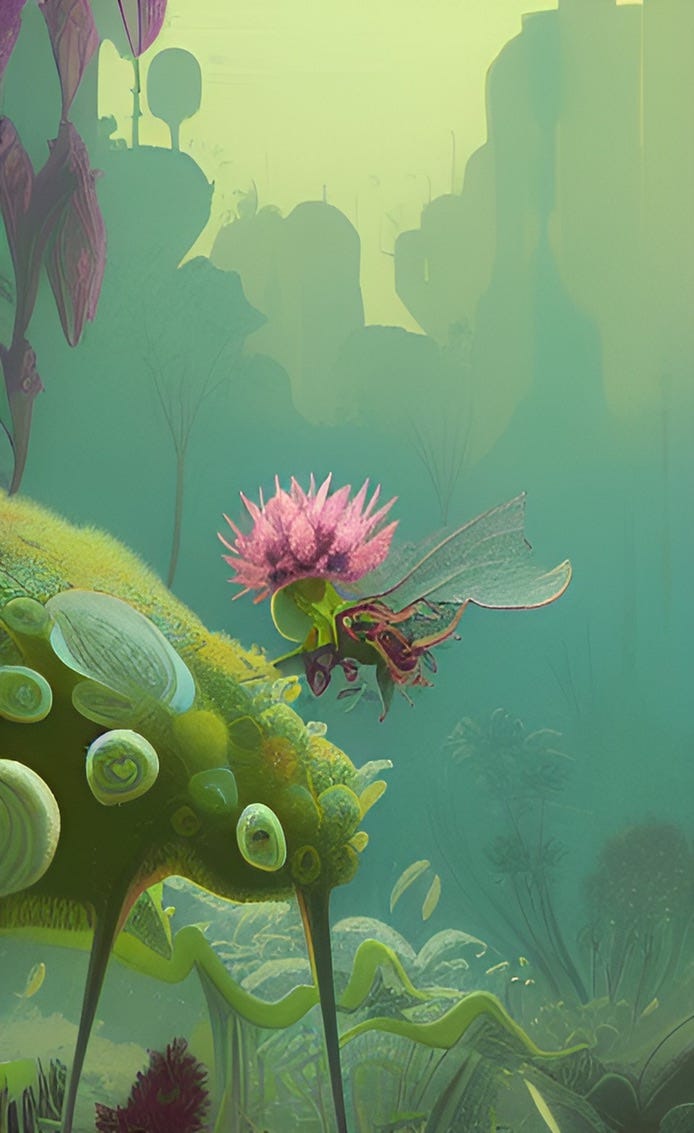
The warm sun flooded over her. The plants had formed in a spiral, with her at the center. The wind floated the powerful gingery scent of the plant’s flowers, which were opening, closing, in some unknown cadence.
Ardena looked up, saw the canopy, the plants around her. She took a deep breath, closed her eyes.
The sun set, and the mighty stars blazed overhead.
By mid morning the heat was building. A fine network of roots had begun to grow over her. Her hands, which lay at her side, were almost completely covered. Within a few days, her husk would be completely enshrouded. The Last Gardener would be one with the plants.
In a distant future, the myths of the plants would tell of their origins, and of a strange creature utterly unlike them, who taught them about the world.
In the glade, the plants maintained their vigil. A giant aerial pod drifted overhead, releasing a shower of seeds on the glade below, delivering word of news and events on mainland Strailya.
And beyond.
For more future histories, visit the list, below.
For some of my other works visit the lists, below. Many thanks for your interest!


