
The Language That Drives Racial Inequality
As the nation wakes up to the reality of racial injustice, Americans must realize that it’s about much more than reforming the police.
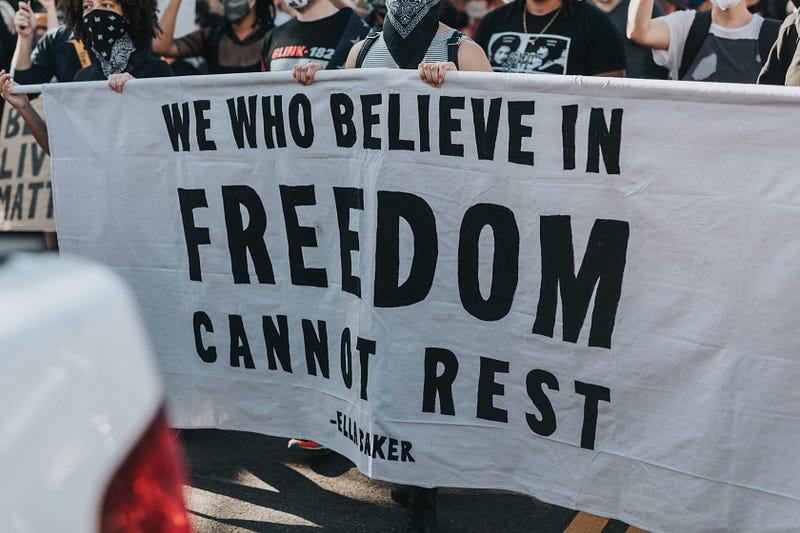
Modern-day systemic racism has evolved since the Civil Rights era. In the 1960s the focus was on the desegregation of schools and racial equality. While the language in the Civil Rights Act addresses many racial equality issues of the time, the evolution of racism has become less about what we see in public spaces and more about the inequitable policies that negatively impact Black, Latino, and Indigenous people more than white communities.
After the implementation of the Civil Rights Act outlawed discrimination based on race, color, religion, sex, and ethnic background, the systems of racial inequality have become harder to detect. Preventing unfair voter registration requirements, racial segregation in schools and employment only progressed society in limited terms. New and more devious tactics have been adopted to continue the legacy of suppression.
As conservative politics continue shifting to the far-right, acknowledging how dog-whistles are used in dictating policy is paramount. Soon after the conservative-led Supreme Court declared racism didn’t exist and destroyed the Voting Rights Act, Republicans have taken numerous steps to make voting more difficult. Particularly in communities of color through policies driven by an ideology of fear of losing power. Of ceding control. Of dog-whistle politics.
The progression of modern dog-whistle politics began during the Civil Rights Era with a vision of a more open and outspoken white nationalist. It encourages its constituents to be well dressed and be better speakers without using the racial language of the Ku Klux Klan’s past. As a result, racially motivated coded language has become normalized throughout American society today.
Lee Atwater, the conservative political operative who worked with many political and presidential campaigns before his death — including segregationist Strom Thurmond, Richard Nixon, Ronald Reagan, and George H.W. Bush — explained the use of coded language in clear terms in a 1981 interview with Alexander Lamis, a political scientist at Case Western Reserve University.
“You start out in 1954 by saying, ‘Ni*ger, ni*ger, ni*ger.’ By 1968 you can’t say ‘ni*ger’ — that hurts you, backfires. So you say stuff like, uh, ‘forced busing,’ ‘states’ rights,’ and all that stuff, and you’re getting so abstract. Now, you’re talking about cutting taxes, and all these things you’re talking about are totally economic things and a byproduct of them is, blacks get hurt worse than whites…” Atwater said. “‘We want to cut this,’ is much more abstract than even the busing thing, uh, and a hell of a lot more abstract than ‘Ni*ger, ni*ger.’”
While Atwater apologized on his death bed for the suffering he caused by bringing this type of rhetoric to the forefront of American politics, the damage had already been done. That same language has become deeply embedded in political rhetoric that it is now normalized thanks in large part to the Karl Roves, the Steve Kings, and the Pat Buchannans of the world. It has since been expanded upon so much that blatant racism has now become mainstream again, not by politicians, but by their constituents.
An Alarming Trend
As many Trump supporters defend his racist rhetoric as being nothing more than him being provocative, it becomes clear that the use of language based on racial animus is now the standard in much of conservative politics. There is a possibility that some of his supporters aren’t aware of the racial implications of what he says, but that can be only due to their own implicit biases. A prejudice that’s programmed as part of their everyday line of thinking.
From the Southern Strategy of Nixon’s campaign to the language of the Reagan administration to the more alarming language of Donald Trump, the progression of hateful propaganda has grown into the aggressive speech and hateful actions towards minorities from a growing portion of American society. A progression that becomes more obvious with each passing day.
In Nixon’s Southern Strategy — targeting predominantly white rural communities across the country — he ran a series of TV commercials that showed montages of burning buildings reminiscent of uprisings at the time in Newark, Detroit, and Watts as he narrated saying, “I pledge to you, we shall have order in the United States.” The tagline at the end of his commercials bolstered his message: “this time vote like your whole world depended on it.”
Thus began the legacy of law and order rhetoric of modern politics.
Conservative politicians would later adopt and expand the use of the Southern Strategy by employing similar dog-whistles. Reagan used it to differentiate “slum dwellers” and “welfare queens” with his “hardworking” supporters in the midwest. He would then augment the strategy using “states’ rights” language which was a clear reference to segregation — implemented by Strom Thurmond’s short-lived States’ Rights Democratic Party — more commonly known as the Dixiecrats.
Bill Clinton would later adopt many of these strategies. As a political genius, Clinton used the same tactics to appeal to rural white voters. To engage those voters and their strawman issues, he bragged about being tough on crime, ending the welfare state, and criminalizing immigrants, among several other issues conservatives are troubled by even today. Clinton’s politics are what many Americans refer to as “neo-liberalism” and arguably cost Hillary Clinton the 2016 election.
As the progression and normalization of racially motivated coded language continued, it should have come as no surprise that blatant racism would become more public with the election of the nation’s first Black president. The use of more open racist rhetoric alongside the dog-whistles of birtherism and declaring Barack Obama a dangerous “secret Muslim” is what made Trump’s election not only plausible but predictable.
All of this was followed by conservatives declaring racism no longer a problem in an effort to rescind the Civil Rights Act and the Voting Rights Act. Although much of the Voting Rights Act was abolished by the Supreme Court, conservatives have continued their attacks on the Civil Rights Act by arguing that the LGBTQ community is not protected by the act. It was a battle they recently lost at the Supreme Court but they have no intention of stopping there.
Race-Based Policy Agenda
The code language adopted by many politicians over the past several decades has resulted in minorities being regarded as second-class in a modern-day caste system. It allows for language declaring Black people thugs and criminals and Latinos rapists and murderers by some of the highest-ranking politicians and well-known pundits in American society. After the end of Jim Crow, the Southern Strategy’s purpose was to deny the rights won by the Civil Rights Act.
The use of racial connotations that demean and demoralize specific racial and ethnic groups serve to drive prejudicial thinking by the majority white population in America. While we may be experiencing a great reckoning in terms of racial justice, there are many issues America has yet to begin to touch. The conversation about racial inequality and injustice must include the myriad problems beyond police brutality, the militarization of police, and the overfunding of police departments nationwide.
From redlining to the disparities in the quality of education to the lack of opportunities to excel in American society to the lack of quality healthcare, these issues are a direct result of the language used for decades to define communities of color. Lawmakers then allow those discriminatory stereotypes to drive their justification in implementing policies that leave the door open to systemic oppression against minorities.
The mass incarceration of Blacks and Latinos to long sentences for victimless crimes is one of the most detrimental policies affecting minorities. The policies that led to a disproportionate amount of people of color to remain incarcerated for much of their lives. Sentences that were justified by the use of discriminatory stereotypes as Reagan did when laying the groundwork for the easy passage of the 1994 Crime Bill.
In 1986, Ronald Reagan signed the Anti-Drug Abuse Act into law. The Act increased federal funding for law enforcement and required harsher penalties for federal drug cases — including life imprisonment. Reagan’s “tough on crime” policies mandated a minimum sentence of 5 years in prison for possession of 5 grams of crack cocaine. His policy began the long-term imprisonment of Black people for nonviolent crimes using over $1 billion set aside for law enforcement.
While many argue that the Congressional Black Caucus (CBC) and Black communities supported various crime bills, those same people are overlooking the politics of the times. Black communities, including the CBC, did not support the aforementioned crime bills outright. They supported the idea of addressing crime. In fact, the CBC introduced an alternative to the 1994 Crime Bill that included investments in crime prevention and alternatives to incarceration.
Much like the solutions being offered today, the CBC’s alternative bill focused on devoting $2 billion to drug treatment and $3 billion to early intervention community programs. While the CBC inevitably voted to support the 1994 Crime Bill, it came as a compromise with 26 of 38 members supporting it. They did so only after receiving much pressure from 10 Black mayors from major cities including Atlanta and Detroit. Context matters.
Silence Is No Longer An Option
Americans must go beyond discussing oppressive policing and mass incarceration and must also address the many other systemic issues that disproportionately affect communities of color more than white communities. Many of these social problems have failed to gain broad attention but if we’re going to address racial injustice, Americans must address them all.
The battle for true racial justice involves tackling the core issues while maintaining focus on the rhetoric that continues to drive these policies. The language used by many politicians has infected the vast majority of Americans today. It’s speech that helped create and reinforce the implicit bias of many Americans — whether they’re aware of their own prejudices or not.
Much of the problem in addressing these issues also stem from those who see themselves as being unaffected by the social inequities that plague America or simply don’t care about the inequities of American society. Others believe they are protected from inequality because of their wealth, race, or religion. However, everyone is impacted by inequality and injustice.
Society does better when everyone does better. Creating opportunities for all doesn’t mean fewer opportunities for others. If those who feel unaffected by these social inequities joined the effort to achieve racial justice, it would allow the country to make progress much faster and to the benefit of society as a whole. Including those who are indifferent to it all.
Arturo is an anti-racist political nerd. He is an upcoming author, journalist, advocate for social justice, and a married father of three. He is a top writer in racism on Medium and a regular contributor to several news media outlets. If you’d like to learn more about the issues covered here, follow him on Twitter, Facebook, and Instagram. You can also support his work here