
The Lack of Aromantic Representation in Media and 4 Rare Examples
Aromantic rep is the last frontier of LGBTQIA+ characters in media. It’s still sorely lacking, but these examples moved the needle over 30 years.

Now that Valentine’s Day has come and gone, another Aro Week is in full swing. As discounted candy and cheap pink and red tchotchkes languish on drugstore shelves across America, us supposedly cynical aromantics are cracking our knuckles to blow the lid on discourse that often invalidates and misinterprets our existence.
And something that this demi/greyromantic who’s been creating and analyzing media most of her career cannot stop thinking about is just how seldom aromanticism is represented in our media at all, let alone in a positive or nuanced light.
We have so much more diverse media in the 2020s compared to yesteryear! We’re finally seeing movies, games, and TV shows feature major characters with traits that formerly relegated them to window dressing, the butt of jokes, or the sassy best friend who serves the socially acceptable protagonist’s storyline. Queer characters are front and center in Netflix series and movies that are seen by millions of people in mainstream audiences, not just small arthouse theaters mostly patronized by doctoral students and neighborhood goths. So why are writers, directors, and financiers still unwilling to cross the final frontier of inclusion by knowingly writing aromantic and/or asexual characters? (Yes, aro and ace are two separate bands of the same spectrum called the aspec.)
The main reason is that people just don’t understand the aro spectrum or dismiss it as people who don’t like being in relationships. If an alloromantic (opposite of aromantic) person is even aware of the aspec, they tend to think solely of aro-ace representation. These characters are written as fearful and lacking confidence in themselves, or even as manipulative and heartless. When it comes to the portrayals of straight women in film and TV in particular, they tend to get pigeonholed as sexual beings who aren’t too sexual, choosing to be single until the hero sweeps her off her feet.
We’re seeing the needle move on more positive and neutral representation of singlehood in media, which does intersect with accurate and respectful aspec representation. But all too often, aro characters aren’t acknowledged for what they are and how their orientation informs their worldview. Rather, they’re treated as broken alloromantics that need to be restored to factory settings. That is, if they’re present at all.
Before I wrap up this intro and dive into the few notable examples of on-screen aromanticism that we do have, I need to shamelessly plug The Ace Space and my dear friend and co-editor, Matt Mason! We both embarked on our coming out journeys on opposite bands of the aspec around the same time, with similar experiences bucking gender norms all our lives and feeling like we never belonged in either straight or queer culture. He founded The Ace Space to put his coming out journey out there, and I followed suit as did other writers on the aspec. I encourage you to read Ace Space stories if you’d like to learn more about the aspec, or you have a loved one on the aspec and you’d like additional insight on what their lived experience might look like.
Without further ado, here’s the four foremost examples of aromantic representation that I could think of with my particular media consumption pattern as an aromantic elder Millennial.
They’re also in a highly specific order, but not for reasons you may think.
4. Grandma Jacqueline Bouvier, The Simpsons
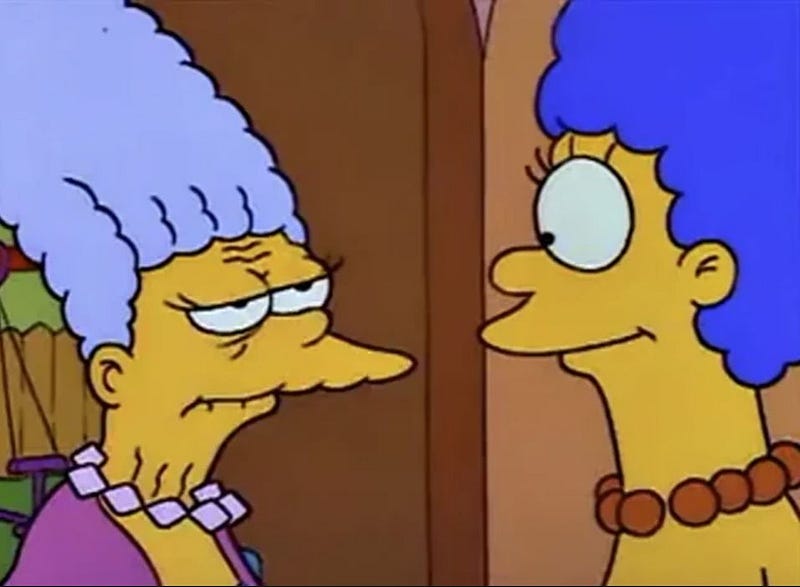
I’ve written about the rich depths of golden age Simpsons, especially the show’s portrayals of women’s issues. The characters are complex and the early years of the show humanized so many things that weren’t even humanized in live-action shows, like how it often sucked to be a kid.
When I wrote about the Season 4 episode “Selma’s Choice” in 2020, I dove into how the writers accidentally said more about how society views older women by never mentioning Aunt Gladys prior to this episode, then never portraying her ever again despite the show running for several more decades.
There’s even more layers with how The Simpsons has portrayed queerness over the years, with Aunt Patty’s lesbianism later written in. Patty and Selma are almost inseparable and treated as a singular character in so many episodes, but Selma got a decade-plus worth of storylines while Patty’s desires and backstories were barely delved into. The Season 16 episode “There’s Something About Marrying” that depicted Aunt Patty coming out of the closet and about to marry a pro golfer named Veronica was pretty transphobic in retrospect, but also a major watershed moment at the time.
Patty and Selma are incredibly acerbic and cynical characters, but neither one shows strong signs of being on the aspec. Selma demonstrates more desire for a romantic relationship than Patty does, with Patty often harshly rebuffing men’s advances and even cockblocking Selma. It’s hard to tell if this is out of sisterly protection, her sexual and romantic preferences for women, or dropping hints that she might be aromantic. Nevertheless, it’s really their mother, Jacqueline, whose aromanticism is the most plausible.
With a universe as extensive as The Simpsons, it’s impossible to fully develop every single character’s backstory and their relationship to the family. But something I find strange is that the show has been on the air almost 40 years, yet Grandma Bouvier only had ONE major episode in the entire show’s run, and one that could easily be solely attributed to Grandpa Simpson. Between Jacqueline being a passive character in this story until the ending and her otherwise scant appearances throughout the series’ run, it’s an echo of the Aunt Gladys phenomenon previously described. The writers accidentally said more about Jacqueline’s lack of agency and who she is as a person by making her such a minor character who’s barely present in her sole spotlight episode. Of all the characters the writers fleshed out and even gave long-running subplots and dedicated episodes to, it’s a little odd that Marge’s mother is barely present despite being alive, cognizant, and living near the Simpson family.
Jacqueline’s marriage to Marge’s father, Clancy, is a whisper of a footnote aside from Clancy’s scant appearances as a kind and loving father concerned about Marge’s future. This ironically contrasts Homer’s parents, whose value dissosance is extremely clear along with the fact that they’re not really in love. Even if Jacqueline lucked out with a kind husband and had three kids with him, it didn’t necessarily mean that they were in love or that she felt romantic attraction. Ace and aro people existed back then too, often had to mask it not to get shunned from society, and women had far less agency in this matter if they didn’t want to struggle in poverty.
I recall Jacqueline being my first exposure to an aromantic character. I peeped that she was different: she never waxed about her dead husband or finding a new beau, as I saw many older women do in real life and movies. She wasn’t as antagonistic towards Homer as Patty and Selma, but she definitely didn’t seem like the type who believed in love and marriage.
In the only episode that fully features her as a character, Season 5’s “Lady Bouvier’s Lover”, she starts dating Grandpa Simpson. Upon rewatching this as an adult who’s been out for more than a year, I must say that my childhood suspicions were correct, even though I did not have language for this until my late thirties.
There’s a scene where Marge tries to urge Jacqueline to see Grandpa Simpson again. She warns him that her mother will get scared if he comes on too strong. Most people would write this off as a cishet dating norm, but this is absolutely an aromantic trait. I’ve been fucking terrified by men who came onto me really strong, even if I found them attractive. And not necessarily in the “What if he fillets my body like a flounder under a bridge” sense, but more “Is he just hellbent on getting a girlfriend and doesn’t really care who it is? Should I at least appreciate his bluntness and be relieved he’s not doing that ambivalent mixed-message crap that drives women psycho? Am I even capable of feeling that way about him in return?”
Before you go in the comments and say “But isn’t that everybody?”, stop what you’re doing and read this post.
Grandma Bouvier does seem to genuinely enjoy Grandpa Simpson’s company…only to be seduced by Mr. Burns and have the two fight for her affection. 30 years after this episode aired, I found myself listening in dazed horror to Mr. Burns gleefully telling Smithers about how much he loved spending time with Jacqueline but that she turned him down for sex. He said that 130 women had said no to him, but she was the first since he became a billionaire. Something about revisiting this in the age of incel rhetoric truly hit differently.
It’s equally fascinating and disturbing how both Mr. Burns and Grandpa declare that they’re in love so soon, with Mr. Burns even going so far as to call Jacqueline his girlfriend that quickly. The audience doesn’t actually see her reciprocate this interest, though. It’s implied that she’s interested because Marge says that she “seems taken with this new beau”. But the audience is TOLD this, not shown. In fact, she has very little agency throughout the entire episode: it’s the men who drive the action and express their love and adoration in such a short time.
She truly doesn’t demonstrate romantic feelings towards Mr. Burns: she enjoys their dates in a passive manner but is barely present. When Marge presses why she wants to marry him, the selling point is “he can provide for me”. After all, it’s implied she’s living off Social Security and any pension Clancy may have had. Shows with older characters in the same era like The Golden Girls often depicted how a lot of women didn’t expect that they’d still be working in their sixties and seventies, or found themselves cut off from their deceased husbands’ pensions.
But the gone and missed dames of Miami certainly fell in love on that show. Even when I was a young kid watching The Simpsons in its original run, I could tell that Jacqueline was not into any of those men even before she bluntly says “I don’t want to marry either of you!” although I couldn’t pin down why. Now I can: she didn’t have the social freedom to live out her life as an aromantic woman until her eighties. She just didn’t realize it until she could no longer ignore Mr. Burns’ vileness at the church, countered by Grandpa Simpson’s overeagerness.
And while entire books could be written about The Simpsons and queerness, I bet some of the OG writers also didn’t have the language yet for aspec folk but had inklings. They already hinted at Smithers being gay, so Grandma Bouvier was the perfect candidate for piloting an aro character.
3. The Great Gatsby (2013)
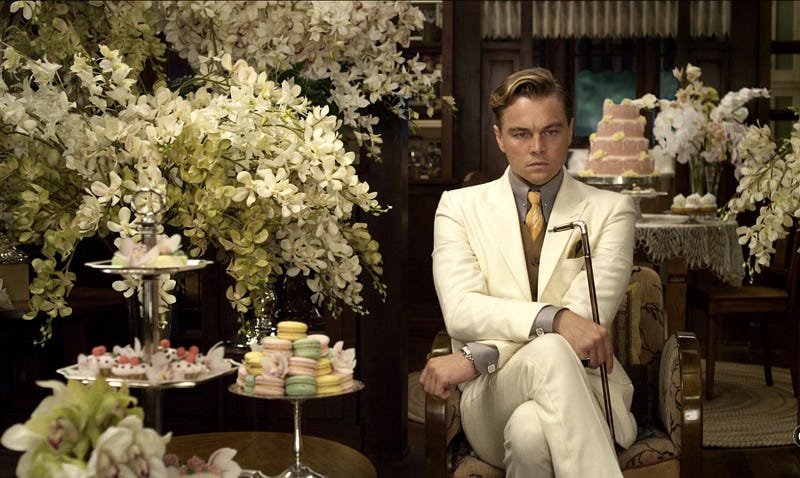
Depending on how much you’ve studied classic American literature, you may find this entry on the list odd. But hear me out.
The original book and early film adaptations didn’t delve into Jay Gatsby’s possible demiromanticism much, but Baz Luhrmann’s 2013 adaptation absolutely did. This is the version I’m most familiar with, so that’s the one I’ll discuss.
Even if you haven’t seen any of the numerous adaptations, or it’s been decades since you had to read The Great Gatsby in high school English class, its foothold in American culture is undeniable. The lawn parties, the high fashion, the embarrassingly extravagant mansions on Long Island — people still find this indelibly appealing despite the story’s focal point being the moral bankruptcy of the obscenely rich and how an earnest dream can hollow out when you attain it through illicit means, and it wasn’t all it was cracked up to be anyway.
Nevertheless, the gist of The Great Gatsby is that Jay Gatsby is this mysterious figure who embodies the American dream of rags to riches. He throws lavish lawn parties every Saturday that shock the landed gentry with their disquieting degree of opulence. The book makes a point of how mysterious he is until he starts confiding in Nick Carraway, the backseat protagonist of Midwestern origin, and the metaphorical walls crumble with the revelation of how he amassed his fortune. Jay hails from similarly humble origins as Nick Carraway and both served in World War I, yet they embarked on radically different life paths that brought them together.
This movie has the caliber of breathtaking visuals and dedication to historical reenactment peppered with neologisms that you’d expect in a Baz Luhrmann film. As this immersive imagery whisked the audience away to Gilded Age excess on the island that’s been the NYC elite’s playground for generations, it immediately became clearer to me than my lizard’s enclosure door that Jay Gatsby is demiromantic.
His whole schtick of throwing these shockingly lavish parties just to get Daisy’s attention without actually speaking to her is VERY much an aromantic behavior. It’s not solely the mansion, his expensive clothes, and throwing parties just because they’re fun and he loves dressing up with champagne. It’s that he wants security in the knowledge that he’s on Daisy’s radar and she’s thinking of him, even if she can’t act on it.
To an alloromantic person, that might not make any sense. Why go through such a grandiose gesture, and repeatedly, instead of simply telling her how he feels? If you’re in that grey area of the aspec that’s not on the completely nonamorous side, surely you wouldn’t want to screw up the infinitesimally rare occurrence of feeling romantic attraction?
It’s not merely shyness, insecurity, or in the context of the real-life tensions between old aristocracy and the nouveau riche in the 1920s that served as a backdrop to the original book and all the film adaptations, a divide brimming with resent. People on the aro spectrum feel romantic attraction so rarely that when that person who actually stokes something in us can’t be in our lives or actively doesn’t want to be there, it can read as strange, obsessive, or just plain nonsensical to alloromantics. But one of the ways that these odd behaviors can manifest is being unable to have a handle on those feelings because they happen so rarely if you’re somewhere on the aspec.
There’s a certain grieving that also happens if that person is already partnered. Alloromantics can grieve a love that didn’t consummate or a relationship that ended, but they don’t grieve like grey and demiromantics do.
When you have a crush once a decade if at all and can only experience romantic attraction with a genuine friendship or sexual connection, it’s a very different manifestation of grief compared to someone who speaks about partners in terms of “the next one” and swiping away on dating apps. Alloromantics feel romantic attraction far more easily and often than aromantics. I’ve seen so many throw partners on and off like a shirt, falling in love isn’t an earth-shattering event for them even if they insist it is. But when it is this colossal event because you virtually never have crushes let alone more intense feelings of attraction, it’s even grander than Jay’s parties but without the organized crime propping it up. I related to Jay in that he clearly felt a sexual connection with Daisy to the point that he felt and fostered this genuine romantic attraction all these years, even if it unfortunately led to limerence in his case.
Jay is seen as a desirable, if slightly strange, bachelor because he’s not just wealthy and handsome. He’s the embodiment of the American Dream. He’s youthful and fun-loving, unlike that stuffy old money who just wants everyone else to serve them and believe fortune should only favor those who fell out of a blue blood vagina covered in foie gras and diamonds instead of amniotic fluid. But underneath it all, Jay is deeply lonely and still pines for Daisy. None of the women throwing themselves at him interest him at all. If the events of The Great Gatsby were set a century later, people would be commenting on social media how weird this is that such a catch “gets no bitches”.
In the 2013 film, Jay is also clearly depicted as being uninterested in casual sex despite living in a hedonistic era and having plenty of opportunities for it. This can also imply he’s demisexual in addition to being obviously demiromantic.
In the context of the original book, his love for Daisy is what motivates him to become wealthy and prove his worth to her. Even though he lied to her just to gain access to her, Jay is ironically of stronger moral character than she is. He honors her marriage to Tom Buchanan, which now makes her inaccessible to him. It’s clear that she doesn’t feel the same way about Jay and plays along with the expectations thrust upon her as a daughter of aristocracy raised in the south. Despite this, Jay’s intense romantic love for her ignites the fire for his dreams even though all the grandeur disintegrates and she’s revealed to be one shitty person.
The original book and other adaptations depict a broken man putting a vain and materialistic woman on a pedestal just like all the other falsehoods of his luxurious lifestyle. In contrast, Baz Luhrmann’s ode to the North Shore is a salient portrayal of demiromantic, and possibly demisexual, traits in men, even though it may not have been entirely intentional.
2. Samantha Jones, Sex and the City

Now we’re getting into a character who was intentionally written as aromantic, even if they didn’t use that term to describe her.
Samantha Jones was a character who made me feel incredibly seen in a hyper-misogynistic era that wanted women to be sexy yet shamed them if they were sexual. Now that Sex and the City is reflected upon with a more critical lens regarding class, diversity and inclusion, and how the show was simultaneously revolutionary and regressive, I’ve certainly written about my own life experiences contextualized through Samantha Jones.
I wrote the above essay when we were still going through the first COVID lockdown. A year later, I’d be set up in a new life across the country and ending the year coming out on the aro spectrum.
Samantha made me feel seen. And to this day, I get so angry when I hear “she’s what you get when a bunch of gay men try to write a woman character”. Women like her exist and are FAR more common than you think! They just aren’t necessarily upper-income skinny blondes in chi-chi Manhattan apartments with a propensity for blunt language and dirty jokes that veer into politically incorrect territory.
Jacqueline Bouvier was my first sighting of aromantic representation as a youngster, never expressing much excitement around men who pursue her or speaking of her dead husband in reverence. But she was and still is a very minor character in a long-running show’s universe, whereas Samantha Jones was one of the first obviously aromantic main characters in a series that became a cultural touchstone. No matter what you think about the show, you can’t deny how much Sex and the City moved the needle despite aging like a lump of goat cheese in the Venice Beach sun.
And while Samantha didn’t wear aromantic labels like a Gucci dress, she was very obviously greyromantic veering into nonamorous territory. Not only was Samantha blatantly aro, but also definitely not ace.
Which as a real-life woman in the exact same place on the aspec, let me tell you how tiring it is to have “demiromantic” constantly confused with “demisexual” since the latter is assumed to be the default in all straight women, yet I relate more to Samantha Jones than a vast majority of the women who write dating articles for Medium.
I’m not saying that to throw shade. So much of the writing is good quality! I just cannot relate to them the way I could in that episode when Samantha hooked up with the dildo model in LA, she thinks it’s just another fun casual encounter, but he starts asking about her interests and wants to read her his poetry, and she completely nopes out. Then gets fucking terrified when he proposes moving to New York.
Samantha’s default state is not wanting a romantic relationship, and she enjoys dates and casual sex regardless. She is capable of falling in love, but it’s a very rare occurrence. When she truly meets her match with Richard Wright, she snidely remarks, “Monogamy. Ugh, I caught it from you people!” to the other ladies. People often think that someone with a rampant sexuality like hers must mean she’s okay with cheating or being in a polyamorous relationship, but I promise you: monogamous people with high sex drives and demiromantic orientations will be fiercely loyal to their partners, and expect that loyalty returned. And we exist in real life, not just HBO writers’ rooms.
I always felt that Richard was the only man in Samantha’s sexual Rolodex who she actually felt genuine romantic attraction towards. Her queer dalliance with Maria was more to titillate the viewers and provide a few episodes’ worth of subplots. Something about her relationship to Smith always seemed more like she went along with it, despite her going back on her initial rebuff of Smith’s declaration that she was his girlfriend.
Samantha clearly had a strong sexual connection with Smith, which she needed in order to feel romantic attraction. People think this is unrealistic for women, but this is literally how I’ve been my entire adult life and part of my teens. This is normal for people on the aromantic spectrum, which the world was not at all prepared to discuss in 2001 when Sex and the City was at its height and everyone at my high school used “gay” as an insult.
Despite all its flaws, Sex and the City was revolutionary for its time and Samantha Jones is the most prominent aromantic rep in 21st century media history to date. It’s infuriating that she’s often written off as unrealistic, satirical, or a projection of a gay man onto a straight woman. Even within the context of the show, many subplots were all about humiliating or humbling her in a way that didn’t routinely happen to the other women.
Had the show been adapted from Candace Bushnell’s work at a later point in time and Carrie been an actual sexologist instead of an immature biphobe, Pat Field would’ve constantly dressed Samantha in black, white, and green then given her grey accessories in the scenes where she truly fell for Richard.
1. Louise Belcher, Bob’s Burgers
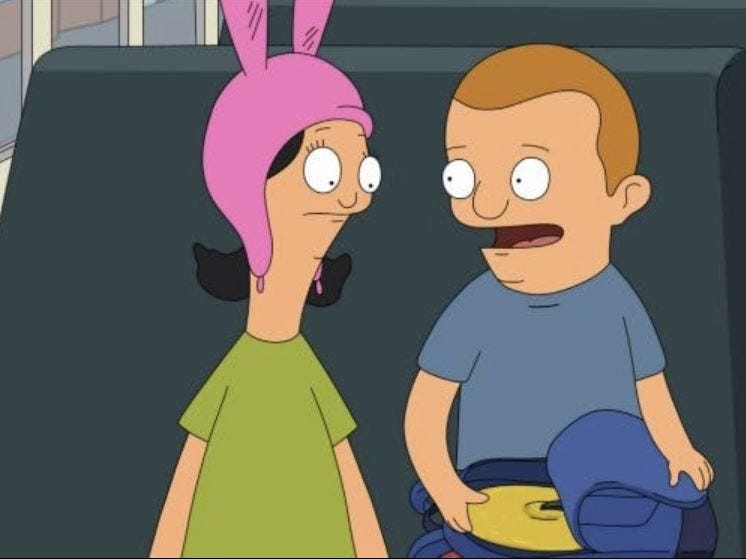
At first, I was unsure whether to include Louise Belcher on this list given that this character is in grade school. But upon watching more recent episodes of Bob’s Burgers, Louise deserves top billing on this list because her wonderfully complex and bombastic character developed more to include more blatant aromantic presentation.
Not to mention that many children often know they’re queer growing up, and we’re having more open discussions about this today despite the pushback from extremist groups.
But even the children’s health resource I just linked doesn’t mention asexuality and aromanticism. Aromanticism can be easily confused for the “Ick, the opposite sex!” attitudes children tend to have. While an adult is unlikely to retain this sentiment after maturing, a child can still have an inkling that they won’t feel romantic attraction the way their peers will.
Louise’s characterization as someone with selfish tendencies and being short on empathy, yet still has a moral line she refuses to cross, is also frustrating. Like all the complex characters on Bob’s Burgers, Louise is richly layered and I love that she subverts so many expectations about young girls. Like many people on the aspec, she also regularly subverts several gender norms.
But my frustration is on account of there being such little aromantic representation at all. One of the most notable examples we have in modern mainstream media is a child who’s often the things aromantic people are perceived as in real life even if we’re not: cold, selfish, uncaring, or even manipulative, as Louise can certainly be.
No, not every character has to be likeable or morally virtuous. I also love Louise’s complexity, and that she’s allowed to be more than a caricature. But when your group is so rarely represented, something is very telling that this is the type of character aromantic rep is given to when we’re already judged in real life for being heartless, cold, or stubborn. Which is ludicrous, because if alloromantics were better people than aromantics? Tony S. would be making way less from Medium and archived Geocities pages would outpace Reddit’s daily traffic.
One of the first cues we get that Louise is somewhere on the aromantic spectrum is in the third season episode where she attends the Boyz 4 Now concert with Tina. Louise instantly forms a little fangirl crush on Boo Boo, then starts freaking out because she’s unsure of who she is now.
After chaos ensues when the Belcher sisters sneak onto the band’s tour bus, the juicy resolution entails Louise pointing out that Tina constantly has crushes and easily falls in love with practically every boy she meets. Tina is written as an incredibly relatable teenage girl, and we do often see her constantly falling for different boys and being unafraid to have horny thoughts.
Bob’s Burgers is constantly praised for being a sex-positive and pro-woman show and that praise is 1000% warranted. I love that Tina isn’t made to feel ashamed for having frequent crushes and sexy thoughts to the point that she writes erotic “friend fiction” and her family just accepts it. She also tells Louise that she’ll be there for her if she has a crush again: it’s implied that at least Tina is aware Louise doesn’t have crushes.
Louise also isn’t patronizingly told that she’ll grow out of it and fall in love one day. This is utterly cemented in the Season 13 episode “What About Job?” where she ponders her future.
This is the episode that gave her both the top slot on this list and hope that the needle is moving on aromantic rep.
It’s shown throughout the series that Louise is close with Regular Size Rudy. She’s even resentful when he reveals he has a crush on Chloe Barbash and not her, despite her reservations about him wanting to take their friendship to another level. I saw shades of Samantha and Smith in Sex and the City when Rudy laments that he hoped for his first kiss, and Louise makes sure it’s from her. Does she have feelings for Rudy she won’t admit to, or is she just exalted by the power of knowing he likes her despite her disinterest? Samantha was uncomfortable that Smith suddenly declared she was his girlfriend, but she liked it less when he said he wasn’t seeing anybody special during his TV appearance. Feeling like that doesn’t always indicate romantic love.
But it’s truly “What About Job?” that is the unspoken watershed moment for aromantic rep that I am now begging to be recognized for what it is.
The episode depicts the Wagstaff students and Belcher children as working adults, and it’s bluntly told but also shown to the audience that Louise and Rudy live together as platonic partners.
Despite the obviously satirical intent of the episode, this almost made me tear up. This is clearly not just a roommate situation, or trying to keep romantic and sexual connotations out because these characters are canonically children. Louise and Rudy are queerplatonic partners, even if the term isn’t used.
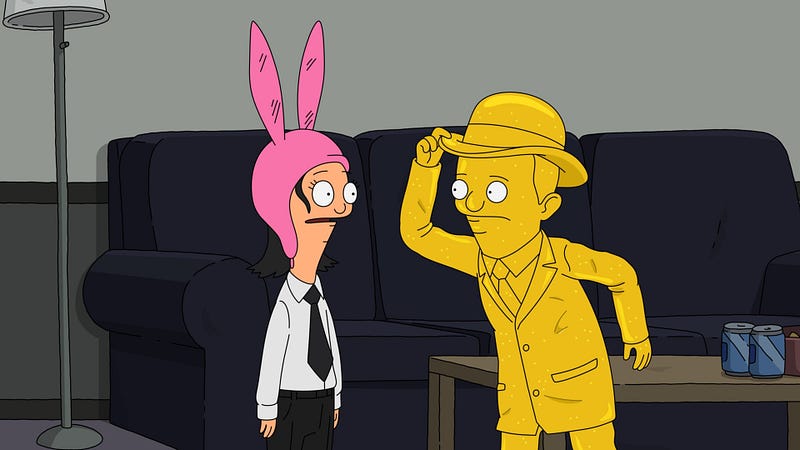
When Louise ponders what her future could look like, she’s not dating or married to Rudy or anyone else. She also takes on a more androgynous appearance with traditionally masculine clothing while retaining her pink bunny ears.
Because she’s canonically nine years old, it makes sense that her sexuality isn’t explored the way it is with Tina and the adult women on the show. It isn’t directly stated if Louise is nonbinary or agender, but she’s certainly shown throughout the series to be gender-nonconforming to some degree. Nonetheless, it’s implied that Louise lacks both romantic and sexual interest and is at peace with the idea of being single and living alone in adulthood. She’s also happy cohabiting with Rudy as extremely close friends rather than romantic partners.
The focal point of the episode is Louise getting into crazy adventures, while her relationship to Rudy takes the backseat. He’s the side character, she’s the protagonist. This alone makes the FBI sketch noteworthy.
But this episode is a watershed moment because Louise’s nonsexual and platonic relationship with Rudy is clearly not a sad fate that makes the audience long for a return to the status quo, such as the alternate timeline when Linda marries Hugo. It also isn’t a consolation prize for Louise on account of her not having a romantic relationship. This is the most affirming aromantic representation I’ve ever seen in mainstream media! It did all but say “aromantic” out loud.
In real life, aromanticism can look like the strong platonic relationship Louise has with Rudy. It can also look like any other straight romantic relationship with two romantic partners living together, except catching feelings was a blue moon occurrence for one or both of them. An aromantic relationship can also be an asexual one, or purely sexual. I love that adult Louise and Rudy are portrayed as queerplatonic partners and not just puppy love crushes that grew up to get married, and long to see more representation like this.
Aromantic is not a dirty word. It doesn’t imply moral inferiority, brokenness, heartlessness, or simply choosing to be single. Despite greater efforts for aspec representation and inclusion, aromanticism is still tiptoed around to the point that the best and most recent example of a popular long-running show won’t even say it out loud.
All of these examples from different chapters in media history moved the needle to some degree. If I ever make it to a Hollywood writer’s room, I’d love to work on an aromantic character and create the rep I wish I’d grown up with. This type of representation isn’t just direly important for people figuring out their sexuality and romantic orientation, and suspecting they might not experience attraction the same as their peers, or at all.
It’s even more important for people who aren’t on the aspec, so they can see that queerplatonic relationships, long-term singlehood, consensual participation in casual sex that doesn’t lead to a romantic relationship, and other types of love can fulfill a person just as much as a traditional romantic relationship. That you don’t have to be ace to be aro and vice versa, and some people are both, and all are totally normal.
I’m doing my part to move the needle and the pen.


