The King is Dead: A Black Meditation on Grieving Chadwick Boseman
Chadwick Boseman’s death has me promising to children a future where Blackness will never leave the Earth.
The body of Chadwick Boseman — the avatar of a future where Black people could politically self-determine — was laid to earthly rest in South Carolina this week, a state in which nearly 60% of its population was enslaved on the eve of the Civil War. Our children mourned.

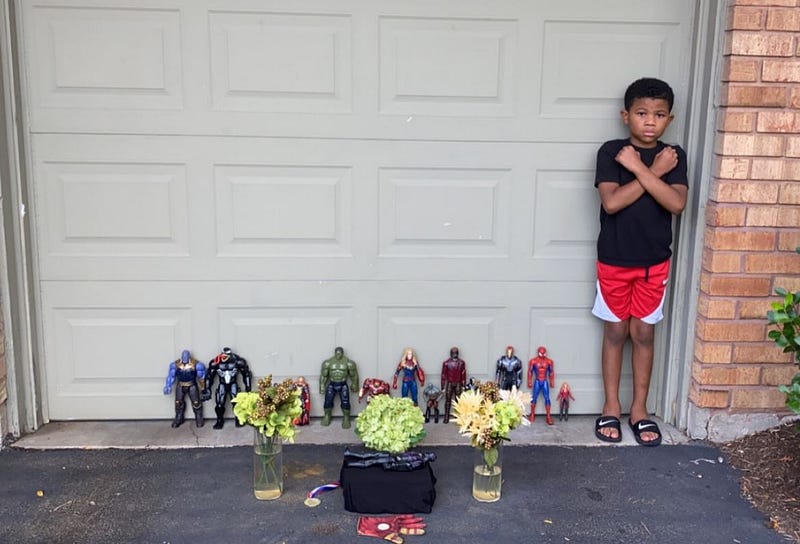
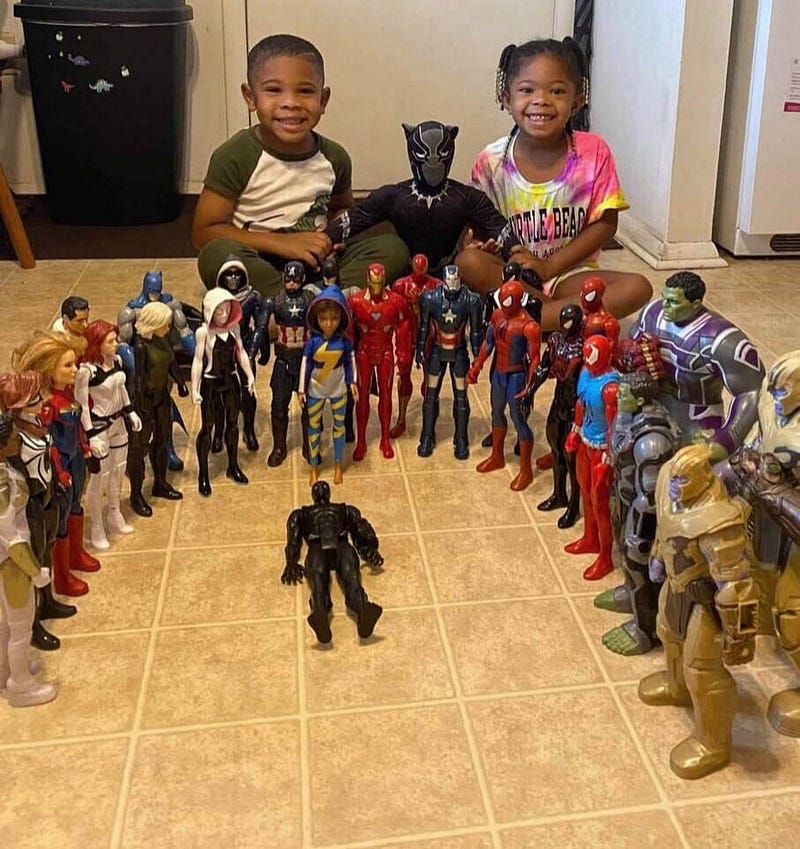
Deprived of the ability to meet with their friends, Black children had their action figures grieve the king. Parents posted photos of their kids holding funerals with their toys. Superhero dolls formed a circle around T’Challa. One can imagine this scene taking place at the end of Avengers: Endgame, honoring the fallen warrior-king who led the bulk of the Earth-based forces against Thanos. In a pandemic reality that has disrupted the communal nature of grieving for public figures together, our children found the most touching way to commemorate the loss of their hero.
I have always felt that the grief Black personhood expresses encompasses all aspects of time.
Boseman’s passing shows how our imagination regarding our historical reality can also cause our grief to span throughout history and into the future. Our children mourn the past because their parents let them know as they walked into the movie theater that they were getting ready to see something that we have ached for since moving pictures became a pastime. They mourn the present, as who would now inspire them in this current moment where we either need a superhero to correct the guilty, or a nation where we could find refuge? And they mourn the future, the anxiety that we would never see the likes of Chadwick Boseman — Jackie Robinson, James Brown, T’Challa — ever again.
The nature of Black grief dovetails with the imaginative future Boseman exemplified in his most famous role. The speculative genres such as science-fiction, comic book universes, and utopian/dystopian stories handle Black personhood poorly. Our presence is the flicker in the projector that causes the stories white people create about themselves to jump; an interruption in the narrative that informs them something needs fixing. T’Challa hinted at a future where Black people were triumphant. We could exercise our humanity on an international scale and save the world from outside forces that would destroy it.
Too many stories that look into the future assume that race will fade as a social determinant. Faced with a zombie disease, or alien invasion, or magical wars, these stories — the Walking Dead, the Marvel Cinematic Universe, Harry Potter — foretell that the West will finally give up its racial caste structure and join hands together in the name of survival. The fiction of writers like Octavia Butler adjusts this. But she does not live deeply enough in the imagination of enough white writers to change the climate of American speculative fiction.
All futures eventually transition to spiritual life. What is the status of Blackness there? As 2Pac said, does heaven have a ghetto?
The erasure of Blackness in the future and spiritual life can only arise from imaginations that have surrendered to the history of white supremacy. Matrilineal enslavement is the bedrock of the West, among the first creations of our economic order. Slavery, as historian David Brion Davis noted, evolved in lockstep with Enlightenment thought and burgeoning capitalism. Long ago, the ancestors who stole this land envisioned a future where white people eternally bonded Black labor to the field. The future they dreamt of, purely speculative — the stuff of science fiction and spirituality — did not have Black personhood becoming full citizens in mind. Our erasure from their forward-thinking imagination signifies the white tendency of eliminating my people’s survival into the future.
Black personhood sees the future and spiritual life differently. White people see the physical world transitioning to the spiritual realm, with the divisions of the Earth fading as humanity makes its linear march forward in time. Black personhood knows better. The physical world white people created impinges on all realms, confounding our inevitable ancestor-hood. As 2Pac said, does heaven have a ghetto? My people, to continually sharpen our political savvy, blend the past, present, and future into our understanding. We want our survival to mean more than endurance. Our children’s reaction to the death of Black Panther shows the enduring march toward full citizenship in this nation and the form our progress — reflected in their grief — will take. Black folk are sure of our past and present. We can hope for a better future, the one that Boseman showed in his acting. But who is to say that our present will not follow us into our undeniable future, when we depart this plane of knowable science and into spiritual existence?
There is a definite endpoint to a human’s future. It is death. Whatever comes next is not bound by linear time, but simultaneously exists in the past, present, and future, exerting influence on our existence. It is the mixture of the past, our politics, and prophecy that is the unique nature of Black grief. It is why our ancestors do not rest in peace, but in power.
Our enduring existence in this country is why we cannot merely see grief as a linear emotion that goes from past to future, but a cosmic energy that stretches into the deceased’s past and toward our future. Boseman survives in ancestor-hood. My faith eases my pain, and I hope I can pass that balm down to my son and the children who hold funerals in the stoicism of their action figures. He joins the hundreds of thousands who lived and died on the rice fields in South Carolina in our terrible, brutal past. We mourn him especially in this time of pandemic and racial unrest. And we pray for a future where his energy, pulling from centuries of bondage, and centuries more of moral agitation, reincarnate into another artist to inspire another generation of children so that Blackness may never leave the Earth.
Hal H. Harris is the founder of Established in 1865, a blog dedicated to exploring Black personhood. He tweets at @Established1865 and hopes you will give him a follow.