
The Kiev war in Russia: reality or propaganda?
What happened in the last few weeks
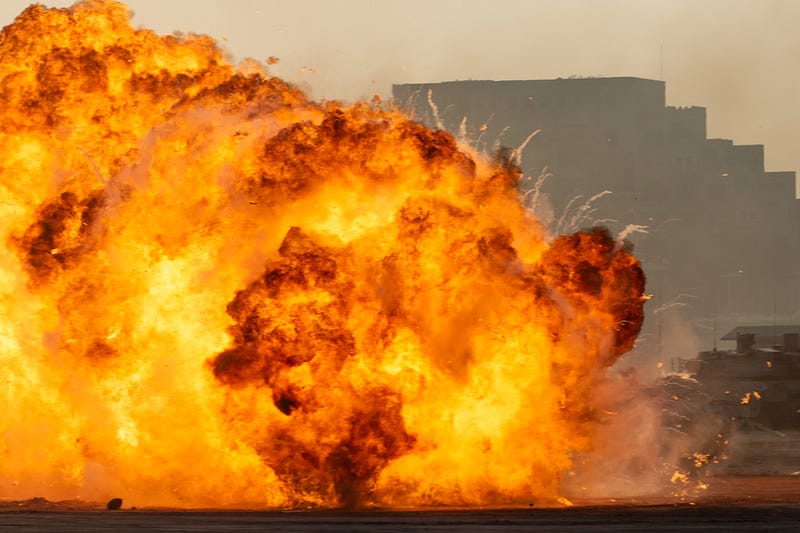
In the last few weeks, several attacks have been carried out on Russian territory, causing damage to warehouses or strategic points. Today, for example, early in the morning an ammunition depot was ablaze in the Belgorod region of Russia. Thus, in the last weeks, journalists have already begun to talk about a secret war that the Ukrainians would have decided to carry out within the borders of Russia.
On April 25, the last major event took place in Bryansk, 100 kilometer from the border. Two incidents occurred simultaneously in two major fuel deposits near the city. The first, civilian, was from the Rosneft company, containing ten thousand tons of diesel. The second included five thousand of fuel. These are part of the so-called Friendship Pipeline, which carries Russian oil to Germany, Hungary and Poland.

What we know of this event comes from the security cameras, whose images show the moment of the burst. The fire seems to have started from an explosion at the base of the tank, which is the most obvious place if the goal is to cause as much damage as possible. The fire quickly spread to surrounding areas, remaining out of control until the evening. There were no casualties, but the smoke remained visible throughout the day from tens of kilometers away.
Naturally, many hypotheses have been formulated by the international community. In fact, what caused it may have been a technical failure, a missile attack or a raid from the sky. The mayor of Bryansk immediately released a photo of a white van, suspected of having transported a team of Ukrainian saboteurs. The precision of the explosion immediately made people think of a job being done from the ground. To fuel the hypothesis, the presence in the Ukrainian special forces and services of a very high percentage of operators who, speaking perfect Russian, could be mistaken for Russian, should also be reiterated.
Therefore, if a missile attack is to be discarded, the assumption linked to drones remains alive. The governor of the Kursk region announced that the antiarea probably shot down two Ukrainian Turkish-made drones, the famous Bayraktar, on the same day. Futhermore, the Ukrainian army has received in recent weeks several drones capable of detonating on target and led by a team of a few men.
It should also be stressed that the explosion in Bryansk was not the first accident. Last month, on March 30, another burst took place fifty kilometers from the Ukrainian border. It was a military installation in Belgorod in Russia (the one attacked this morning), used to store missiles. Also in this case, there was talk of both an internal problem that occurred during the transport of ammunition and a night attack by the Ukrainian hand.
On April 1, an attack on an oil depot occurred newly in Belgorod, while on April 14 the Russians claimed two Ukrainian helicopters hit buildings in Klimovo. However, these events would not have caused civilian casualties. Finally, on April 14, the famous sinking of the Moskva took place. This was done in Ukrainian territorial waters, but apparently by two Neptune missiles supplied to Kiev.

Nevertheless, it is also important to refer to the latest explosions recorded in Transnistria, the separatist and pro-Russian region of Moldova. On Monday, grenades were fired at the security ministry of the capital Tiraspol, while yesterday the Russian radio transmission center and a military unit just outside the city were hit. In this case, however, it is feared these events could result only in destabilizing actions that could put the blame on Kiev and therefore trigger a new Russian intervention, in order to annex the self-proclaimed interventionist republic.
Be that as it may, the attacks and fires that have been taking place on Russian territory in recent weeks show how much the Ukrainian people have been underestimated by the Kremlin, namely how ready they are to undertake a fierce resistance. This possible form of Ukrainian retaliation has indeed an immediate negative effect on Russian soldiers’ morale and on their conviction of being the strongest. Anyway, it should be stressed that Moscow could in response carry on the victim’s narrative, fueling internal propaganda to justify the invasion of Ukraine. To such attacks, Russia only threatens heavy consequences
Sources I was inspired by to write this article:
- La guerra segreta di Kiev: nel mirino i depositi di petrolio in Russia, published by La Repubblica
- Raid, incendi e sabotaggi in territorio russo: il «fronte fantasma», tra realtà e propaganda, published by Il Corriere della Sera
- Guerra Ucraina, tre attacchi in Transnistria, published by Il Fatto Quotidiano
I am an Italian student who tries every day to improve her English. I really like writing and studying in this language, also to be able to reach more people. However, I still often run into mistakes. So, if while reading my article you have found some, do not hesitate to contact me, either though a comment or private note!