
The Kids I Taught to Swim Taught Me to Be a Better Person
They needed my best, and that meant I needed to learn.
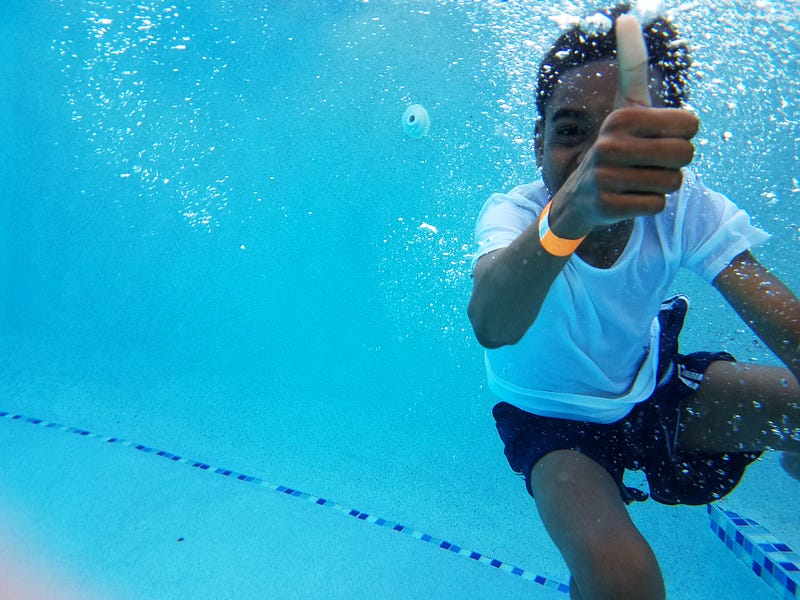
For much of my twenties, I worked as a swim instructor (and then a supervisor and manager) for a program that taught school-day swim lessons to kids from underprivileged schools.
Although the job was often difficult and frustrating (and cold!), it remains the most meaningful job I’ve ever had. There was not a single day when I had any doubt that what I was doing was important.
To this day, I begin to cry almost every time I talk about it. Working with those kids meant the world to me; they needed things — things I found I could give them.
In turn, the kids who I taught to swim became my best teachers. Through their struggles and successes, the ways they expressed their fears and upsets and love, they helped me see and interact with the world differently.
Quite unintentionally, the kids showed me the areas where I needed to grow, and in the process, they helped me become the adult I wanted to be and the one they needed me to be.
I want to tell you about all of it.
The Context
This swim program took place in New York, a city with a lot of kids and a huge wealth gap — a place where the ability to swim is far from guaranteed. This becomes all the more significant when you consider that the ability to swim is a life-saving skill.
We worked with kids in public and charter schools in the less affluent areas of The Bronx, Brooklyn, and Upper Manhattan. Although across the years we worked with just about every grade K-12, the majority of the kids were 7 or 8-years old.
These kids came, for the most part, from families who wouldn’t have been able to afford swim lessons on their own. Many of the students were minorities and/or recent immigrants. They didn’t all speak English. Some had special needs that meant they didn’t speak at all.
Each year, only a few kids started the program with any swimming skills whatsoever. Most had no prior swimming experience, and the majority were afraid. Many had been warned away from the water by parents who themselves didn’t know how to swim and were, with good reason, afraid of themselves or their children drowning.
This program was the only chance that many of these students would have to learn to swim.
That was a lot of pressure for me, but it also made it very special. What made it more special? I got to help these kids learn to do something that they never thought they’d be able to do. That’s magic.
Meeting People Where They Are
One of the first and most difficult lessons I had to learn was that each child had to be treated as an individual within the group. I might be tasked with eight to ten kids at a time who were at roughly the same skill level, but that didn’t mean that I could treat them as a homogenous group.
As an instructor, I had to be able to see each child and their needs, listen to them, and be able to adapt.
Every child — every person — has different strengths and weaknesses. We have different fears and motivations, and we’re emotionally triggered by different things.
I worked with a lot of students with special needs. They did not all have the same needs; they were each unique. And I needed to figure out what each of these children needed, wanted, loved, and was good at.
It was often not easy, particularly when a child was nonverbal, but it was never impossible.
I always smile when I think of a boy I worked with one-on-one a couple of times. He was a big kid, tall, and although he couldn’t use words to tell anyone, it was clear from his vocalizations and body language that he was very afraid he would sink and that he did not want to get his face wet.
So instead, I taught him how the water worked — how it would flow and hold him. I moved his body through the water in a way that he felt supported but could also feel what the water was doing. He soon went from sounds and expressions of upset to delight and laughter.
I was able to get him gliding on his back like this, and he loved it so much that each time we stopped, he’d take my hands to show me he wanted me to do it again. In this way, he slowly got used to the feeling of the water touching his ears and learned that he could float.
Trying Again
One of the greatest things this program taught both me and the kids was resilience.
You don’t give up when it isn’t working; you try differently.
I’ve always been afraid of failure. Always. As a young person, I hated making mistakes more than just about anything else, and I didn’t know what to do when I failed at something. Failure, I thought, meant you weren’t good enough.
And yet I failed many times as an instructor, a supervisor, and a manager with this program. There were too many inherent obstacles and too many variables for a perfect outcome to ever be achieved.
It was, in many ways, an exercise in failure, and for a kid in her early twenties, that was really hard on me.
In the past, I probably would have given up on anything that I continued to fail at, but here, that wasn’t an option. It did not work for me to give up on these kids.
So I tried everything I could think of. I wasn’t afraid to look ridiculous if the end result was positive, and so I did a lot of ridiculous things and came up with a lot of solutions. They didn’t all work, of course, but that’s how life goes.
I came to realize that trying, improvising, problem-solving — those things were exciting and rewarding in and of themselves.
Making It About Them
Let’s be honest though, having fun and just trying things didn’t come easily. Especially at first, when I had this idea in my head of how swim lessons were “supposed to go,” it was extremely frustrating when the kids weren’t understanding or didn’t seem to be making any progress. Or worse, when I was trying so hard to teach them and they were goofing off.
In my first year, and especially in the latter part of the year as expectations rose, I found myself very frustrated, angry even. Why weren’t they getting it?!
And let’s keep in mind that as professional as I may have been, my frustration wouldn’t have been invisible to them. It wouldn’t have gone without making an impact. People know when you’re frustrated.
Do you think a scared kid is going to trust you when they sense that you're mad at them? Of course not.
When I started to get frustrated, I could see how it made it harder for them. The fear in their eyes and the tension in their bodies increased as my internal upset rose, and that was a problem. They couldn’t learn to swim like that.
What I came to realize though, was that my frustration really wasn’t with them; my frustration was with me. Why couldn’t I get through to them? What was wrong with me? Why wasn’t I good enough? Those were the emotional, insecure, and ego-driven questions at the heart of my frustration.
So I changed my mindset.
(I hate saying that because it sounds so cliche and saccharin. Advice to change one’s mindset usually comes across as preachy and so ignorant of mental-emotional realities. However…)
When I began to focus on how the students felt instead of how they were performing, everything shifted.
They felt more cared for, I felt less pressured, and we all had more fun. As a result, they learned more too.
When I focused on their skills, I made it about me. But when I focused on their well-being, I made it about them, and that was better for everyone.
Dealing With Fear
Many instructors had trouble working with the kids who were most afraid, particularly those who seemed “unwilling” to try things that the instructor knew were obviously safe and not scary.
But here’s the thing: all fear is valid.
The kids who didn’t want to put their head underwater weren’t exaggerating. They genuinely believed they were going to die. How could you ever hold that against someone, let alone a child?
Being understanding and empathetic to their very real fear was the first step that I had to take as an instructor if I was ever going to help them break through it.
I would always explain why they were safe, but I made sure they knew that I understood them. I really understood them because I’d been there.
In fact, I had a story I liked to tell them. It goes like this.
When I was a kid, I lived in Florida, near Disney World. There was a ride there called Splash Mountain that everyone wanted to go on. But I was really afraid of it.
I remember year after year, I would spend hours standing in line for the ride, being afraid. Each time, I’d finally get to the front and decide I couldn’t do it. And then I’d cry because I felt disappointed in myself.
But then one year, my little brothers decided they wanted to go on Splash Mountain. They were seven years younger than me and I decided I couldn’t let them go on a ride that I was afraid to go on.
So that year, I made it to the front of the line, and I got into the boat, and I didn’t get out. And I was so so so so scared.
But then I did it. And once it happened, I realized it wasn’t scary after all. It was fun!
The worst part had been waiting in line, thinking about how scary it was going to be. The big splash? Easy.
And that’s how it was with swimming. The part they were doing at that moment — when they were standing on the edge afraid to go — that was the scariest part. The jumping, the swimming — that was the fun bit.
Sometimes, a lot of times, this story worked. When combined with trust in me, the children tried.
I also asked kids at times if they knew what it meant to be brave. Invariably, children would answer that it meant not being scared.
I told them, being brave means that you do something you’re scared to do, because you know it’s important. Everyone gets scared. I’m a grown-up and I’m scared every day. It’s okay to be scared, but when it’s important, you do your best to be brave. That’s how we grow.
And of course, as much as that was a pep talk for them, it was also a pep talk for myself.
It’s easy to underestimate the power of facing your fears, but I saw it every day in that job. These small, sweet kids faced one fear, realized they could do whatever it was they had been afraid of, and then suddenly they were ready for anything.
A little girl named Syriah actually told me that once. After she had finally done a jump into the pool’s deep end, something she’d been afraid of for so long, she said to me, “Thank you for teaching me how to jump. Now I know I can do anything.”
It sounds like an ad — like copy to be sent out to potential donors, but this barely eight-year-old really did say that to me.
Can you imagine what that could mean for a child who doesn’t have every advantage in life? Who is going to need to beat the odds?
One Last Thought
In my later years with the program, I worked not as an instructor but as a manager. I got in the pool at times when I saw kids who needed some extra help, but for the most part, my job was outside of the water and at multiple pools each day.
What this meant was that I’d see the same kids very rarely, and yet there was something that happened with surprising frequency: when I’d arrive at a pool, at least one child would be thrilled to see me and come to try to give me a hug.
Sometimes, I hadn’t even taught this child. Often, it was a child who I’d talked to once because they were sitting out and not swimming on a given day. They didn’t really know me.
But they did know that I had listened to them. I had asked questions and taken an interest in them. That simple interaction I’d had with them once in the past had meant far more to them than I had realized.
People have expressed to me that they don’t know how to interact with kids; they don’t know how to talk to them or what to do with them.
The secret is that kids want what everyone wants. They want to be seen. They want someone to be interested in them, who they are, and what they think and feel.
Not every child grows up surrounded by adults who treat them like people. Even the most well-intentioned adults can fail in this regard, sometimes just because they’re overworked and under-resourced.
You never know what kind of positive impact you can have on someone, child or adult, just by taking a few moments to genuinely take an interest, be kind, and listen to them.