
The Kids Are Not Alright — So They’re Simping for Terrorism
From promoting Nazi propaganda to justifying 9/11, today’s entitled youth are taking “I experimented in college” to a new level
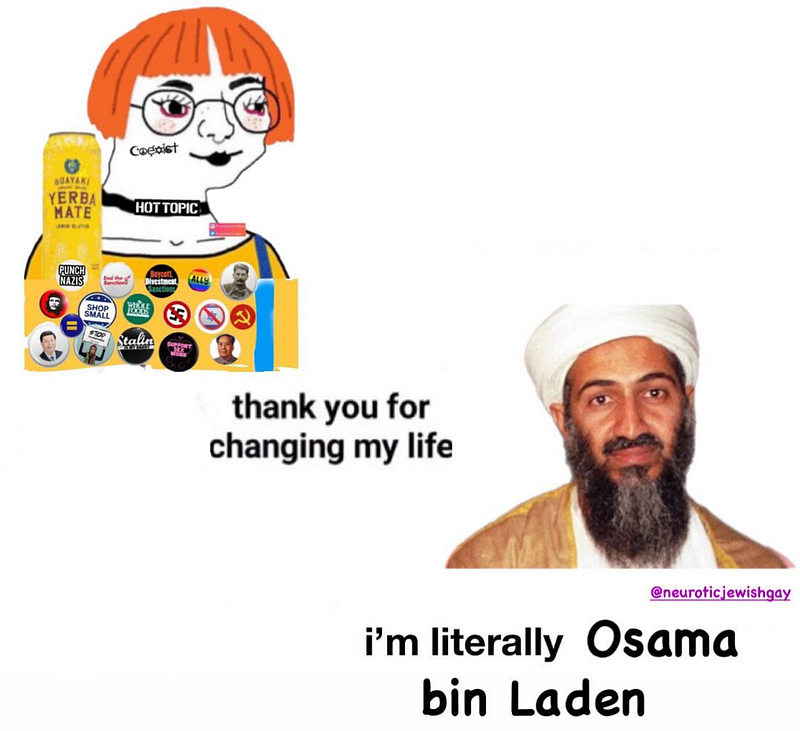
The year is 2023.
A 25-year-old white girl in pigtails named Ciera, with her Cash App listed on her X profile, tweets that Osama bin Laden “was not the bad guy.”
She is one among countless, diverse young people finding solace and inspiration in bin Laden’s justification for why he committed 9/11. You pinch yourself, thinking maybe this is just a sugar-induced nightmare from eating too many Oreos before bed.
Nope, no such luck.
Your eyes and ears do not deceive you. Welcome to the world of terror-sympathizing Gen Z.
Antisemitism is known as the world’s oldest hatred.
In the aftermath of the October 7th massacre, much of the world proceeded to justify, gaslight, and/or celebrate the mass torture, rape, abduction and execution of Israelis (and non-Israelis who were visiting Israel, aka “sympathizers”). For most Jews, while the reaction was vulgar, it wasn’t entirely surprising.
A complex geopolitical crisis involving the much-maligned and misunderstood Jewish people (whose population of 15 million constitutes a mere 0.2% of the global population, compared with 2 billion Muslims worldwide) is a perfect scapegoat for lazy virtue-signalers to project all of their blame, resentment and bigotry in a politically correct way.
The language of “decolonizing” and “resistance” quickly permeated the social media sphere with hot takes about the conflict. Self-determination for Jewish people in our ancestral homeland (aka Zionism) was rebranded as “settler colonialism,” which quickly morphed into why indiscriminate brutality and violence against Jews worldwide is actually social justice (something, something, cabal, vermin, etc.).
Since 2016, amplified by the murder of George Floyd in 2020, the language of social justice has become a standard part of the American lexicon. A generation has come of age in the zeitgeist of protests and social media; the revolution was not only televised but live-tweeted.
And amidst a faltering education system, COVID, a mental health crisis, a financial crisis, a Tide pod-eating crisis (a lot of crises), this generation seems to have been lost.
9/11 amnesia
Yes, the Millennials were entitled and ate so much avocado toast that they couldn’t buy houses, but the existential crisis of Gen Z is a different caliber.
Not only do Millennials remember 9/11, but the horrific terrorist event that claimed almost 3,000 civilian lives foundationally changed our culture and being forever. As a Jewish person, it’s the most visceral manifestation I experienced in my lifetime (until last month) of the imperative to “never forget.”
Only 22 years have passed since 9/11.
This isn’t even comparable to the 80 years (which is still not too distant) that have passed since the Holocaust. Most people alive right now intimately remember the horror and fear of 9/11; it was such a singularly atrocious event, it is impossible to put into words the absolute terror that it instilled into the collective American consciousness.
For Gen Z, a generation that simultaneously disavows capitalism but upholds a relentlessly harmful industry of fast fashion, the passage of time happens at warp speed.
As the ADHD generation, 22 years may as well have been 220 years ago.
With a disturbingly affected ambivalence for the generation that has never consciously witnessed any kind of war or terror in their backyards, 9/11 is relegated to the likes of the Russian Revolution — something to intellectualize and aspire to as part of a vacant Marxist praxis.
Bonus points if it makes you go viral!
Terror is trendy
A recent Harvard-Harris poll revealed that 48% of Gen Z Americans from age 18–24 support Hamas. No, not Palestine or Palestinian civilians. HAMAS. Just 52% of them support Israel.
Compare that to 84% of the general population supporting Israel, with 16% supporting Hamas.
The shifting of identity politics in American culture over the past several years has engendered a worldview where many values associated with Leftism are also considered “cool.”
This isn’t always a bad thing; the modern reckoning of racism in America was long overdue, but the end result of the mass protests filtered through social media and rigid, absolutist interpretations of “intersectionality” that lack any nuance have bred a dangerously simplistic ethos.
Nuance doesn’t exist in the algorithms, and in a culture where nearly 60% of Gen Zers would be influencers if given the opportunity, pithy hot takes that accrue social capital are more important than sincerity, critical thought, listening or dialogue.
When Osama bin Laden’s “letter to America” went viral on TikTok this week, reaching millions of viewers, it felt like a breaking point. It is clear is that we are witnessing the end-result of a commoditized, twisted, social justice ideology that is poisonous to the minds of our youth, and to the safety of our country.
What’s wrong with these kids
While there isn’t exactly a blueprint for how to address a generation becoming rapidly sympathetic to Islamist terror, there is some writing on the wall about what got us to this point, and what needs to be remedied.
You may or may not have heard that Gen Z is an unprecedentedly lonely generation. According to a 2021 study commissioned by Cigna, 79% of surveyed young adults aged 18 to 24 reported feeling lonely, compared to 41% of seniors aged 66 and older — and many seniors are notoriously lonely.
Furthermore, a McKinsey study in 2021 showed Gen Z have the least positive outlook on life. 45% are concerned about the stability of their employment (compared with 40% of all respondents) and are less likely than other respondents to report being able to cover living expenses for more than two months if faced with job loss. 25% of them don’t think they’ll ever retire, and many doubt they’ll be able to hit key economic milestones like owning a house.
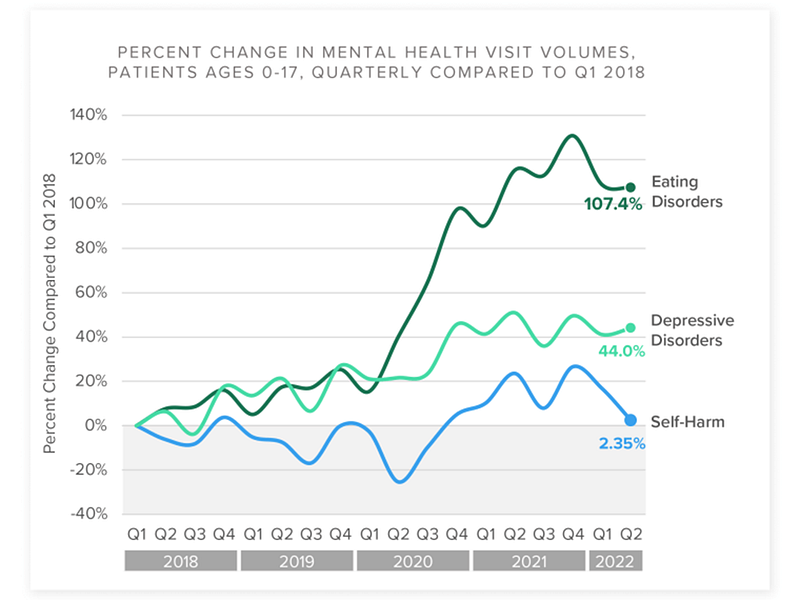
But more than anything, Gen Z is facing an epidemic of mental illness. Over 60% of Gen Z have an anxiety disorder (compared with 19.1% for the general population). Eating disorders are worse and more severe for kids today than ever before.
As an Entitled Avocado Millennial™, I hate to paint a generation with a broad brush. But if you watch or read the hot takes from Gen Z influencers about why Osama bin Laden was right, you may be thinking “Are young people getting stupider?” and the answer would be yes.
Studies from this year show American IQs are falling for the first time in decades. Chronic absenteeism may be a partial culprit here. Since the pandemic, it has been worse in high-poverty districts, but it’s widespread; nearly 70% of the highest-poverty schools experienced chronic absenteeism in the 2021–22 school year, compared with 25% pre-pandemic.
However, even in the most affluent schools, widespread chronic absenteeism also increased.
Absentee rates in affluent schools rose to 14%, up from 3% before the pandemic. The education system has been broken for a long time, but it’s unlikely kids will be able to learn any critical thinking if they don’t go to school at all. And TikTok is definitely not a substitute for any kind of meaningful education.
TikTok ‘round the clock
In order to contextualize the stanning of Osama bin Laden, it’s important to understand the role TikTok (and other social media) play in young people’s lives. Eighty-three percent of Gen Z use TikTok at least once a month, with 59% of them using it daily — making it the second most used app for the generation behind YouTube.
2021 data showed monthly usage of TikTok among users hovered around 25.7 hours per month. It’s highly plausible that number could be much higher among digital natives of Gen Z.
TikTok is more than just a salve for Gen Z loneliness, however. Internal Google research revealed that around 40% of Gen Z use TikTok to conduct online searches rather than search engines. Nearly one-third of young Americans get their news from TikTok as well.
Given the Chinese government’s involvement with TikTok and the high risks of surveillance and threats to democracy through propaganda (which we are witnessing in real-time), there are continuous attempts to ban TikTok in America. The “Osama was right” brigade makes a good case for this.
In an era of deep-fakes, election interference, hacking and Cold War-esque tensions between the West and the likes of China, Russia and Iran, it’s difficult to conceptualize the unfolding of war through social media — let alone its impact on the young, malleable minds that are so addicted to it.
40,000 social media bot accounts were found that have been stoking support of Hamas through disinformation around the Israel-Hamas war. We have been told for years to beware of misinformation online, but young people simply do not have the intellectual or mental capacity to be able to properly distill right from wrong in the haze.
It is a sad moment when the young people no longer overwhelmingly represent hope but a deep collective disappointment. Nothing is black and white, and while the world that these kids grew up in is not their fault, there is still a grotesque entitlement that these children of privilege brazenly overlook in their personal quests for social capital.
Defaulting to whatever corners of marginalization they can claim in a country and a culture that is still among one of the freest and most privileged in the entire world, an entire generation of kids and young adults have become proud champions of terrorism out of sheer boredom and greed.
Something needs to change.


