
The Kid in “The Giving Tree” is a Victim
An open letter to cancel culture
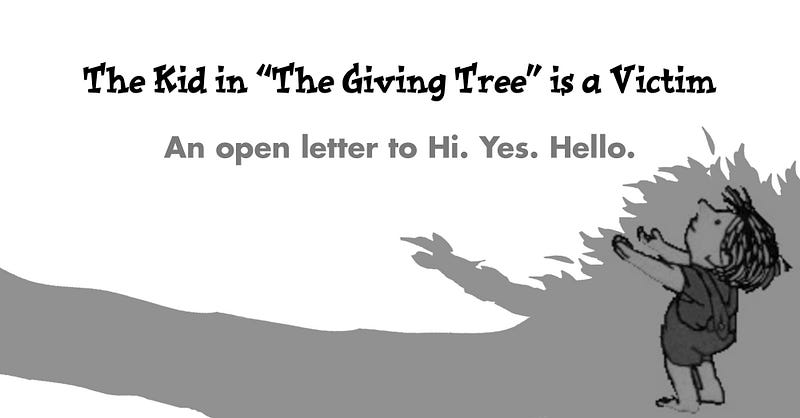
I analyzed the children’s book “The Giving Tree” in response to this humorous story written about it.
Dear Carlyn,
While I enjoy your writing, it was sad that a humorous article could elicit what seemed like pained and angry responses. As a public service, I feel the need to clear up some basic misunderstandings about “The Giving Tree”. Please understand, I am in no way diminishing or ignoring the real pain people have experienced in their lives.
There are three key pieces of evidence missing from your analysis.
Exhibit #1: The tree is already full grown when she meets the child in question, but calls him “boy” throughout his entire life.
There is only one person who calls you by an affectionate baby name that embarrasses the sh*t out of you after about age 8— a Jewish mother. I know, because I had one. I remember her yelling “Lonnnnnie!” in a crowded supermarket as she searched for me… and my wife… and our seven year old son.
Because of this, we must view the characters as perhaps a mother and son. Now, the story is about a parent’s unconditional love. As a father, I can totally relate. I would sacrifice anything for my sons, so helping them build a house or a boat is not a big deal. Besides, at an advanced age, I would need to downsize to a pied a terre. And what could be closer to the terre than a tree stump?
Exhibit #2: The story was written during the good old days.
We can’t use modern ideals to deconstruct and attack a character from a different era, any more than we would attack Huckleberry Finn as a racist because of his language. The Giving Tree was written in 1964, an idyllic time when only three Civil Rights workers were murdered, thousands of young girls suffered from uncontrollable screaming syndrome (brought on by some shaggy band from Liverpool), and the N.S.A. made false claims about the Gulf of Tonkin incident as an excuse to enter the Viet Nam war.
Surely, this innocent book was written with tenderness, sincerity, and a love for children. As evidence, I submit a picture of the book’s author:

Exhibit #3: Trees are male characters (they grow out of gaia, mother earth, you know yin-yang and all that)
Famous examples include Groot (Guardians of the Galaxy), the Ents (Lord of the Rings), the Great Deku (Legend of Zelda series), Bodhi trees (planted by Buddhist monks who vow celibacy) and the Stub Hub Ticket tree:
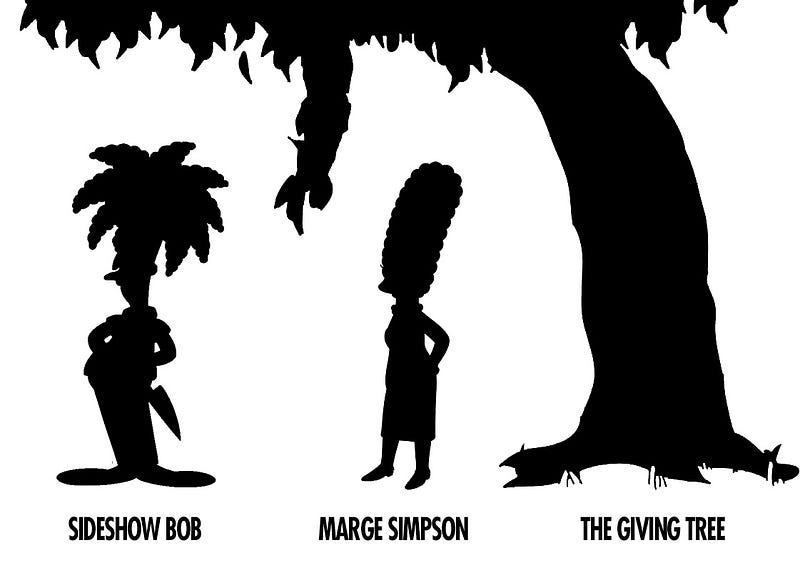
As final proof of the tree’s masculinity, I give you visual evidence provided by an unimpeachable source — The Simpsons. Notice the resemblance of Sideshow Bob’s foliage and root structure to the tree in question.
So if the tree is not a female, what are we left with? To quote Sherlock Holmes,
“when you have eliminated the impossible, whatever remains, however improbable, must be the truth.”
Let’s review all the facts about the boy.
Lacking parental guidance — perhaps orphaned — a boy strayed into the forest. An older self-identified “she” male loved the boy, who exhibited troubling behavior. He made and wore crowns of leaves (similar to a crown of thorns?), suggesting a martyr complex. He ran around haphazardly and called himself king of the forest, indicative of delusions of grandeur commonly associated with bipolar disorder or schizophrenia.
The tree satisfied the boy’s desires and in return the boy “slept in her shade”.
What is meant, exactly, by “in her shade”? We’ll have to let the courts decide, but it’s clear the boy was scarred for life. As a young man, he turned to pimping, selling the tree’s fruit so he could have fun. As an adult, he returned to hack off the tree’s limbs in a symbolic attempt to reclaim his manhood for his wife and children. Years later, he came back — abandoning his family — and hacked off the tree’s trunk to escape.
Somehow, the tree ruined his ability to ever enjoy healthy relationships with bushes.
The boy’s violent adult actions represent the need to be mothered and to exact revenge upon the tree. Perhaps the choice to escape was to break the cycle of abuse with his own children.
Is there redemption?
At the end, the old man returned and tried to make amends by warming the tree’s trunk with his butt. This is not the typical amend recommended by 12-step programs, but it’s all he could do. Still, his attempt to repair their relationship made the tree happy. While we can not condone his crimes, we should grieve for the tragic and wasted life of an innocent but disturbed boy.
The Giving Tree is a dark parable for child abuse. The End.
Or, maybe it’s just a kids’ story about a boy and a tree.