avatarDouglas Rushkoff

Free AI web copilot to create summaries, insights and extended knowledge, download it at here

1345

Abstract

end up emphasizing very particular strategies. We improve the metrics that a given technology can improve, but often ignore or leave behind the sorts of problems that the technology can’t address. We move out of balance, because our money and effort go toward the things we can solve and the people who can pay for those solutions. We’ve got a greater part of humanity working on making our social media feeds more persuasive than we have on making clean water more accessible. We build our world around what our technologies can do.</p><p id="6e56">Most technologies start out as mere tools. At first they exist to serve our needs, and don’t directly contradict our worldview or our way of life. If anything, we use them to express our own existing values. We built airplanes so humans could experience flight and travel great distances. We developed radio to extend our voices across space. Their primary impact on our world is to execute their original purpose.</p><p id="5eaf">However, as technologies become more a part of our world, we begin making more accommodations to their functioning. We learn to cross the street carefully so as not to be hit by automobiles, we clear-cut a forest to make way for electric cables, or we dedicate a room once devoted to conversation and family — the living<i> </i>room — to the television. The technol

Options

ogy forces negotiations and compromises.</p><p id="8768">Without human intervention, technology becomes an accepted premise of our value system: the starting point from which everything else must be inferred. In a world of text, illiteracy is the same as stupidity, and the written law may as well be the word of God. In a world defined by computers, speed and efficiency become the primary values. Refusing a technological upgrade may as well be a rejection of the social norm, or a desire to remain sick, weak, and unrepentantly human.</p><p id="c08a"><i>This was section 56 of the new book </i>Team Human<i> by Douglas Rushkoff, which is being serialized weekly on Medium. Read the previous section <a href="https://readmedium.com/artificial-intelligence-will-soon-shape-themselves-and-us-59683f3dc5d">here</a> and the following section <a href="https://readmedium.com/why-does-silicon-valley-want-to-reengineer-humans-f7cfcf9ad052">here</a>.</i></p><figure id="d946"><img src="https://cdn-images-1.readmedium.com/v2/resize:fit:800/1*[email protected]"><figcaption>From ‘<a href="https://books.wwnorton.com/books/Team-Human/">Team Human</a>’ by Douglas Rushkoff. Copyright © 2019 by Douglas Rushkoff. Used with permission of the publisher, W.W. Norton & Company, Inc. All rights reserved.</figcaption></figure></article></body>

The Key to Successful A.I.? Continual Human Intervention.

We must not accept any technology as the default solution for our problems

Photo: Westend61/Getty Images

Algorithms do reflect the brilliance of the engineers who craft them, as well as the power of iterative processes to solve problems in novel ways. They can answer the specific questions we bring them, or even generate fascinating imitations of human creations, from songs to screenplays. But we are mistaken if we look to algorithms for direction. They are not guided by a core set of values so much as by a specific set of outcomes. They are utilitarian.

To a hammer, everything is a nail. To an A.I., everything is a computational challenge.

We must not accept any technology as the default solution for our problems. When we do, we end up trying to optimize ourselves for our machines, instead of optimizing our machines for us. Whenever people or institutions fail, we assume they are simply lacking the appropriate algorithms or upgrades.

By starting with the assumption that our problems are fixable by technology, we end up emphasizing very particular strategies. We improve the metrics that a given technology can improve, but often ignore or leave behind the sorts of problems that the technology can’t address. We move out of balance, because our money and effort go toward the things we can solve and the people who can pay for those solutions. We’ve got a greater part of humanity working on making our social media feeds more persuasive than we have on making clean water more accessible. We build our world around what our technologies can do.

Most technologies start out as mere tools. At first they exist to serve our needs, and don’t directly contradict our worldview or our way of life. If anything, we use them to express our own existing values. We built airplanes so humans could experience flight and travel great distances. We developed radio to extend our voices across space. Their primary impact on our world is to execute their original purpose.

However, as technologies become more a part of our world, we begin making more accommodations to their functioning. We learn to cross the street carefully so as not to be hit by automobiles, we clear-cut a forest to make way for electric cables, or we dedicate a room once devoted to conversation and family — the living room — to the television. The technology forces negotiations and compromises.

Without human intervention, technology becomes an accepted premise of our value system: the starting point from which everything else must be inferred. In a world of text, illiteracy is the same as stupidity, and the written law may as well be the word of God. In a world defined by computers, speed and efficiency become the primary values. Refusing a technological upgrade may as well be a rejection of the social norm, or a desire to remain sick, weak, and unrepentantly human.

This was section 56 of the new book Team Human by Douglas Rushkoff, which is being serialized weekly on Medium. Read the previous section here and the following section here.
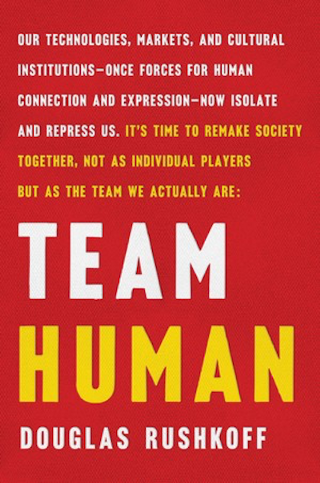
From ‘Team Human’ by Douglas Rushkoff. Copyright © 2019 by Douglas Rushkoff. Used with permission of the publisher, W.W. Norton & Company, Inc. All rights reserved.
Book Excerpt
AI
Artificial Intelligence
Technology
Society
Recommended from ReadMedium