
The Kettlebell Swing Is the Opposite of Sitting. That’s Why It’s the Best Exercise for Almost Everyone.
Here’s why and how to swing

Most of us are sitting too much. Yes, even if you are an avid gym-goer, running enthusiast, or yoga lover.
Just think about it. How often do you go to the gym, or are otherwise active?
Unless you are a professional athlete or have a job that requires you to be on your feet all day, you spend much more of your time stationary in front of a screen than in an upright position, moving around.
And if you now think, “Well, surely I am not sedentary. I exercise a lot”, let’s do some basic math.
Assuming you go to the gym four times per week and lift for 1 hour. You’d spend 2.38% of your weekly hours exercising. If you do some type of structured exercise for 1 hour daily, that would be 4.17%.
And someone who works out 2 hours daily, much more than most people can fit into their lives, still uses only 8% of their time to be active. So, even if you are a recreational athlete or weekend warrior, you are sedentary if you are otherwise sitting the whole day.
And your body adapts to the posture you routinely put it in.
If you sit most of the time with your arms extended in front of you, your body will become good at sitting. The effects of this are easy to see. Many people walk around with tight and shortened hip flexors, weak back and gluteal muscles, and rounded shoulders.
A slouched posture is more common nowadays than an upright one with a proud chest.
However, there is hope.
And no, you don’t need to spend another hour per day in the gym doing isolation exercises for specific body parts.
You also don’t need a new elaborate training plan. You don’t even need to dedicate much more time to your physical health.
All you need is one exercise performed for 10–20 minutes daily.
The kettlebell corrects muscle imbalances caused by sitting too much.
A properly executed kettlebell swing corrects muscle imbalances caused by too much sitting. With each swing you perform, you strengthen almost all of the muscles on your backside while simultaneously stretching your hip flexors.
Think of it this way: Sitting is a static flexion of your hips while swinging a kettlebell is a dynamic hip extension. Sitting weakens the glutes and back muscles, and swinging a kettlebell strengthens them.
A nice benefit of strong posterior muscles is a better alignment of the shoulders and hips. As a result, you will stand more upright and look more confident and decrease your risk of injury.
The kettlebell swing is a time-efficient exercise that requires little space.
I consider the kettlebell swing the little brother of the barbell deadlift. The mechanics and benefits are similar. And, in fact, the starting point for most people who learn the swing is the kettlebell deadlift.
However, the swing offers a few advantages compared to a barbell deadlift, making it an ideal exercise for the time-crunched fitness enthusiast.
First of all, a kettlebell takes up very little space.
You can park one in even the tiniest apartments or offices. You can simply bang out a few swings whenever you need a 5-minute break from work. No commute, excessive warmup, or even change of clothes is required.
And secondly, due to the ballistic nature of the exercise, you can effectively strengthen your body and improve your cardiovascular health with minimal time investment.
Depending on your goals, you can design a swing workout that promotes strength or focuses more on developing endurance.
More on that later.
The kettlebell swing is a back-friendly and safe exercise for most people (if performed correctly).
Spine and biomechanics expert Prof. Dr. Stuart McGill researched the effects of the kettlebell swing on spinal health. He found that kettlebell swings pose a unique loading pattern to the spine opposite to that of more traditional lifts, such as the deadlift.
He reasoned that this may be why some individuals report improved back health after incorporating the swing into their workout routine.
Besides, due to the dynamic nature of the lift, the loads are much lower than those you would use for traditional lifts, such as the deadlift or good morning. Therefore, the chance of overloading your back and injuring it is much lower.
However, there is a caveat: you must perform the kettlebell swing with proper technique. What is the “proper” technique? I’m glad you asked.
Anatomy of a proper kettlebell swing.
Before we go any further, let me say this. There are various ways to swing a kettlebell. And, despite what some kettlebell experts may claim, different swing styles can be considered “correct.”
People who rigidly promote one particular type of swing are either unaware of the other style and the history of kettlebell usage or try to promote their favorite training style as superior.
In general, two “styles” of kettlebell training exist. Hardstyle, popularized in the West by Pavel Tsatsouline (and is the style I learned first), and softstyle, which is much older and used in kettlebell sport lifting.
However, despite some differences in execution, all types of swings share specific characteristics.
The first is the hinge from the hips. A kettlebell swing is a hinge, not a squat. The pictures below show the difference.
When performing a hip hinge, your hips bend only slightly. In a squat, your knees bend fully.
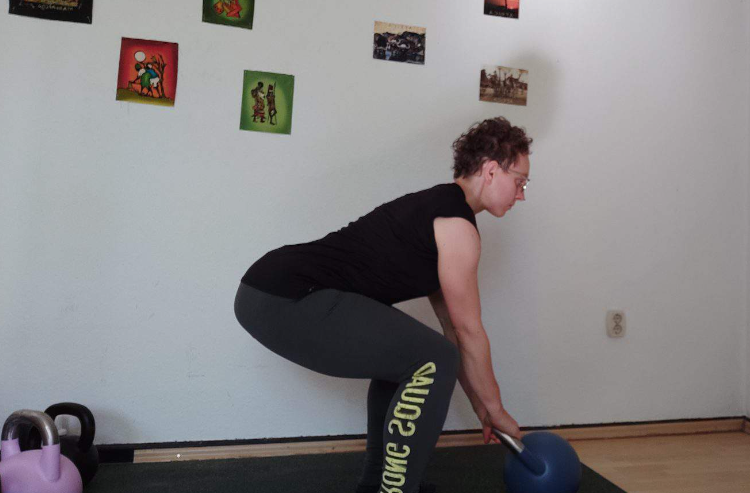
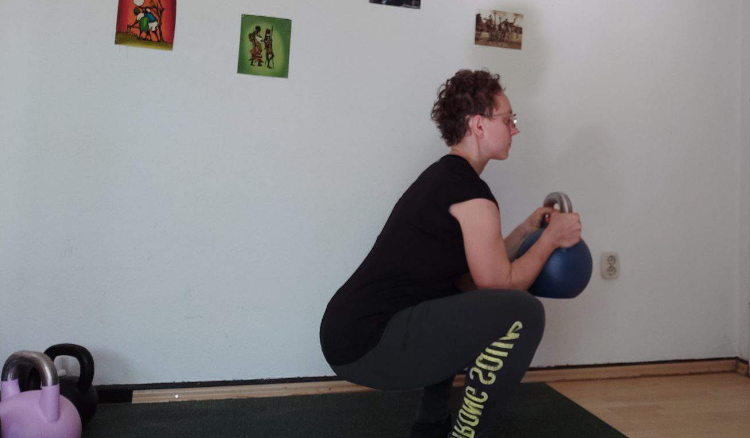
The second characteristic of a properly executed swing is that the arms stay connected to the body for as long as possible during the upswing.
I see too many people lifting the kettlebell with their arms. This is a recipe for back pain and possibly injury. A properly executed kettlebell swing is powered by the hips, not the arms. The arms are only holding the bell, not actively moving it.
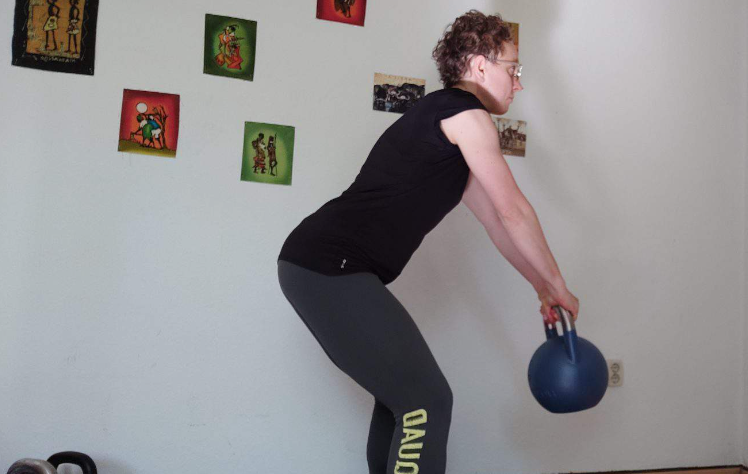
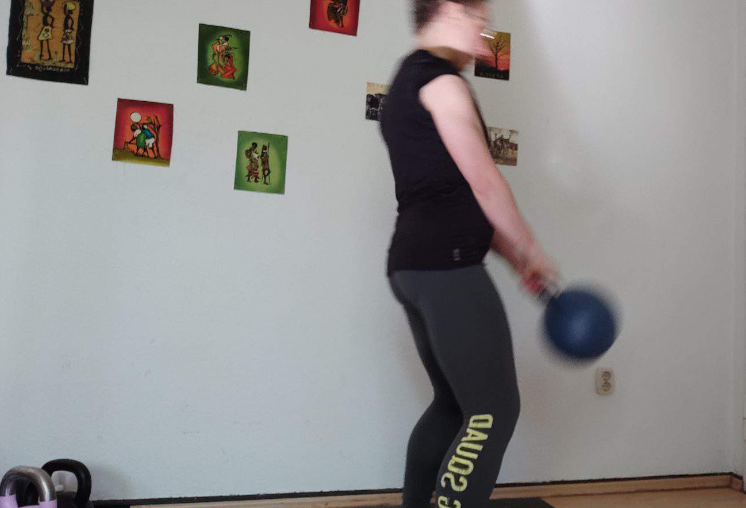
And finally, you need to have the patience to push your hips back at the last minute on the downswing. Many people break at the hips too early, putting their backs in a compromised position.
Now that we have covered the basics of a kettlebell swing let’s look at the different styles and their advantages.
Kettlebell swings — hardstyle and softstyle.
Hardstyle 2-handed swing.
The hardstyle 2-hand swing was developed by Pavel Tstasouline, a former physical instructor for the elite Russian special forces units, also known as the Spetsnaz.
The 2-hand swing is an explosive exercise performed to achieve maximum power output.
The movements are sharp and snappy, and the breathing is powerful. Sharp inhales on the downswing of the bell are followed by powerful exhales during the upswing portion.
Hardstyle 1-handed swing.
Once you have mastered the two-handed swing, you can add 1-handed hardstyle swings to the mix. The movement looks identical to the 2-handed swing, except that you are holding the kettlebell in one hand.
Because of the one-sided load, your stabilizing muscles must work extra hard to prevent your core from rotating.
The one-handed swing is harder on your grip and core muscles. However, you won’t be able to develop as much explosive power as with the two-handed swing.
The video below shows the hardstyle one-handed swing.
Hardstyle double swing.
And finally, the double kettlebell swing. When you start working with two kettlebells, you can unlock new levels of strength and muscle development.
Plus, double kettlebell training is more fun.
However, you must have mastered the two-handed and one-handed swing and be strong enough to handle two separately moving weights.
The video below shows the double swing.
Softstyle 1 handed-swing.
After training the hardstyle way for around seven years, I have become increasingly into softstyle training. This type of kettlebell training maximizes endurance and efficiency.
In kettlebell sport, there is only a one-hand swing. And many use it only as an assistant exercise to practice for the snatch.
However, even if you are not preparing to compete in kettlebell sport lifting, the softstyle swing is for you.
The leg movement differs slightly from the hardstyle swing, and the bell moves more rhythmically with your body. This style of swing is also sometimes referred to as the pendulum swing. You counterbalance the bell’s weight with your body and, by so doing, can conserve energy.
The video below shows the softstyle one-handed swing.
In case you are wondering about the two-handed softstyle swing — it isn’t really practiced. Remember, the softstyle variant originates from kettlebell (girevoy) sport. And in kettlebell sport, no exercises require a two-handed swing. That is not to say you can’t perform a two-handed swing with a pendulum motion. However, it’s not practiced very often.
A similar case can be made for the double softstyle swing. It’s not practiced very often because it’s not used in competition. Instead, kettlebell sport practitioners focus on practicing the double clean, a fundamental movement for the competition exercise Clean and Jerk.
Power, strength, endurance — you choose.
The kettlebell swing is an exercise that can be programmed to meet your needs. You can design your workouts focusing on power, strength, or endurance.
When focusing on power and strength, choose a hardstyle variant and set the weight, reps, and sets accordingly.
When you want to focus on endurance, choose the softstyle variant and learn how to pace yourself for extended sets of 10 minutes or more.
And if you have any questions on kettlebell training, feel free to send me a message.
Like what you read? Then you will love my weekly newsletter, “The Strength Files,” designed to empower you to live your strongest life. Receive actionable ideas, tools, and routines to supercharge your physical and mental strength.
Connect with me on Instagram 😊


