
The Kernel of Truth in Neil deGrasse Tyson’s Juvenile Scientism
Why philosophy is poison for the average person
In one of his “Hours of Power,” the Presbyterian minister Bobby Schuller tried to explain to his audience how the Bible was correct all along in saying that God spoke everything into being and that in the beginning there was the Word. Schuller said that in the “modern computing era,” we can see how DNA, atoms, and algorithms in virtual realities run everything.
Then, to try to keep his audience from falling asleep on him, Schuller made a telling remark: “This is important. I know this is very philosophical, but it’s important” (48:30).
You see, Schuller believed his somewhat philosophical discourse was important, but he had to acknowledge that people don’t generally regard philosophy as being important. That’s why he couldn’t say “It’s philosophical and it’s important.” He had to talk as though the two were mutually exclusive because philosophy is irrelevant to the public.
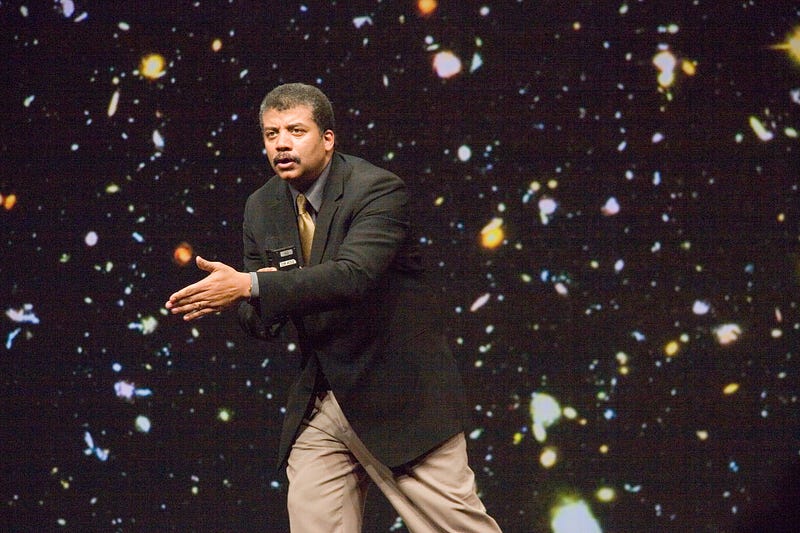
Now, the science popularizer Neil deGrasse Tyson voiced this same prejudice in a 2014 Nerdist podcast when he condemned philosophy for being a harmful waste of time. (See the podcast’s 20:20 minute mark.) The philosopher Massimo Pigliucci wrote out a transcript of that part of the conversation, which includes these harsh remarks by Tyson:
Tyson: …My concern here is that the philosophers believe they are actually asking deep questions about nature. And to the scientist it’s, “What are you doing? Why are you concerning yourself with the meaning of meaning?”
An interviewer: I think a healthy balance of both is good.
Tyson: Well, I’m still worried even about a healthy balance. Yeah, if you are distracted by your questions so that you can’t move forward, you are not being a productive contributor to our understanding of the natural world. And so the scientist knows when the question, “What is the sound of one hand clapping?” is a pointless delay in our progress…
How do you define clapping? All of a sudden it devolves into a discussion of the definition of words. And I’d rather keep the conversation about ideas. And when you do that, don’t derail yourself on questions that you think are important because philosophy class tells you this. The scientist says, “Look, I got all this world of unknown out there, I’m moving on, I’m leaving you behind. You can’t even cross the street because you are distracted by what you are sure are deep questions you’ve asked yourself. I don’t have the time for that.”
It would be easy to point out that Schuller needs to put down philosophy because philosophy is kryptonite to the archaic religious dogmas he’s selling. And it would be just as easy to criticize Tyson for being scientistic, for only pretending to be unphilosophical while presupposing an untenable philosophy of neoliberal positivism.
But the deeper truth is that philosophy is problematic, and less reflective folks are right to be suspicious. From their opposite perspectives, Schuller and Tyson defer to the same public prejudice, yet without thinking the matter through.
The longstanding culture war
The truth is that philosophy isn’t for everyone; on the contrary, it’s fit for a neo-shamanic minority. Western philosophy recognized this as early as Plato in the fifth century BCE. Socrates tried to engage the public with philosophical interrogations, and he was executed, in part, for his troubles. Consequently, Plato advocated a cynical, elitist view of society, according to which philosophers ought to rule but they could hope to do so only from the sidelines because the bulk of society would have to be governed by “noble lies” (such as the religious myths that Schuller repackages).
The same lesson was learned in Western religion, as esoteric spirituality distinguished itself from organized religiosity. According to Christian records, a prophet or thought leader named Jesus of Nazareth rose in the first century CE to challenge Jew and pagan alike. Just like Socrates he was executed for his troubles.
Both the secular and the religious challenges were philosophical, broadly speaking, in that they flowed from an obsessive love of knowledge and ideas at the expense of everything else. The flipside of loving logos is that you despise fabula and dogma, myth and opinion. That obsessive love is relatively rare, and it naturally isolates philosophers from the rest of society.
The philosopher Leo Strauss pondered this problem and distinguished between how the ancient and modern worlds handle what I’ve called the longstanding cold war between the intellectual minority and the less reflective majority. The ancient and medieval philosophers, Strauss said, were wise to segregate themselves by writing in code and hiding their destabilizing knowledge from the masses.
Yet modern philosophers followed scientists and liberals in thinking that knowledge should be as public as possible, so they broadcast the death of God to the masses. As a result, modern society became as corrupt as only the intellectual elites ought to be. The masses finally caught a glimpse, at least, of the nihilism, relativism, and cynicism that are entailed by philosophical reflection.
Lovers of thought have sacrificed themselves for the truth for thousands of years, ever since shamans, prophets, philosophers, monks, saints, and bohemian artists withdrew from society to adopt an alienating meta-perspective on life, the universe, and everything.
Neither Minister Schuller nor Influencer Tyson is an authentic philosopher because they’re too popular. They have too much power to lose as leaders of their respective tribes.
To be sure, a lover of ideas can gain a large following. But what tends to happen in that case is that the muse flees the unfaithful intellectual who’s forced to compromise his or her true love by falling for a lesser mistress, as it were, such as Fame, Wealth, or Power.
Stephen Colbert’s rise to prominence illustrates the point. Colbert was once a philosopher in the broad sense since he was a truth teller. His fellow comedians bowed down to him as he satirized conservatism in the most dramatic way possible, by delivering — in character, as a conservative ignoramus and blowhard — his truthiness speech to George W. Bush himself and to the Washington establishment at the 2006 White House Correspondents’ Dinner.
Yet the establishment had the last laugh and got the better of Colbert by rewarding him with the job of being host of CBS’s Late Show. In that role Colbert could no longer tell the truth; he had to kowtow to the biases of his large audience and of his advertisers. The comedy gods fled Colbert, as did his fellow comedians’ respect, and he became a hack who went dumb in going broad with his art.
That dynamic of corruption is familiar across all areas of excellence, in the arts and even in the sciences.
It’s no accident that the great scientists and mathematicians make their mark when they’re young adults. True, they’re at their healthiest at that point, but they have another advantage which is their relative powerlessness. After they revolutionize knowledge with their genius, they acquire prestige and power, which distract them so that they must give up the chase. They’re installed at the top of institutions that must be managed, and they find that although they used to despise those who follow fashions or who seek power, these one-time geniuses must play defense in protecting their fashion and their dominance.
The tragic fate of the perennial counterculture
What matters, then, isn’t so much the content of the vitriol that popular critics of philosophy spew. The medium is their truer message, as it were. Tyson’s criticism, for example, betrays his confusions. Obviously, if philosophers are directly competing with scientists in trying to discern the empirical nature of the universe, they’ll lose. But that’s not the heart of philosophy.
Philosophy is about building a coherent, honourable worldview, one that does justice to all areas of knowledge and that eschews delusion and self-deception. Also, philosophy isn’t just an ideology but a way of life. A true philosopher practices what he or she preaches and does so largely by renouncing the distractions of mass society.
In so far as lies spread faster than truth, philosophy — meaning intellectual and artistic greatness — will never be suitable to the broad public. Philosophy will be a joke to the masses, an extravagant irrelevance to the task of living “well,” to succeeding in some socially approved role. Indeed, philosophers will seem deranged or mentally disordered.
And that will be true! From the mass vantage point, with its conventional values and projects in mind, philosophy — and spirituality, existential authenticity, and artistic genius — are and have always been counterproductive. Some societies, such as prehistoric clans of hunter-gatherers found some useful roles for these outsiders to play. But the philosophical, spiritual, and existential tasks themselves are antisocial.
Shamans wrestled with revelations descending from peak states of consciousness. Philosophers question everything, adopting a meta-perspective that casts them adrift in the realm of ideas. Great scientists and artists struggle with their genius or their muse which shows them an original idea or form of expression that awes them with the prospect of changing the world.
Intellectuals generally, then, are self-sacrificial beings. Whether they fail or succeed, whether they languish in obscurity or rise to the top of a paradigm, mass society kills these outsiders on its altar.


