
Writing: conferences
The Joy of Writing
In the company of creatives
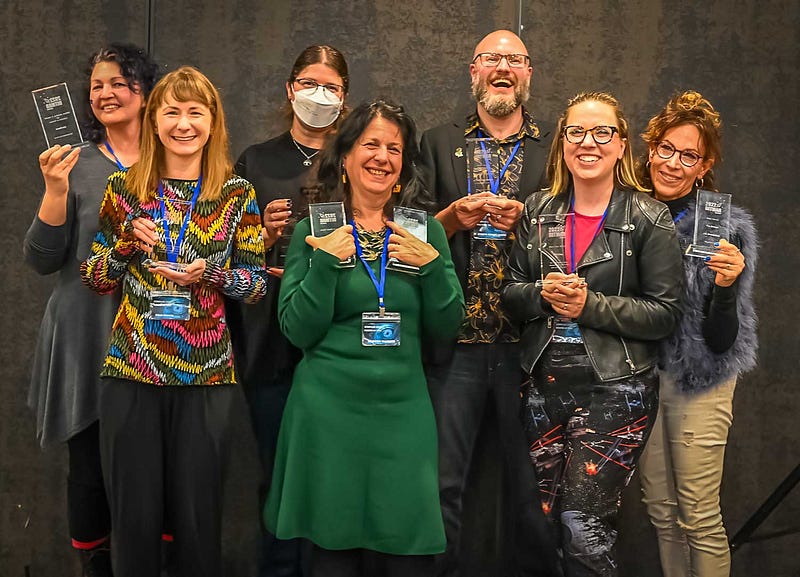
It’s been a thin year or so for me as a writer — and editor — because my day job has been flat out with the resumption of international travel. I finish a long day and there is no energy left for writing. I’m drained from the stress, the emotion, and the grinding effort of trying to do the work of several people at once.
“I’ll make a fresh start tomorrow,” I tell myself. Finally, tomorrow has come. I’m back.
Getting away from Melbourne for an all too brief holiday in a warm seaside place was marvellous, and following it up with a writers’ conference in Canberra topped up the energy. I feel I have a surplus for the first time in a long while. A very long while.
Writers abound
You know the scene. A hotel or convention centre, harried organisers, milling attendees, piles of books in the dealers’ room, people hugging old friends — or not, if wearing a mask — people peering at convention schedules in the finest of fine print, fans gawking at famous authors, undo the top button, flutter the eyelashes, do that thing with the tongue, you know how it goes.
Ahem.
These things have changed. Once upon a time the female side of writing conventions was young women sitting in the audience, an occasional romance writer launching her latest heaving bosom and hot pants epic.
Now, women rule. They pretty much dominate the panel discussions, win all the awards, sell all the books. Now it’s the men who are fighting for recognition.
That’s not the pendulum swinging in a politically-correct way. That’s talent and skill and art.
You want to make it big in Australian publishing, write for someone like me.
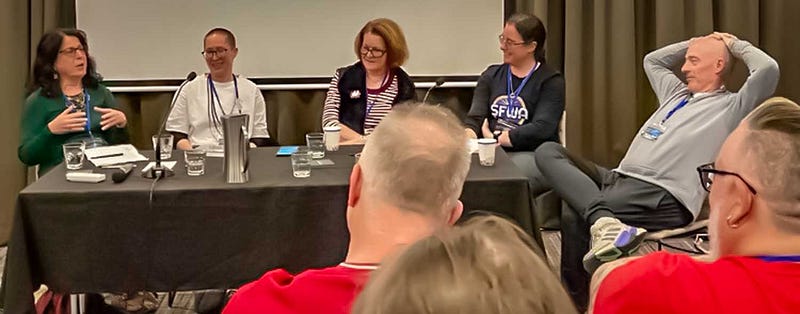
Australian speculative fiction is no longer nerdboys zooming around space blasting the aliens. It’s deeper, richer, more thoughtful. More satisfying. Characters, worlds, relationships, not just outlined but coloured in.
I love a good panel discussion. These are masters — mistresses? — of their craft speaking with assurance and authority. They write the books, they make the money, and they inspire the budding writers.
They discuss a topic — something simple like researching your first draft, perhaps — and they have the experience, the case studies, the traps to avoid, the resources to use, the way to leverage for success.
This is why I like to think of a writers’ conference as an education. Go along, open your eyes, listen carefully, take notes, flutter your eyelashes, you’ll have a great time.
The pick of the con
The highlight for me wasn’t the book launches, the fizzy drinks, the banquet, the awards, the flirting, fun though those things were.
Most of the panel discussions and workshops were great, listening to experts talk about their craft and leading hands-on exercises.
The highlight for me was a Jewish academic of a certain age in conversation with a famous author who seemed to be on the far side of the continent in every way possible.
It wasn’t that she handed out the most delicious slices of honey cake to everyone in the room — though my appreciation jumped up a couple of notches right there — it was that she had two doctorates, a string of books, five academic conferences in two weeks and the assured authority of someone who knows what they are talking about because they wrote the peer-reviewed text that defines the field.
Reader, I listened with rapt attention.
Her name is Gillian Polack, her words ring true, she provided a set of building blocks that make creating stories across diverse cultures and genres if not a breeze then at least a sigh of pleasure, and she took on the bewildered grimaces of the famous author with unblinking aplomb.
Her book is called Story Matrices, it is the roadmap and the signposts that others follow, it is the plain English guide to the craft.
I downloaded a copy, read it on the flight home, read it on the train, read it over dinner, read it in bed, and found satisfaction on every page. Gillian made my brain fizz.
Gillian recharged my batteries.
I’m back.
Britni