
The Joy of Working
How to Commit to Things That Bring Us Joy

Let’s take a moment and reflect: How was your day? What did you enjoy? Was there something you didn’t like? Did you accomplish all you had planned? Hopefully, you had a good day. Now, let’s talk a little about work.
The vast majority of us have to work to earn a living. It’s one of those things we can’t change, at least not for now. What would our lives be if we could do whatever we like without worrying about expenses? What would we do with all of our free time? Would you travel the world? Would you finally learn that hobby you always wanted? Would you stay home and play all day? What would you think if I told you that other people just like you are doing that exact thing and are making a living out of it?
You might be wondering, how exactly are these people doing those things and earning money? Either they’re rich, won the lottery, or don’t have responsibilities. That might be true for some, but the majority are just like you and me. They have bills to pay, families to raise, and other responsibilities.
Maybe they have other privileges or are just very lucky. One or two might have been at the right place at the right moment, but the majority started just like you are now, with a job they didn’t like or even without one. Their secret is creativity and perseverance.
“Choose a job you love, and you will never have to work a day in your life” — Confucius.
What these people have in common is that they enjoy what they do. Some are passionate about it. They discovered something they liked and kept on doing it. As they gained more experience, they progressively became better. Their abilities got so good that people were willing to pay them to continue doing them.
You might be thinking -this sounds too good to be true. Where is the catch? Well, there is none. When you discover something you enjoy, it’s natural to spend more time doing it. With each new attempt, you will become skillful and proficient. Your skills will lead you to get noticed. Sooner or later, somebody will reach out to you with an offer.
Now you might be thinking -that seems unlikely. Why would someone offer me to keep doing my hobby? I don’t know many professional hobbyists. That is true. Don’t expect someone to contact you to keep doing your hobby. Some people might ask for classes or even just a couple of tips.
From this point on, your creativity and perseverance will guide you on your newly found career opportunity. If people are interested in your abilities, it opens the possibility of starting a business. Analyze your customer’s expectations and think about ways to promote yourself.
You will probably notice that your customers are interested in your genuine talent and individuality. If this is the case, focus on potential new opportunities to land a job as a professional passionate. Now it’s time to tell you that your hobby, or better said, your talent, could be as ordinary as narrating sports events, generating ingenious solutions to common problems, making people laugh, fixing electronics, or playing video games.
Some of us discovered we enjoy solving problems. A good challenge excites us. We find logical and creative thinking fun. A career in engineering was a match for us. More specifically, software development, where there is so much to do, learn and create.
Others have artistic talents and enjoy creating and expressing themselves through their art. Musicians, for example, have a wide range of possibilities for expressing themselves. The internet makes it possible to listen to many types of music, learn theory, and share our skills.
People who record themselves exercising their talents are a good example of how it’s possible to avoid working and make a living. We have most likely seen people enjoying their craft to the point they cause admiration. Thankfully, there are a few examples we can talk about, for example, performing artists. Have you ever been inspired to try an art form by watching an artist perform?
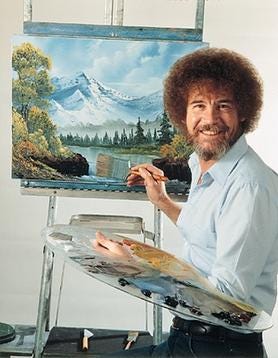
Bob Ross was an American painter who hosted The Joy of Painting, a television show which ran from January 1983 to May 1994. The show’s format consisted of Bob completing a painting, usually a landscape, in 30 minutes.
His mastery and craftsmanship reflected a person who enjoyed painting and did so in a natural way. Bob portrayed the idea that anybody can paint. “Talent is a pursued interest. Anything that you’re willing to practice, you can do”.
Bob inspired a lot of us to try painting. He also taught us an important lesson in creativity and self-esteem. While working on the canvas, he usually reminded us: “We don’t make mistakes, just happy little accidents.” It’s easy to start any activity with this type of mentality. The ones of us who tried, even for a moment, experienced the Joy of Painting.
There are more people like Bob. People with talent that perform and execute gracefully on different activities. Their actions make us reflect on our concept of success. Are we successful? Do we want to be successful?
Dharma
The concept of Dharma refers to the natural abilities each person receives. These gifted abilities serve a purpose. If somebody performs exceptionally well at something, it’s Dharma for that person to exercise their talents.
Some of us have experienced problems finding something we enjoy and instead had to conform with something we do well. For example, a job that we could do but wanted to quit. Life is complicated, and in most cases, it’s better to keep this frustrating job until we find something we enjoy.
Each person is different, and there could be several circumstances that contribute to the situation. Nevertheless, we all can overcome challenges and find things that bring us joy.
Sometimes, having certain constraints is life’s way of helping us uncover our abilities. Some people have found success after being in unfavorable conditions. After experiencing trouble or unrest, our “hidden talents” kick in and start findings ways to help get out of our situation.
For some, it can be physical abilities. We suddenly notice we’re good at sports or other demanding activities. Our bodies respond to stress by naturally producing more energy. In certain situations, this can lead to the discovery of talented athletes. It’s common to find sports stars with complicated or troubled origins.
Others find ingenuity in solving problems. Some businesspeople began as entrepreneurs with an innovative idea who decided to bet on it. The ability to influence partners and persuade customers is their complementary talent. “Necessity is the mother of invention.”
After some ups and downs, we’ll usually try to settle for something that gives us stability. The next thing we might look at is something we can do without too much effort. At the end of our priority list is our enjoyment. Even at this point, our essence manifests through our hobbies and interests. Maybe we’re not musicians, but we listen to music. We might not be chefs, but we like to eat good food. Our home team doesn’t have us in their lineup, but we cheer for them every week.
Life can give us second chances. If we commit to our stability and find time to carry out our interests, there were always be the possibility to accomplish our goals.
Have you ever heard of people who retire and pick up a new full-time job they always wanted? Our musicians become indie artists, producers, composers, promoters, sellers of musical instruments and merchandise. Our chefs follow a similar path, working on restaurants, culinary contributors, reviewers, or cooks at home. Finally, our sports enthusiasts get involved with their local franchise, volunteer with minor leagues, promoters or join local clubs in their communities.
A Spark of Joy
Mary Kondo is an organizing consultant, author, and TV host. She gained notoriety in 2019 with Netflix’s Tyding Up, where she visited families in need of organizing and de-cluttering. She became known for her method of keeping only things that spark joy.
Mary’s complete phrase is: “Does this spark joy? If it doesn’t, thank it for its service and get rid of it.”. This piece of advice applies to everything in life. We might be surprised after thinking about all the things we do and keep that don’t spark joy.
Let’s do an exercise and think about all the things that do spark joy. Let’s take our time and think about everything we do and wish we could do. Now let’s focus on our current situation. How can we do these things more? What is preventing us from doing them? Are we willing to attempt to do them more?
Don’t worry about the things that don’t spark joy. We can deal with them after we finish doing what sparks us joy.