
Interviews | Gentleness Ambassadors
The Joy of Being Gentle to Inanimate Objects
An interview with Sayaka Ganz — Artist
Interviewing Sayaka Ganz made me feel a little like Alice in Wonderland! There is so much childlike wonder and joy in her words.
Through this article, I will be sharing with you how she found magical joy through practicing Gentleness on inanimate objects, with other people and herself too.
More about Sayaka Ganz
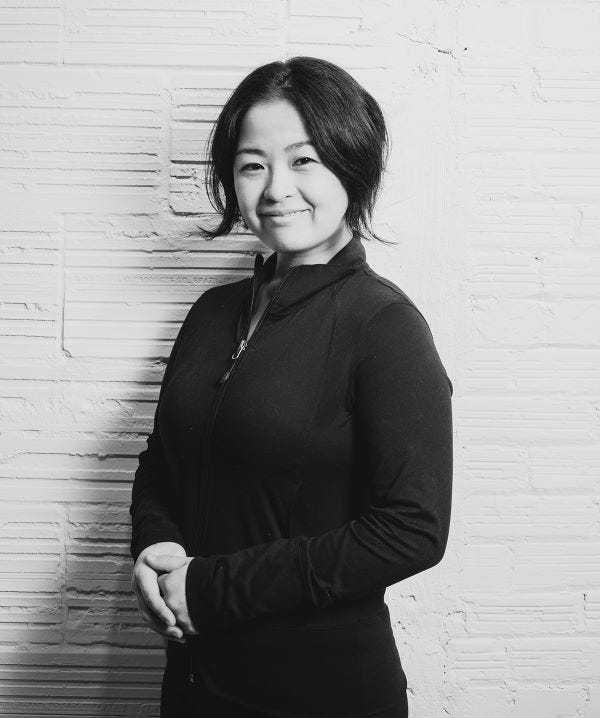
Sayaka Ganz was born in Yokohama, Japan and grew up living in Japan, Brazil, and Hong Kong. She now lives and works in the United States.
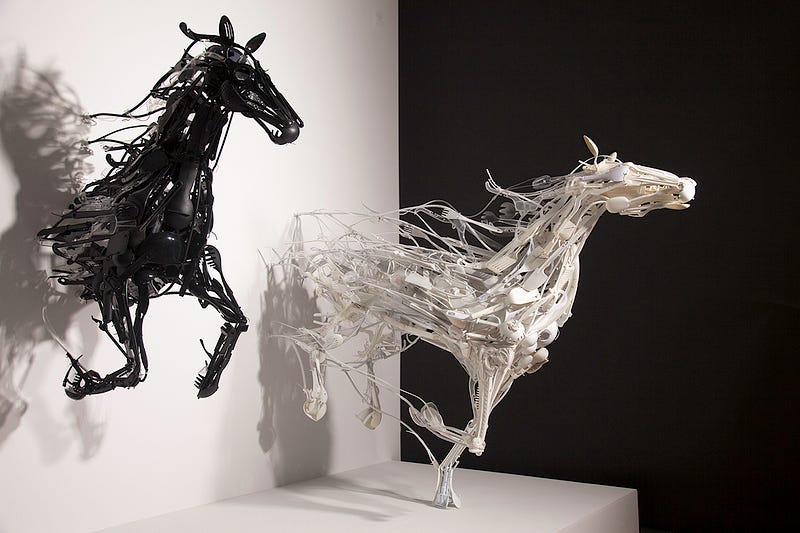
Using reclaimed metal and plastic objects, Sayaka’s recent sculptures depict animals in motion with rich colors and energy.
She describes her style as “3D impressionism”, creating an illusion of solid form using plastic objects as brushstrokes that become visible upon observation from close proximity.
Since 2017, her traveling exhibition “Sayaka Ganz — Reclaimed Creations” has been shown in 8 venues across the United States so far and is booked for five more through 2022. Her recent commissions include a series of marine life sculptures for the Monterey Bay Aquarium in California, USA, and a permanent installation of an underwater scene featuring whales and turtles in the lobby of Cimer Spa at the Paradise Resort in Incheon, South Korea.
The questions I asked Sayaka are in headings, and her answers are within each section.
Can you describe more about your work as an artist?
I’m an artist, and I specialize in using discarded plastic objects as my materials.
I go to the thrift stores, and I collect items that people donated from their homes such as spatulas, or coat hangers, or serving forks. Sometimes I use larger items like plastic sleds for playing in the snow, or parts of a vacuum cleaner, or a fan. I can incorporate any piece of plastic that has a nice curved shape into my work.
Bingz: Your sculptures are so beautiful! I can see the spirit of the animal inside each of them!
Are all of your sculptures modeled after animals?
I’ve done a few abstract sculptures, but over 90 percent of my sculptures I’ve made so far are of animals.
I really enjoy making them. I want my sculptures to look alive and as if they can breathe and move. I try to create a sense of motion and energy.
How did you develop this passion for creating such sculptures?
When I was a child I loved to draw and make stuff. My mother had so many different craft hobbies when I was growing up and I would always get scrap materials from her.
I would start by mimicking what she did, but after a while, I would be doing my own thing with them. I didn’t have any skills and tools, so everything’s kind of not very well-put-together. But that process of fitting together things that I’ve found gave me a lot of joy!
When I was in college, I studied art, and I majored in printmaking. Printmaking is such a vast field. You need to have a lot of drawing skills to make good prints. I think of it as a 2D sculpture because the sculpture is very all-encompassing.
But towards the end of my degree, I took a one-day welding workshop, and I just loved the process so much! At first, I started to make scrap metal animal forms by welding the scrap metal pieces that I found in the little junkyard area, just outside the sculpture building. Eventually, I switched to using plastic.
Bingz: I’m feeling a lot of goosebumps as you describe that! You radiate so much joy!
How much time do you take to do your sculptures in a single work session?
It depends. When I’m in the flow of my process, I can spend three to five hours easily per session, with a break in-between. On some days, I’ll spend all day, eight to nine hours, in my studio. I do short sessions too.
Things that don’t feel like work to me are my best pieces. I find that the more I flow with ease in my work, the more energized and life-like my sculptures become.
I tend to sit still in the studio even if I’m not working on something specific. That gives me inspiration and a sense of peace.
Does it feel like a meditative experience when you’re doing your work?
Yes, especially when I’m attaching the plastics.
My process has different stages. First, I build a metal structure for the plastics to mount them. This stage is very logical and requires some pre-planning.
But once I get past that stage and start attaching the plastic to the framework, that’s a very spontaneous process that I enjoy the most! It just feels really magical. I’m not consciously thinking so much and I feel the magic through my body. It’s a very joyful experience when I’m interacting with my projects.
How do you practice Gentleness on inanimate objects through your work?
In Japan, we practice Shinto philosophy, and that’s an animistic belief.
We teach children that everything in this world has a spirit and I think that’s why Japan has so many mascot characters that are animals. It’s very easy for people to imagine inanimate objects and animals having the same anthropomorphic experiences and expressions.
I think the way we treat things it’s kind of at the bottom of our priorities. How we treat other human beings is at the top of the list, followed by animals. Finally, inanimate objects are usually at the lowest priority.
If we can be kind and gentle to even inanimate objects, then I believe this kindness and Gentleness will easily flow into other areas that you care more about in life.
How do you practice being kind and gentle to inanimate objects? What does that look like daily?
It feels like a softening of my emotions.
When I just stop and think: somebody designed and made this thing so others can use it for a specific purpose. Maybe it doesn’t want to be used in another way.
If I imagine that, then I feel gentler towards everything around me.
In my studio, I would start work by walking around, ring my bell, and talk to the objects. I would say: “This is my plan today. I want to accomplish this, so please help me.”
I also apologize in advance to the things that I might have to throw away. The bells carry the message, “I’m sorry if I have to throw you away. I’m going to try my best not to throw too many things, but it’s not possible. I’m going to try to help us create a future where one day you can go back to earth.”
Bingz: That’s so touching! It makes my heart soften like the way you described just now. It’s so different from what I learned when I was a child. If I bumped into a door, my dad would knock hard on it and blame the door loudly! So it’s the total opposite. It’s the Harshness that you blame things for hurting us, instead of having respect and reverence for them.
Oh yes, in this situation, there’s this need for a scapegoat, like a sacrificial object, because this fury/anger/frustration needs to go somewhere. I’m sure in your father’s perspective, it’s better to vent your anger on the object, rather than on a person. So, I can understand that point of view.
What kind of Harshness do you see in the objects you use for your sculptures?
So much of the problem comes from us producing too much and in a thoughtless manner. I feel these discarded objects are almost like orphans. I feel sad for them.
How do you embody Gentleness in your personal life?
I’m usually a gentle person, but of course, I have moments of frustration and anger that flare-up. What I usually do at those times is to do something else with my body.
For example, if I’m driving on the road and someone just did a dangerous maneuver to cut in front of my car, I’d be so mad, but I still need to keep driving. So I might yell out, “Why did he/she do that?!”
But if I’m in a situation where I can do something else with my body, such as if I’m walking in the middle of a supermarket lane and someone says or does something rude to me, then I would switch and walk in another direction. Or if I am about to pick up a fruit, then I’ll put it back and do something else and return later.
Even just this little bit of motion and switch to another activity can help to reset my mind.
Do you see yourself as an Empath?
I don’t identify as an Empath, but I can feel what the person beside me wants. I’m happy to do what the other person wants to do most of the time, such as with my husband. But if I ignore my wants and needs for a long time, then my resentment builds up.
If I’m with somebody else, I can’t be very sensitive to my own wants and needs, so this is why I need a lot of time to be by myself. If I’m alone, then I can remember what I truly want and need, and make a conscious effort to express them and satisfy those wants and needs myself.
How do you become more confident in the value that you provide as an artist with your sensitivity?
I’m trying to teach myself to trust my clients more.
For the longest time, I used to have this vague assumption that they always want to pay less, while I work longer hours. But recently I came to realize that I seemed to think of them as really abusive people!
Then I told myself that my clients don’t want me to suffer. They like what I can provide for them, such as beautiful sculptures with great energy!
So, I try to imagine my clients wanting me to be happy, wanting me to take some time off when I need to rest, and wanting me to have abundance. That helped me.
Most of the time, people find me on the internet because I have many beautiful images. These people eventually become my clients.
You have such a beautiful and unique personality. Have you ever felt that it’s difficult to blend in with other people?
Yes, in Japan, we are taught to fit in.
The general belief, even though nobody says it out loud, is that fitting in mean safety. If you stick out, you get bashed.
So it’s been a struggle feeling like I don’t belong in a group.
That was exaggerated in my case because I used to live in various countries when I was growing up. When I was nine, my family moved to Brazil, and we were there for four and a half years. Then I went back to Japan, and this time I didn’t fit in at all!
Nobody else had been to Brazil, so I was like this weird girl in Junior High, When I was in High School, my family moved to Hong Kong, and I lived there for about a year and a half, and then I came to the United States to study in college here.
Here in the United States, the pressure to fit in is not as intense, but the instinct is still there. It’s so ingrained in my psyche that I tend to suppress expressing who I am because I’m afraid that it’ll make me stand out.
Bingz: And you do stand out and shine, especially when I see your masterpieces and your kind-heartedness towards other people and inanimate objects.
Was there any specific person or group of people who guide and support you in your unique art?
My husband has always been a great supporter because he always helps me make bigger decisions in my work.
I do freelance work so that I might receive a commission, and then I don’t have any new income for five months. I kept saying to my husband and friends that maybe I should find a part-time job, but they urged me not to do that and to continue focusing on my artwork. I sincerely appreciate this support.
But the core direction of my work and what I do comes through the animal guides and my spirit guide.
If I’m working on the sculpture of an animal, then I would have that particular animal spirit guide during that time and right after as well. I also have another spirit guide who helps me for a more extended period. Right now, I have the spirit guides of a crane and a dolphin.
Bingz: That sounds so magical :)
A mini-excerpt of our interview and a whale song!
In this mini-excerpt, Sayaka describes how practicing the Shinto philosophy led her to consciously be gentler on inanimate objects and how she does this in her daily life.
Sayaka would also like to share with you a new project she’s been working on. These are experimental non-verbal expressions, just as she describes the form, movement, and spirit of the animal using plastic objects in her sculptures, she uses her voice and sounds to describe the feeling and the movement of the animal and the surrounding environment.
Enjoy her mesmerizing whale song embedded in the link below!
Thank you, Sayaka Ganz, for this fascinating conversation that’s filled with childlike joy and wonder!
If you are interested in connecting with Sayaka, do contact her through her website and Facebook page.


