
The Joy (and Price Tags) of Collecting
A tale of napkin rings and surprises
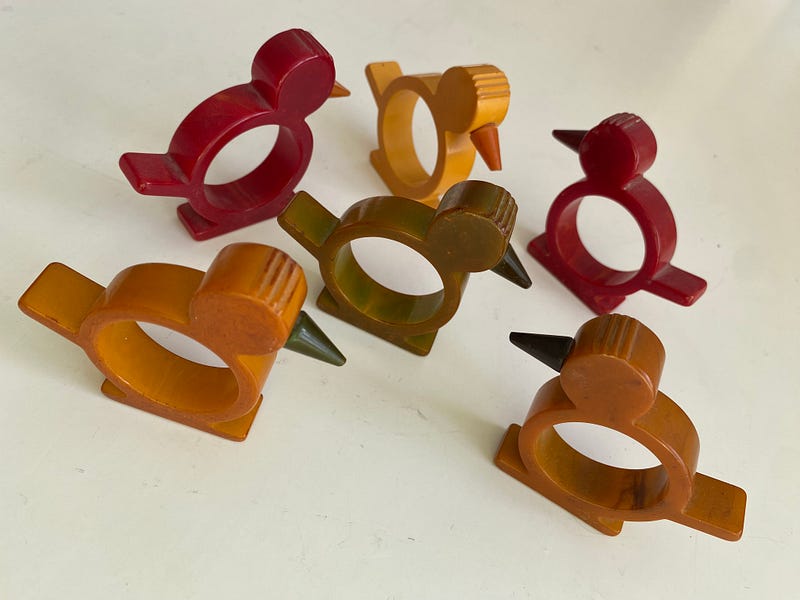
My mother bought them, two for a nickel. Back in the day when a nickel was a nickel, and could get you a loaf of bread or five penny candies.
My mother counted her nickels and her pennies; they were never spent on frivolities. The green chick, a necessity and definitely not a frivolity, became my napkin ring at some age far too early for me to recall. This was in the days when family dinners involved cloth napkins. Since who wants to wash napkins all day, they went back into napkin rings after meals for at least a few days.
Green chick (sturdy, lightweight plastic Bakelite) was mine. Mimi had the red dog; Helen got a yellow duck; Jane was the green elephant. God forbid anyone should grab a napkin, unthinking, out of the wrong ring.
Somehow, over the tumultuous twenty years of my father’s widowhood (age 70 to age 90) the green chick survived, along with Jane’s elephant. The other two luckless napkin creatures disappeared into Bakelite heaven, or wherever else the family stuff disappeared while my father, oblivious to any wordly goods other than books, lived in serene bachelorhood.
But upon his death, here was Green Chick in the buffet drawer. How could I not bring her home to new life in San Francisco? (Where, admittedly, we used paper napkins unless company was coming.) Green Chick was tossed unceremoniously into the silverware drawer where she languished while company napkins found themselves in fancier rings.
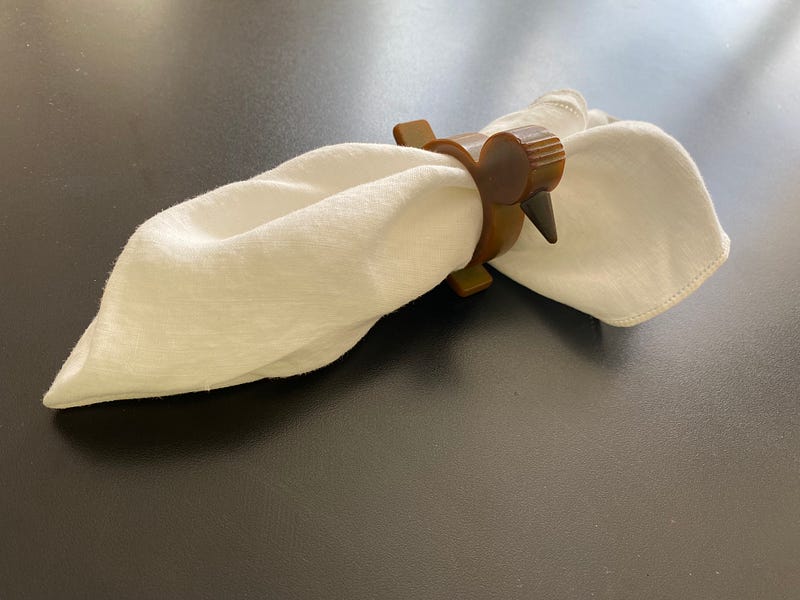
One day in the sunshiny 1990s I happened to stumble into a posh antique store in downtown Healdsburg CA, where my husband and I were wont to go for frequent getaways. He would head straight to the used bookstores; I tended to wander the streets of flea markets and antique shops. For some reason, posh being beyond my interest or budget, I had nevertheless strolled into a boutique that redefined the term.
And lo, there on a medium-high shelf, behind glass, were two identical chick brethren.
“How much for the two-for-a-nickel napkin rings?” I asked with a smile.
The clerk did not smile back. It may have been our attire. He looked like he might have just stepped out of a British fashion magazine. I was dressed in tourist jeans-shorts and sandals, and not very fancy ones at that. I didn’t really say “two-for-a-nickel,” but that was what I was thinking and perhaps implied.
“Ninety-five,” said the clerk, lifting his chin ever so slightly so he could say this while looking down his nose. He did not bother to say “dollars;” presumably he gave me that much credit for economic brain. But then he added, rather quickly —
“Each.”
After backing out of the shop, still smiling politely, I went to find my husband and tell the tale. We made a mutual decision to go home and be nicer to the green chick.
It seems, in the decades since Bakelite was invented in 1907 and became ubiquitous throughout the 1920s and 30s as buttons, bracelets and knick-knacks, it had become a collectors’ Thing. Within a very short time my husband and I learned that a good friend in Amsterdam, Reindert Groot, was a famed Bakelite collector. (Some time in the early 2000s I even visited a show of Reindert’s collection at the Yonkers, NY museum — but that’s another story.)

Now seeing my three-cent chick with new eyes, I began to roam around flea markets looking for its kin. The first time I spotted one, for $25 I think, I snapped it up. My mother is turning over in her grave.
My new chick was dark-ish yellow with a brown beak. And of course, by now I was hooked.
Like collectors everywhere, I slowly came down to earth. Whatever the snooty sales clerk thought, these things are still bascially just three-cent plastic napkin rings that happened to survive their 1930s-40s childhoods, as did some of us unthinking cloth napkin users. I set an absolute $10 limit, and in future roamings around flea markets I picked up a couple of red chicks and another yellowish one. At informal dinner gatherings they were unfailing conversation openers.
One Manhattan evening in the early 2000s my husband and I were strolling the theater district in search of a dinner place open late when I happened to look up at a sign on West 46th and lo, there again was Green Chick!
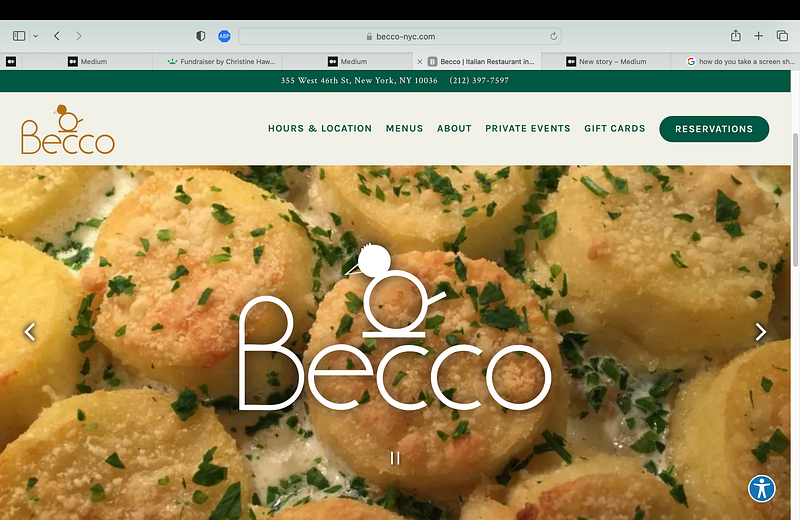
Where else would we want to dine?
It turned out the current management had no idea where that clever logo originated. They were happy to hear of its early days on my dining room table in the 1930s, and additionally the dinner was delicious. We went home loaded down with matchbooks, cocktail napkins and other paraphernalia emblazoned with friends of Green Chick, now renamed Becco. I’ve actually returned to the restaurant enough times to swear off ever re-telling the story because they are bored to tears with it.
But such is the joy of collecting.
Ten years ago I downsized my way into a 1600-sq ft apartment from a beloved old San Francisco Victorian that housed more collections — to my husband’s credit, they were mostly art and books — than any human needs, and am pretty much cured of the acquisition bug.
But if you ever spot a blue Bakelite chick napkin ring — I’m told they were made in that color but I never spotted one — let me know.
I’d probably pay $95. If you promised not to tell the ghost of my mother.