
THE NARRATIVE ARC
The Journey to the Clinic
A love story of another type
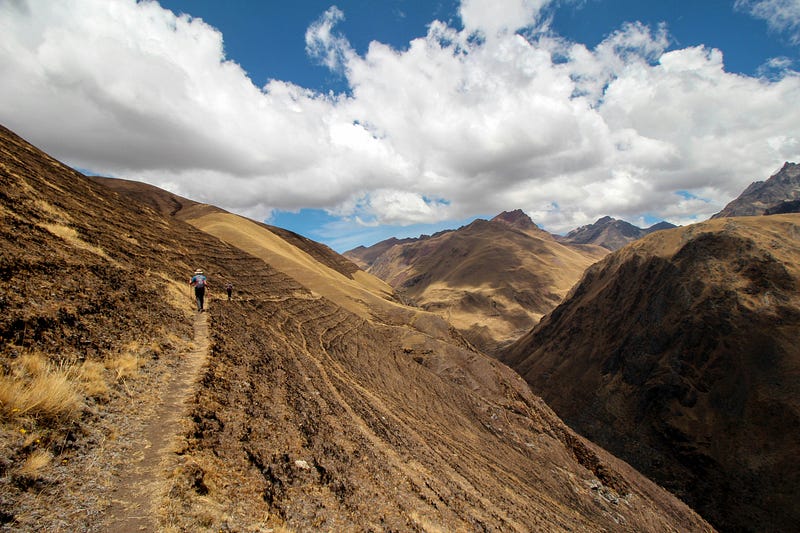
Peru is variations on brown. The dust of the high mountain desert powders the world with ochre; the true shade of an object is found only when you brush against it — trading away some brightness of your own. The eroding mountains seem to smother life; and one escapes only out the top into the crystalline blue of the Andean sky or at the bottom into the heavy violet of the Pacific. The men dress in drab; the women fight back with red, yellow, and blue as they pull the cart of life from one generation to the next.
Many years ago, I spent time doing research and clinical medicine in tropical diseases. The work was done in Colombia, Peru, and Bolivia, but the majority was in Peru. The research was done in Lima, and the clinical work in the smaller towns in the mountains. Against the massive cordillera of the Andes, the tenuousness of human existence in these towns is palpable. There is an immediacy to life there. Poverty pervades, and joy is rare. The unchanging drabness of the unforgiving terrain is reflected in the inhabitants.
The clinic is in a small Andean town whose twisted streets seem to go up as if two-and-a-half miles into the air were not enough. Because this town has a clinic, it is special among the other pueblos where life plays out. People travel here, often walking for days, fueled by hope. It is a focus for those who need it and those who use it simply as a view into a better world and hang about to partake of the mystique. The scene is more akin to religion than to the applied science of medicine.
The street running up the mountainside is brown with cobblestones; it leads to a building white with serious purpose and shared by the clinic and a posada where people who walk these distances can stay for a day or two while waiting for the people to come and open the clinic and for the dispensing of medicines to begin.
Clinic day is important both to those who need it and for the theater it brings to brighten the lives of the spectators. The outside white contrasts with the dark interior, where lights are few and which has seen too often the results of disease in a place where life’s margin between happiness and despair is thin.
A victory here, when medicine helps, is a victory for all and a restoration of faith in life. When this does not happen, and a person is sent back out the door into an uncertain life, the community is the poorer for it.
One day there came a little girl in red and her father in somber brown. Both were looking for something that was not there. She was as light with hope as he was heavy with reality. He would not let her die without one last attempt. His obvious love for her and their strength humbled us all.
They had walked two days over mountains that daunted the conquistadors, sustained only by love and a belief in the power that lay ahead. She was small but toughened by life and would not yet have been in school — had there been one. She walked hand in hand with the man she trusted to make things better. Her love for him flowed from that round, dark face shaded by ebony hair, and lightened by courage and faith. She and her bright red garment transformed a dirty courtyard. Her manifest faith in us transformed the clinic itself.
She was a work of art and a picture of childhood everywhere. She looked at me with some awe because I was about to change her life. But, one look and I was devastated. She had mucocutaneous leishmaniasis, a serious disease endemic to that part of Peru, and for which there was no treatment. It is a chronic infection caused by a parasite transmitted by the bite of a sandfly.
It begins as an ulcer at one corner of the mouth, and slowly burrows into the lip, gum, and hard palate. The process evolves over years, and leaves the person with a retracted lip, with swollen granulomatous tissue around it, an opening to the outside, and speech that is difficult to understand. The cosmetic result can be grotesque.
This girl would have no normal adolescence, or marriage, or family. She probably was condemned to menial jobs; living with her family, then alone; and an empty life.
Nevertheless, they had walked here for two days and I would not turn her away with some brusque remark about no treatment. We owed her more than that, even if it were a charade. We talked; I touched and probed; did a tissue preparation and found the microorganisms with the microscope. She sat quietly awaiting the miracle that would occur here today.
Her father was old from experience and adversity, with a lined and bronzed face under a faded cap that had known colors when it was young. His brown shirt and trousers, from which protruded callused feet, were layered with Andean sand. It was travail and not time that had done this to him.
As I began to explain he looked directly at me, and I understood immediately that he had read the future. He was a man without formal education, yet too wise in life to be fooled by promises and nostrums. He had brought his only link with that future — his precious daughter — to us in the hope that there was something here this time.
I do not recall just how I delivered the prognosis or at what point in the charade he put aside his despair to help explain to his daughter how somehow it would all be better — but not right now. As we spoke, the hollowness of the clinic and the impotence of our medicine grew vast and seemed to fill the room. So, we stopped. There would be no victory here today.
In the cold afternoon he took her hand and they walked out of the dark room and down the brown street, into the fading yellow light of the blue Andean sky, to retrace a two-day journey across the high desert to a place known to none of us. And I stood and watched that bright jewel become smaller in the distance and then disappear into the dusty, brown road.
Thank you for reading! here’s another love story you may enjoy.