The journey is more captivating than the destination
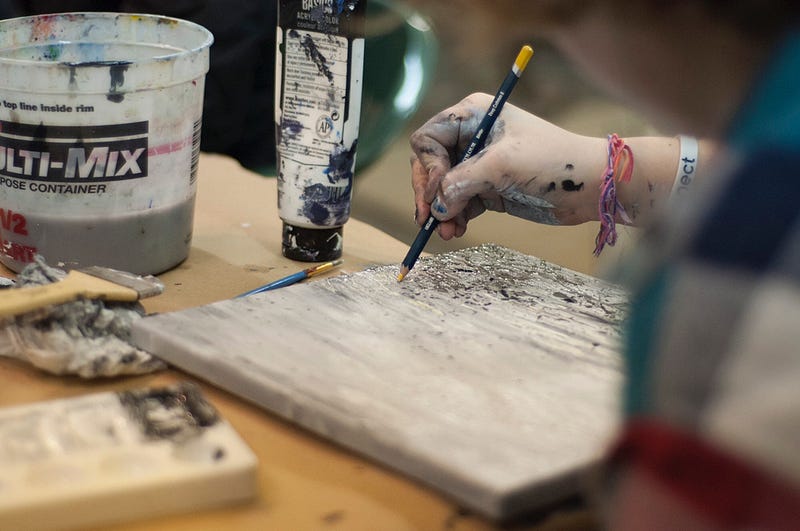
What has always interested me more than art exhibits in clinical, sanitised and mono-colour gallery spaces is the chaotic studio space in which this end goal is realised. More than the buildings constructed by architects are the array of trinkets and collections of knowledge in their practices. More than beautiful leather book covers are the smells, stories and tools found in the book binders workshop.
I think my interest in these creatives spaces probably came from my parents. I remember as a kid being in my Dad’s architectural studio, at the bottom of the garden. The big man’s from the old school so he used to draw his plans by hand; an array of lead, rulers, erasers at his disposal and surrounded by stacks of sketches and proofs. The studio had stained glass windows and low desk lighting, a place where I had to keep the noise down; it always seemed like a mystical place to my younger self.
Similarly, my Mum was (and still is) the Head of Art and Design at a really great school. This school’s in this awesome old country house with nooks and crannies to explore everywhere. I spent days over the summer holidays, when she’d be preparing for the coming year, exploring the art room and sculpture studio. The smell of the clay, the well used tools, the paints and materials, the huge old kiln where I’d have to wait patiently after school during term time as Mum loaded the kid’s clay sculptures. These things have stayed with me.
These spaces ignited in me an interest in space. The space we create will be reflected in the work that is created, and visa versa. These two spaces above made a particular imprint when I was a child: I want to just write today about three spaces that particularly caught my eye over the past few years; about Steelcase, a company that helps create these spaces; and about what we can learn from these spaces.
Henry Moore’s house in Perry Green is an exquisite example of an individual’s workspace. Walking into his workshop lays bare a man made infamous for his ability to sculpt. There’s a nakedness to the space, where he made his tea, washed his tools, listened to Radio 4. You look around the space and see it as a reflection of him; a room used to mirror his thoughts. Inspiration, provocation plastered across the walls. Tools and workbenches hinting at the processes and techniques he used to apply to manifest his visions. These places offer us a window into the creative process, allowing the voyeur to step into the shoes of the creator.
Pixar studios, the revolutionary animation house, bases the design of its offices on their central tenet; that creativity is realised through equality in collaboration. After the release of Toy Story in 1995, founder Alvy Ray Smith had an epiphany. Every day for the previous decade they had sat around the same table during much of the creative process. That table was long and thin, the founders and managers needed to be in the centre, as to hear everything going on, which pushed ‘secondary’ contributors to the ends of the table; there was even a third tier of staff sat in chairs around the edge of the room. This table had inadvertently created a hierarchy in Pixar’s work, despite the table being picked out by Steve Jobs – Alvy elected to put it in the skip. To this day and since that moment, the design of their space has been based on equity, ownership (employees are encouraged to express themselves in their workspace) and creativity.
A fairly new phenomenon is that of co-working. We see in these spaces, freelances, makers and entrepreneurs come together in a curated space. Tribe Porty is one such experiment, positioned in Portabello Edinburgh, a three minute walk from the beach. I visited the space for work a few months back, and was taken aback by the level of ownership the tenants had been given. One of the requirements of being a resident is that you hack your space, reflecting yourself, your business. Another is that you regularly join for Thursday drinks at the local beach-side pub; an opportunity to share problems, visions with the group. You could see the free exchange of ideas; accomplishing the collaborative environment of Pixar in a space for freelancers.
The new CEO of Ford is a man called Jim Hackett, who previously was the head of the driverless car division. He started out building a company called Steelcase, essentially what they do is build office furniture. However, this furniture is designed to enable people’s minds. Human centric design in the workplace to give people the range of environments required to solve problems and create new stuff. Recently Steelcase and Microsoft have come together, embedding office furniture and technology to create an augmented studio experience. The duo realise the future of creativity and productivity lie in the intersection between space and tech. Much like Alvy Ray Smith found his passion in the intersection between animation and technology, Mr Hackett created a whole new industry: from creating office furniture to making spaces that enable and insure us. Quite cool.
What’s the point? For me it’s about the places we spend our time. We’ve seen technology start-ups creating ever more wondrous places to house their staff over the past few years; Facebook hq is basically Disneyland. This demonstrates the value in creating these spaces. We should all have the chance, no matter our industry or job, to hack our own spaces and to reflect our individual and working cultures within them. It’s just much more fun isn’t it when the place you work is somewhere you can contribute to, identify with and create a little corner of you in. My parents studios we’re some of the most honest of these spaces, even if we can take a bit of this into our workspace we’ll be better off.