
The Joke That Led to $1 Billion Cut in Company’s Valuation.
We all can agree; this was “THE” most significant blunder in business history.
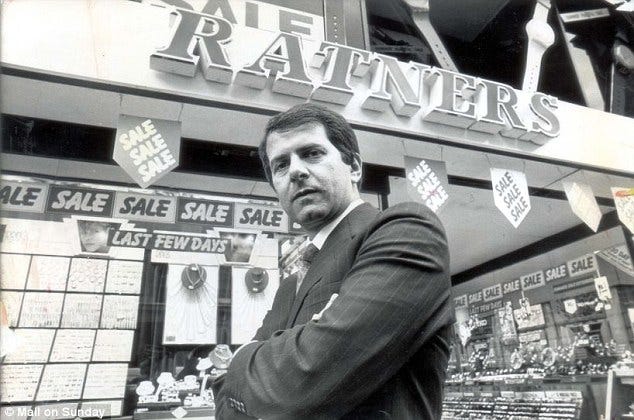
Have you ever heard of the “Ratner effect”?
Wait! Let me start with an incident that happened in my life.
I got admitted to a new college for my 2nd-year degree. I made some new friends. Things were going well. We had a subject called Communication History. The subject was extremely uninteresting as it was stuffed with theory and nothing practical, and the Professor for the subject was SUPA BORING too.
I made a joke about the Professor, how boring he was. And I got punched with immense bad luck. Professor was the Uncle of one of my new friends.
She told him, and Professor hated me after that. Thank God! He was in college for just one semester. Saying that joke was a bit costly. I told the wrong thing at the wrong time in front of the wrong audience.
Maybe you would have also experienced something like this.
Saying Something Wrong, at the wrong place.
Let’s get back to Gerald Ratner- How his one joke created the biggest PR disaster in history.
Gerald joined his father’s budding jewelry shop in 1965 after getting expelled from school for being called stupid.
He used to clean glasses, engage with customers, and was understanding the perplex puzzle of business, and he was getting good at it. He observed the successful street stores in London and noticed how businesses that yelled the loudest and have an eye-catching display attracted the most amount of sales.
When he inherited the company in 1984, Retnar had 120 stores with dull front-ends, and the company was making an annual loss of $460k.
As Ratner took the remote in his hand, he changed the front-end of all his stores. He got all of his stores plastered with vibrant orange and red posters with all-caps pitches like “LAST CHANCE — MEGA RED STAR SALE!” and “SALE SALE SALE: HALF PRICE!”
No Doubt Gerald was a hell of a marketer and understood business.
Everything that you can get your eyes at Retnars had a price tag. Other jewelry stores didn’t operate in this way. They were boring, dull, and darn hot costly.

Ratner marketed his chains towards the working class. It was said if an average working-class man wants to buy a ring for his average working-class girlfriend, he will walk in Ratner. Within the next six years, Ratner went from 120 dull stores, which were making losses to 2000 shops covering 50% of the jewelry market in the UK.
“I put the earrings and chains in the front of the window and diamond rings at the back, and played pop music,” He told in an Interview.
Ratner had shops in every corner of London and became a household name. Life was good, Expensive Cars, Boats, Houses, everything that you can dream of.
Things were going pretty great until April 23, 1991, for Gerald Ratner.
Gerald was invited for a speech at the prestigious Institute of Directors’ annual convention. Ratner ran his speech draft through a speaking consultant. The consultant told him to add some jokes, but Gerald took it to the extreme.
Over 6000 business people and journalists attended the event.
Ratner started his speech innocently by talking about himself and his companies product line. In for 3 mins, he tried to be a little funny and said this joke (He was talking about one of his product)-
They ask me “How can you sell this for such a low price?”, I say, “because it’s total crap.”
These were the exact lines that came out of his mouth like arrows and stuck in his back. This wasn’t enough for Gerald, so he also said this-
We sell a pair of earrings for under a pound, which is cheaper than a shrimp sandwich from Marks and Spencer, but probably sandwich would last longer.

Gerald thought that it was a private event, and nothing will leak-out, but to his surprise, the next day, media slammed headlines with his name. He knew he messed up. The company shares started to plunge drastically. The video started getting viral.
With the next six months, The company shares dropped from 10$ to 2$. In November, Gerald was pushed from his chair, and a new CEO was appointed. The day he left, he sold his shares for “pittance” to pay off the £1B (US$1.3B) he owed the bank and walked away with nothing.
In today’s world CEO is the PR spokesperson of the company. Every action he takes and the word he speaks is reflected in the voice and image of the company.
The so-called ‘Ratner effect’ and ‘doing a Ratner’ came into popular parlance and was used when someone messes something badly.
Three crucial rules for Public Relations that the CEO should not dare to break-
- Don’t talk about unreasonable — or inappropriate features, series, events.
- Understand the consequence your words are going to create. Speak after calculation.
- Don’t add more work to a journalist’s plate.
Today CEOs are exposed to a broad audience base due to social media. Whatever they say creates a massive impact on the company’s stock price and image. People start to connect the image of the company with the vision of the CEO as they assume them as the same entities.
Let’s talk about a recent event. Remember when Elon Musk made a joke about going bankrupt, resulted in a 5% fall in share prices, and the other time when he tweeted that Tesla shares are overpriced. The tweet resulted in a whopping 12% fall in the share price.
Upper-level management influences the future of the company and should have control of their voice that they send out in the world, or things can get pretty ugly for them as well as the whole company.
What we can learn from this incident:
- Dont try too hard to stand-out among the audience; It might go a little too extreme.
- Do not take steps whose results can’t be calculated.
- Everything upper-level management says reflects the voice of the company.


