
The Jizo Guarding the Caves
The Family Business, Chapter 10
The bus slowly steadily climbed the hill to the school.
As the grade became steeper, the bus slowed.
There was a grinding noise as the driver shifted, the bus hesitating for a split second, then jerking forward unsteadily for a few feet before regaining its confidence and resuming its steady climb.
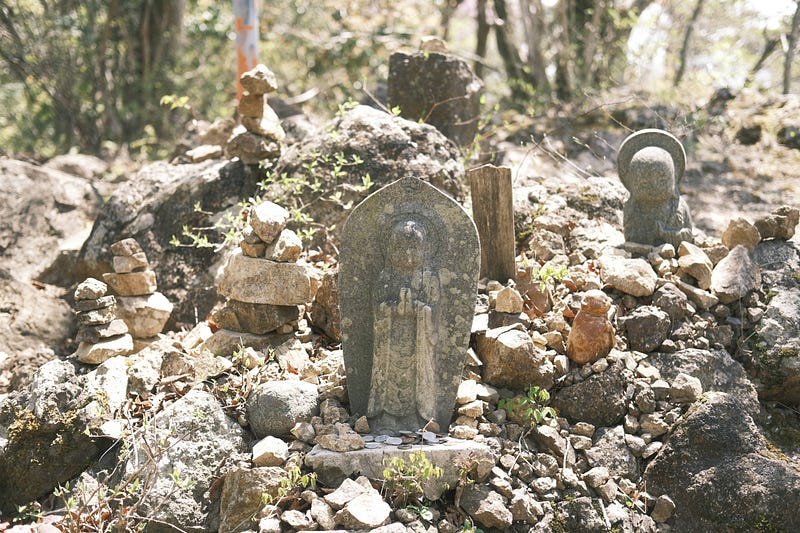
I looked out the window to my left, through the droplets of rain sticking to the glass, to the caves guarded by haphazard rows of Jizo statues. I wondered why so many Jizo were gathered along this road.
Upon arrival, I found the halls filled with a flurry of activity.
I could almost taste the electricity of excitement in the air as the entire school prepared for our participation at the Opening Ceremony for the 1970 Japan World Exposition (Expo-70) in Osaka. I was amused at its effect on normally quiet and reasonable people.
“We might be on TV,” I overheard one classmate say.
“I heard that the Emperor and his family might be there,” said another. Her comrade breathed in quickly as her eyes widened.
Our class was assigned to be part of a great chorus of schoolchildren from across Japan joining voices to sing some yet-to-be-announced song. In addition, the class behind ours would participate in the parade and help carry some festival float through the ceremony hall.
After lunch, I sought out one of the cooks in the cafeteria to see if he could shed any light on the mystery of the Jizo.
I could see him smile as he noticed my approach. He was always cheerful and happy to speak to me because I spoke with him in Japanese, and he had trouble with English.
I knew he was busy, and I always asked difficult questions, but he always did his best, patiently, to answer them.
“Why are there so many Jizo statues by the road on the other side of the river,” I asked.
He frowned and thought for a minute, then turned his head to look at the sky as if he were searching for something.
After a brief pause, he looked back at me.
“There were some terrible things that happened during the war. There was bombing of the city from the air. Kuushuu,” he said. “Do you know that term?”
I shook my head, then said, “but I do now.”
He nodded and continued lowering his voice as if not wanting to be overheard.
“During the air raids, people from the city came up the mountain and hid in those caves to escape the bombs and the fires. I don’t know why the Jizo-sama are there,” he said, using the honorific term for the figures, “but it must certainly have to do with people losing their children to the bombs.”
It was my turn to nod.
“By the way,” he said, “do you know why there are rocks stacked up near the Jizo-sama?”
Again, I shook my head.
“No,” I said.
“We believe,” he continued, “that the oJizo-sama protect children who die before they are born or before their parents die. When children die before their parents, their souls cannot get to heaven, so they work tirelessly for their parents to help improve their chances in the afterlife by building little stacks of stones. But each night, evil spirits called youkai come out and knock over the stones. So travelers and kind passers-by help reduce the work they have to do by helping to make the stacks of stones and rocks.”
He smiled. “It is one of the strange Buddhist customs we Japanese believe.”
The bell rang, signaling the end of lunch and calling us back to our classrooms. A rush of voices and feet began streaming from the playground below, up the hill, and into the school building.
I smiled, thanked him, and quickly climbed the stone staircase to join my classmates.
The day had turned unseasonably warm after the rain stopped. It felt like spring was definitely on the way, but there was still a biting chill in the air as the sun became low in the sky while I walked home from the train station. I pulled my jacket tighter and snapped it up to my neck.
I stepped up into the house, kicking off my shoes, ignored the slippers, smelled the wonderful aroma of something cooking, and went straight into the kitchen. There I found Tanaka-san, our housekeeper, busy preparing the evening meal.
“Is it ok if I help you?” I asked.
Sometimes she didn’t want my help, but on this occasion, she was happy for me to lend a hand.
She handed me a cucumber.
“Wash the salt off in the sink,” she said, “and cut it using that….”
She pointed to a plastic box with a cutting blade built into the lid.
“We’re going to make some quick pickles to go with the subuta..”
Subuta, Japanese-Chinese sweet and sour pork, was one of the dishes our family loved. Tanaka-san had her own recipe and used canned pineapple to add texture and sweetness to the dish. I saw the pan on the stove simmering and reluctantly resisted the temptation to steal a little taste.
I rinsed the long, dark green, bumpy vegetable under the faucet, then dried it with a dish towel. Next, I began passing one end back and forth along the lid. With each pass, a perfectly sliced piece of cucumber fell into the box below.
“Tanaka-san,” I began. “Is it ok if I ask you a question? It’s about the war.”
She frowned and stirred the pan, remaining silent.
I knew she didn’t want to talk about the war. My heart started beating faster as I chose my words, hoping she would respond to me.
“Along the road going up the hill to my school in Kobe, as you approach the top of the hill where it crosses the river, there are some caves going into the hillside. Outside of the caves, there are many Jizo-san. People bring them decorations and keep the area tidied up. I heard that people hid in the caves during the war. I was just wondering if you knew anything about it.”
I waited.
She turned down the cooking flames, untied her apron, and sat by the kitchen table at one of the chairs. She motioned for me to take the seat next to her.
The house became very quiet. From outdoors, I could hear a motorcycle passing in the distance.
“War is a terrible thing,” she began. “I pray to God every day that you children and your children will never have to experience anything like the horrors we lived through.”
She turned and looked through me, her eyes dark as charcoal, her lined face stern and serious.
She continued with a very soft voice, looking up at the ceiling, then back at me.
“The city of Kobe was destroyed by fire from air attacks, and people fled the city and went into the mountains to try to get away. But the fire was everywhere, and in the end, nothing was left but ashes.”
“Those statues were placed there by people who lost their children in those terrible fires. People, human beings, just disappeared and were never seen or heard from again.”
“You know I lived in Fukui, on the Japan Sea. Like Kobe, our city was spared the bombings that other cities experienced regularly. Then one night, in July, almost at the war’s end, the air-raid sirens started sounding. We didn’t know what to do, but we had heard and read of the fire bombings in the other cities. “
“’ To the river! Everyone get into the river,’ I heard someone yelling.”
“I grabbed my children, and we ran. We could hear the engines from the airplanes. There were hundreds of planes filling the sky.”
“Then the bombs started falling. They weren’t regular bombs with great explosions, but the houses became consumed with flame wherever they fell. In those days, almost all of the houses were made of wood, and they caught fire quickly, and the fires spread from house to house until it seemed the entire city was one big flame.”
“It was already a hot and humid summer night, but then we could feel the heat from the fires on our faces and skin.”
“Shoji was little, so I tied him to my back, and Yutaka stood beside me. There were so many people in the river, it was overflowing with people, and many could not get in.”
“Then the winds came, and we had to cover our mouths with our hands to breathe. It was like a great typhoon, but instead of rain, it was a firestorm. The winds were so hot that they burned our skin, and steam rose from the river.”
She stopped for a moment, looked down at her hands, and tears started streaming from her eyes. I felt her overwhelming sadness and felt hot tears on my face. I took my hands and started wiping them away.
“We could hear people screaming and yelling for help, but there was nothing anyone could do. It was everyone for himself, just trying to hang on to life. We were in the river for hours, and when it was over, there was only silence. Then the sound of voices, people yelling for their families, children, and loved ones. Those who didn’t make it into the river perished. Many of them were burned up.”
She looked up and said, “I was lucky. Both of my children were with me, and we were able to get into the river and stay there with the water up to our necks. The river saved us and let us breathe. Many people lost their children, some drowned, and some were carried away by the river. But we were there, and we knew that we would never be the same after that.”
She took her apron and dried her face. I heard a creak on the floor and looked toward the entrance.
Mom was there, standing in the doorway, big tears falling from her face and onto the floor. She walked to where Tanaka-san was sitting and put her arm around her, giving her a tight hug. I stood and hugged them both, not wanting to disturb the solemnity of the moment.
I turned and walked quietly back to my room, reflecting on the story I had heard. It made me wonder how people could put aside things like that and how people who had once been on opposing sides, who had each experienced horrors and atrocities, who had engaged each other in the act of war, which provided excuses for the many things they did to each other, could now even look at each other, much less work together in seeming peace. This became a question that lodged deep in my heart and about which I thought whenever I saw conflict.
(The next chapter will be linked here when published)