
The Jail from Hell in Caracas
An undercover visit finds an abundance of human rights violations.
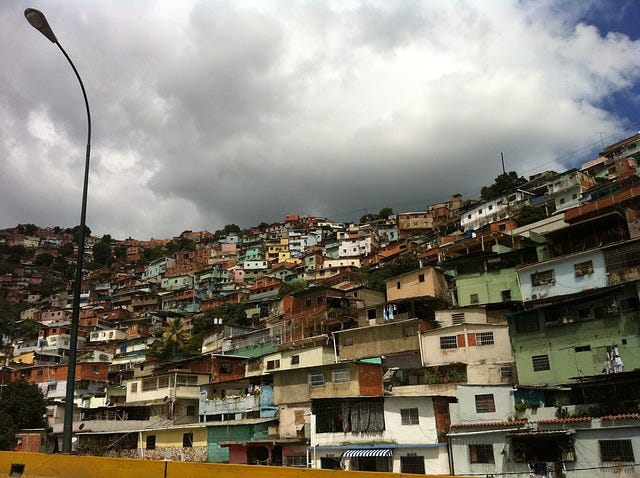
Raw sewage. The stench hits me like a belt across the face. It grows stronger as we walk the two blocks from the Metro station to the four-story concrete jail pockmarked with peeling paint and crumbling corners. I switch to breathing through my mouth.
The pounding sun of early morning in the tropics bounces off the razor wire coils on the flat roof, making me squint. A drab collection of grey rags — I make out trouser legs, shirt sleeves, the odd sheet or towel — hangs from a narrow strip of wire-meshed windows along the top of each floor in a shroud of squalor.
Jesus, I think. Jesus.
I trail my escort, Sister Concepción, onto the end of the Saturday visitors’ queue for El Retén de Catia, located in a sprawling slum on the west side of Caracas, Venezuela. The visitors’ line is mostly women, as at any men’s prison, but many of them teeter on high-heeled sandals, wear shorts and skirts revealing melon slices of buttocks and rib-tight T-shirts that put swells of dusky skin on mercantile display. Prostitutes.
I catch one of them staring at me. Having lived five years in Latin America, I’m used to being stared at since I look different than most people here. I’m tall, fair-skinned, with long russet hair and green eyes. I know staring is not considered rude. It’s more a sign of curiosity, in this case perhaps of competitive interest. But since I’m dressed in a loose T-shirt, denims and sneakers, I’m clearly not there to take business from this woman.
She purses her glossy, scarlet lips and flicks a waterfall of bottle-blonded hair over her shoulder as she turns back to huddle under a friend’s umbrella that serves as a parasol.
I’m no longer smelling shit as I’ve already got used to it. I suppose that’s how local residents manage to live in this neighborhood. The line inches forward. Ahead men are separated out. The women file one by one into a guard hut. I’m guessing that’s where the vaginal search that Concepción, a doll-like young Filipina nun, warned me about is going to take place.
I glance at Concepción. She appears unfazed. She comes to the jail every few weeks as part of her ministry to the poor. I’m here as a reporter doing a story on Venezuela’s notorious prison system for a human rights magazine in London.
El Retén de Catia is the worst of the system. In fact, it’s been called the worst penitentiary in Latin America. I’d applied for official permission to visit the jail through the national Ministry of Prisons, but I was turned down on the grounds that my safety could not be guaranteed.
Just a month or so earlier, inmates had stolen the camera from a photographer for El Nacional, one of Venezuela’s two national newspapers, during a reporting visit. I wasn’t daunted. My friend Bart, a reporter in The Associated Press’s Caracas bureau, suggested I call Concepción. She readily agreed to take me in, but I’d have to pose as a nun.
“The prisoners don’t like journalists,” she said.
My experience with prison inmates was they generally liked media exposure of subpar conditions as a way of pressuring officials to improve them. But this wasn’t the United States.
“Do I have to wear a habit?” I asked.
“I just wear jeans and a T-shirt,” she said.
That was a relief.
“There’s one more thing.” She paused. I gripped the phone a little harder. What was coming? “They do a vaginal search of women visitors, checking for contraband, drugs and stuff.”
“Oh.” My stomach plummeted. Was I really going to do this? But I’d got this far. I couldn’t back down now. You do what you have to do to get the story. I swallowed. “Okay.”
We come to the entrance of the guard hut. Concepción is waved in. I can’t believe a nun would go through this, but the fact that she does makes me feel better. If she can do it, I can.
Then it’s my turn. I enter, pinched with dread. A middle-aged female guard, wearing a skirted uniform and hair in a tidy bun, is waiting, holding a rubber-gloved hand in the air as if ready to unscrew a lightbulb.
“Lie down on the table and unzip,” she directs.
I do as I’m told. She pats my abdomen under the flaps of my dungarees. “Zip up,” she says.
I’m taken aback. “That’s it?”
“That’s it. El Ministerio changed the policy this week due to all the complaints.”
I slide off the table and rejoin Concepción on the other side of the hut.
“No search!” I rejoice.
“Yeah,” says Concepción. “I was told women were complaining that they weren’t changing gloves between searches.”
I can’t let my mind go there. I just can’t.
It soon becomes apparent why prison officials said they couldn’t guarantee my safety. The guards stay in an office on the perimeter. That’s as far as they go. Past that is under complete control of the inmates.
We walk alongside a sunken concrete courtyard where men mill about. They are so scrawny and tough they look like pieces of human leather, their faces so gaunt, it’s hard to see they are young men. Their heads are all shaved to a bristle, I assume to prevent lice infection. Several spot Concepción and rush to the side.
“Hermana! Hermana!” A thicket of hands stretches up, clamoring for her blessing. “Bendiciones, Hermana. Bendiciones.”
She crouches and clasps fingers, hand over hand, like a rock star on the edge of a stage. “Dios te bendiga. Dios te bendiga.” God bless you. More pleading hands appear. Desperation sweats the air. “Dios te bendiga. Dios te bendiga.” This scrap of solace is all she can give but eventually, she has to pull away or we’ll never get anywhere else.
We move into the building and meet some other inmates that Concepción knows. I’m introduced as “Hermana Christina, visiting from the United States.” She explains that I want to see prison conditions. They seem pleased with the attention and take us into the cafeteria.
It’s a dim hall striped by shafts of light spearing through louvred windows. Everything is concrete, the floor, walls, long tables, benches. A layer of black grease, a good half-inch thick, covers the surfaces. It is revolting.
“What do they give you to eat?” I ask.
“Rice and beans with sides of maggots and mold,” says a guy, taller and with broader shoulders than most. His name is Juan Pablo.
I peer through the food serving window into the kitchen. It’s also blanketed with grease.
“There’s a broken pipe they never fix downstairs. Aguas negras are just pouring out,” Juan Pablo says. “Do you want to see it?”
Of course, I want to see it. He and a shorter fellow lead me down to the basement, where sure enough, the jagged end of a pipe sticks out of a torn wall, pissing a torrent of black wastewater. It cannons onto the floor where it finds a groove and flows into the basement shadows.
Again, I stare at this scene in disbelief. “Why don’t they fix this?”
The tall guy shrugs. We chitchat for a minute about the horror of it all then he says, “Mira.” From the back waistband of his jeans, he draws out a metal rod, maybe two feet long. It’s been filed so one end forms a point as sharp as an arrowhead. “Mi chuzo. I made it out of a bed leg.” He brandishes it with pride.
“It’s quite a weapon. What do you need that for?” I say.
“Protección.”
Alarm sizzles through me as I realize, for not the first time in my life, that I’ve put myself in a highly vulnerable situation. I’m alone with two hardened convicts in a basement. If I screamed, no one would hear me. And even if they did, it’s doubtful anyone would come to my rescue. I feel a sudden dampness in my armpits but I remain calm.
“Let’s go back upstairs and find la hermana,” I suggest.
Thankfully, they agree.
Concepción wants to visit the infirmary. I’m stunned when we enter a blindingly sunny courtyard surrounded by towering walls. Maybe twenty men loll on the ground in the triangles of shade afforded by lee of the walls. No beds, chairs, nothing. Absolutely nothing.
“This is the infirmary?”
Concepción squats by a skinful of bones, a man who is dying of AIDS, takes his hand and asks how he is. He’s evidently feeble, but he nods and says okay.
“What do you get in the way of treatment?” I say.
“A glass of milk every day.”
We head into the cellblocks where the visiting takes place. Mothers and wives, girlfriends and sisters, brothers and fathers, perch on the twin beds, two to a cell. Babies’ wails pierce the chatter drone. Some of the cell doors are closed with a sentry standing outside. I assume that’s where the women who came to work are working, as well as wives and girlfriends.
The beds sit on overturned hard plastic buckets. Juan Pablo already showed me the reason for that, but other buckets crowd the cells. When we go into one cell, I ask its occupant, what all the buckets are for.
“Water. There’s one tap per floor,” the guy says.
I press him for more details about how they carry out the minutiae of daily living, bathing, toilets, laundry, all the time observing everything intensely. I couldn’t bring a notebook in so I’ve had to mentally record everything.
A scowl crosses his rugged face. His eyes narrow and he leans forward on his knees. “You’re asking a lot of questions. You wouldn’t be a journalist, would you?”
My heart crashes into my rib cage. “No, no. I just want to learn about prison conditions so I can tell people in the United States.” My voice is as steady as I can make it. I have no idea what he’ll do if he doesn’t believe me.
Concepción sees the confrontation. “She’s una religiosa like me,” she says in a rush of words.
He eyes me for a second then sits back, relaxing. He bought it.
We stay a little while longer then Concepción and I exchange a glance. It’s been an emotionally taxing and draining day, and I’m on sensory overload. Time to get out of there.
***
My article was published a few months later. A few months after that, the Venezuelan government transferred the inmates to other prisons and demolished El Retén de Catia in a spectacular implosion. Even for a country, and a region, that does not do a good job in protecting prisoner rights, it was a huge embarrassment. It’s now history.