
The iPhone 12 Pro is the Attention-Seeker’s Smartphone
You can have the most clout in the room for just $999
Crack! There goes your phone. You waited in line for two hours, and you already dropped it. Too bad you didn’t put a case on it. You already spent all your money, so you couldn’t afford Apple’s $50 silicone one.
It’s unfortunate. You’re old phone was just fine. You work on your computer all day anyway. You’d hardly have time to use that triple-lensed camera. And 5G isn’t that big of a deal after-all. Also, you wanted it in black, but the iPhone 12 Pro only doesn’t come in that color.
Oh well, at least you have clout.
The new iPhones are upon us, friends. Apple announced a quartet of phones Tuesday, both big and small. It seems there’s an iPhone 12 for everyone.
The pro versions, however, are hardly different than their less expensive companions. One may want the “best of the best,” but simply looking at Apple’s website reveals the obvious.
If Apple wanted you to know how great their phone was, they’d tell you. That’s why it’s beyond why Apple made the iPhone 12 and iPhone 12 Pro so similar.
Anyway, I’m not diving into the metrics. I’m relaying exactly what Apple promotes on their website. I think the new iPhone 12 is a great looking phone, but the Pro version is a waste of your hard-earned cash. Let me explain.
(Disclaimer: I’m simply comparing the iPhone 12 to the iPhone 12 Pro. I am not speaking for their counterparts: the 12 Mini and 12 Pro Max. This article is not a review, nor is it intended to be a review. Unless stated otherwise, all relevant data and information was found on Apple’s website.)
The similarities
The standard iPhone 12 and the Pro version share numerous features. From a marketing standpoint, they share too many. It makes the consumer’s decision too easy.
Both phones feature the exact same 6.1 inch super retina XDR display, utilize 5G connectivity, and run on the same A14 Bionic chip. I’m incredibly surprised Apple took these three key aspects of their smartphones and put them in each.
Other meaningful similarities:
- Battery (both up to 17 hours of video playback)
- Ceramic Shield front
- Four-times better drop performance (to be determined)
- Crafted from the same “aerospace-grade” aluminum
- Display: 2532-by-1170-pixel resolution at 460 ppi with the same contrast display and true tone colors
- 12 megapixel cameras
Alone, these specs are a significant upgrade from my current iPhone 8. I’m more than happy to pay for the iPhone 12, but not $200 more for essentially the same device in the Pro.
The differences
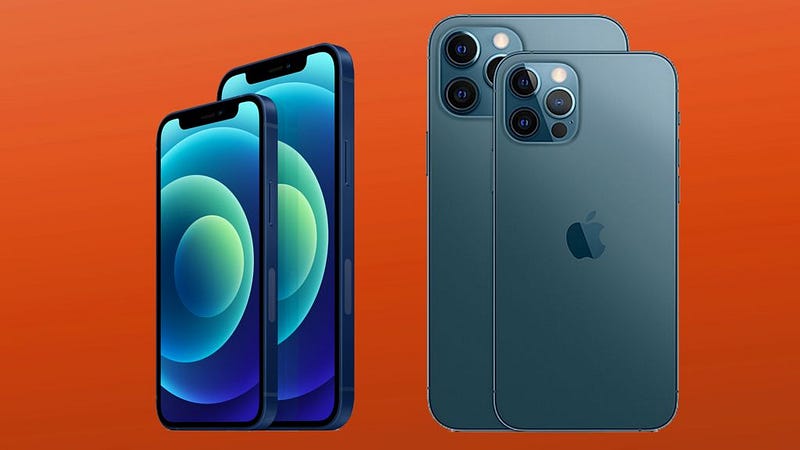
The only significant differences between the iPhone 12 and the iPhone 12 Pro are the cameras, storage capacities, finishes, weights, and prices. The camera is easily the biggest difference.
Storage space
The iPhone 12’s base storage capacity is 64 gigs, while the Pro’s is 128. However, buying the Pro for more space is pointless. If you want to practically double your phone’s space, you can pay $0.99 cents a month for 50 gigs of storage via iCloud.
I currently sport a 64 gig iPhone 8, and iCloud completely alleviates any storage issues. I’d rather pay $36 for the three-year lifespan of my phone than an extra $200 for the same amount of memory.
Finishes
The Pro sports a ceramic shield front panel, a stainless steel frame, and a textured matte glass back. In comparison, the iPhone 12 features a regular glass back and an aluminum frame. They also come in phone specific colors.
Weight
Additionally, the regular 12 is almost an ounce lighter than the Pro version even though they share the same form factor.
Price
The regular 12 starts at $799 (at Verizon and AT&T), while the Pro model starts at $999.
The Pro’s camera is better, but not enough
Does anyone get an iPhone for serious photography though? I have to ask.
I know of photographers who use their phones as a third camera option. But no self respecting photographer is using an iPhone as their main shooter.
Most obviously, the Pro features an extra telephoto lens. It also supports the new ProRAW shooting mode. I’m unsure what the difference between regular RAW and ProRAW is though. My only guess is more machine learning that makes the photos look faker.
The Pro does have a liDAR scanner that assists in photo taking and augmented reality. If you’re into that, get the phone. I don’t care for such technology. iPhones have used AR for years with their regular cameras. Unless you’re 3-D mapping real estate, you probably don’t need this thing.
For night shooting, the Apple website says this about the Pro’s LiDAR.
“LiDAR makes Night mode portraits possible. And the Wide camera lets in 27 percent more light, for greater detail and sharper focus day or night.”
27% more light than what, exactly? Another lens? Wide aperture lenses naturally allow more light to pass through them than narrow aperture ones.
Now, LiDAR does have an advantage in autofocus. The Pro will autofocus on subjects faster than the regular 12, especially in low light situations.
For video, the Pro shoots in Dolby Vision. It’s nice, but it’s still not cinema quality. The phone’s camera sensor is just too small to capture 4K footage that looks good on any screen other than the iPhone’s.
Yes, size matters. I shoot with a full frame, mirrorless camera. It may only have 24 megapixels, but the size of these pixels are immense compared to the iPhone’s. This means my camera has far superior low light abilities, and higher dynamic range.
The each pixel on the iPhone 12 Pro camera is 1.4 um. The Sony A7iii’s pixel size is 35.5 um. And it has twice the amount of megapixels as the iPhone.
Photographer Reed Hoffman says this about pixel size:
“All pixels collect the same amount of noise, but larger pixels collect more of the “good” data than smaller pixels. With all else equal, a larger pixel will result in a higher quality image (less noise) than a smaller one.”
Obviously a designated camera will be better than a phone’s, but I’m making the comparison to show you how overhyped Apple’s phone cameras are. They take nice pictures, but no amount of machine learning can compete with a true DSLR or mirrorless.
The bottom line
The two groups have the same chip, the same resolution, and are both 5G ready. The Pro version is simply more expensive than the other. If you’re the type of person who needs the “best” equipment, then this is the phone for you. It’s hardly better than the regular 12. You’ll just look cooler than everyone else for having it.
If you really want the highest quality photos, go buy yourself a real camera. There’s such a marginal difference in quality between the cameras that the price jump isn’t worth it. The LiDAR scanner is a nice touch for autofocus and night portraits though.
I probably forgot to mention a few minor details, but that’s not the point. Apple missed an opportunity to sell more Pro models. The two phones are practically the same. It’s like they want to market the Pro to the person who needs to be the center of attention.
It’s a strange tactic, but we all know they’ll sell like hotcakes. It’s Apple afterall.
The Pro has one clear advantage: its camera. Other than that, it’s a more expensive piece of metal that performs the same function as its more humble counterpart.
Don’t miss another story — Vibe Check is my exclusive newsletter for those who want to take their content to the next level.